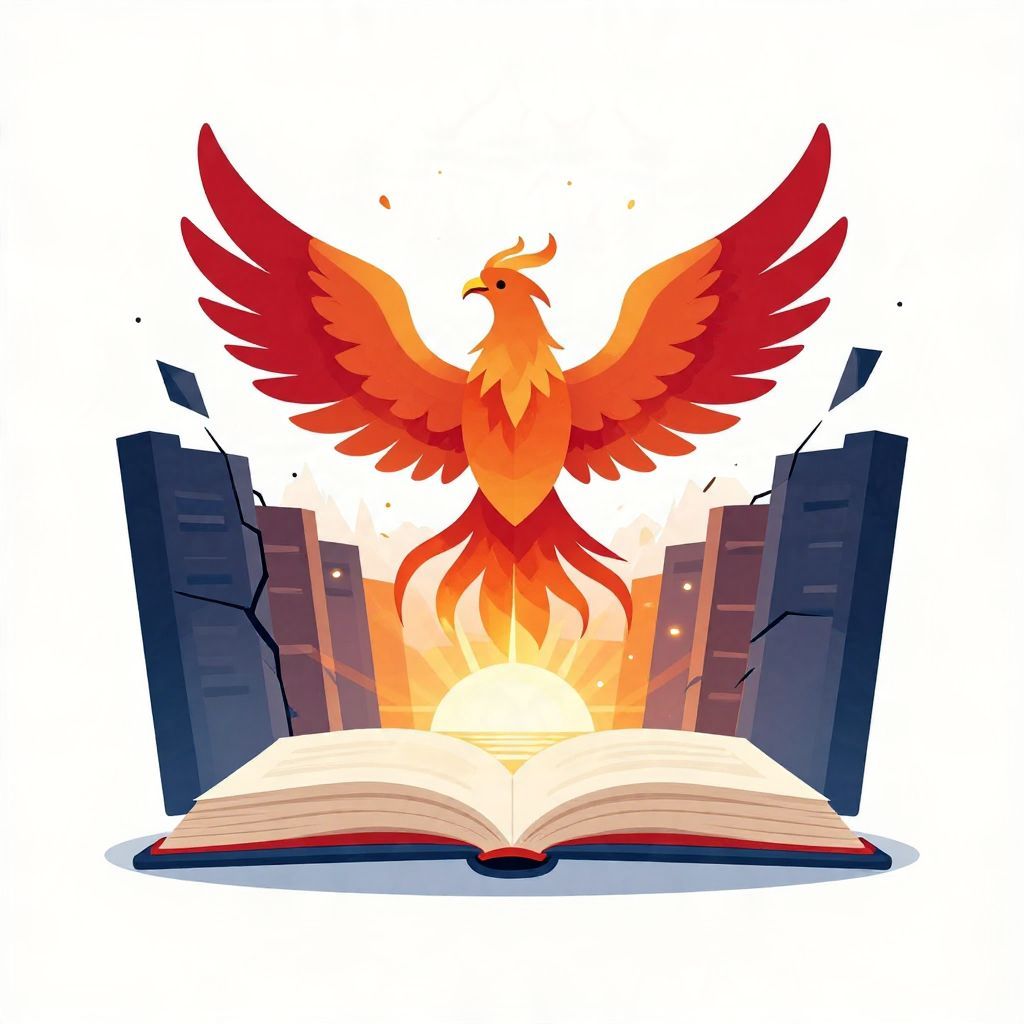
If you’re wondering what happens at the end of Fahrenheit 451, the short answer is that Montag escapes the city, joins a group of book-preserving exiles, and witnesses the destruction of the place he once served. The ending is both bleak and strangely hopeful: civilization is collapsing, but memory and renewal are still possible.
Ray Bradbury closes the novel with a vision of loss, survival, and the uneasy possibility of rebuilding after catastrophe.
What happens at the end of Fahrenheit 451?
Spoiler answer: Montag flees after killing Captain Beatty, is hunted by the Mechanical Hound, and eventually reaches a group of wandering intellectuals who memorize books. As war destroys the city, Montag and the others survive outside it, then begin moving back toward the ruins with a plan to help preserve knowledge and rebuild society.
How the final section unfolds
Montag’s break with the firemen
By the final part of the novel, Montag has fully turned against the fireman system he once served. After his secret reading, his growing disgust with censorship, and his conversations with Faber, he can no longer pretend that obedience is enough.
The turning point comes when Beatty forces Montag into a trap. Montag responds by killing him, an act that marks the collapse of his old identity and the beginning of his flight.
The chase and Montag’s escape
After Beatty’s death, Montag becomes the target of a citywide manhunt. The Mechanical Hound is unleashed, and the state uses the pursuit as a spectacle, broadcasting the chase to the public.
Montag manages to evade capture by crossing into the river and leaving the city behind. The river matters symbolically: it breaks the mechanical logic of the city and gives him a kind of cleansing passage into another life.
The book people
Outside the city, Montag encounters a small community of exiles led by Granger. These people do not simply collect books; they memorize them, preserving literature in human memory because physical books are too dangerous in their world.
This is one of the novel’s most important reversals. The people who have been forced out of society become its cultural memory, while the official culture inside the city has become shallow, distracted, and self-destructive.
The bombing of the city
As Montag joins the group, war finally reaches the city. The bombing destroys the urban world that had seemed permanent and technologically advanced.
The destruction is not presented as triumph. It is a grim consequence of the society’s moral emptiness, political violence, and refusal to think deeply. Yet the group’s survival suggests that something human can still endure after collapse.
What the ending means
Destruction is not the final word
Bradbury does not end the novel with a neat victory. The city is gone, and many lives are lost. But the ending insists that culture can survive if people are willing to carry it, remember it, and rebuild from it.
That is why the book people matter so much. They represent continuity without complacency: knowledge preserved not as decoration, but as responsibility.
Montag’s rebirth
Montag’s journey is also a personal rebirth. At the start of the novel, he is numb, dutiful, and spiritually empty. By the end, he has become a seeker, capable of memory, reflection, and moral choice.
His survival is not just physical. It is intellectual and ethical. He has learned to question the system he once served, even though that questioning comes too late to save the city.
Hope is cautious, not cheerful
The ending is often called hopeful, but that hope is fragile. Bradbury does not suggest that knowledge automatically saves civilization. Instead, he suggests that people must actively choose to value thought, language, and memory.
The final movement toward rebuilding is promising because it begins with humility, not certainty.
Main themes in the ending of Fahrenheit 451
Censorship and the loss of meaning
The novel’s ending shows what happens when a society empties language and literature of depth. The city has become a place of noise, speed, and distraction, but not understanding.
By contrast, the book people preserve meaning through slow, careful remembrance. Bradbury suggests that reading is not just an activity; it is a way of staying fully human.
Memory as resistance
Memory becomes an act of defiance in the final chapters. The exiles preserve books by becoming living archives, which turns the human mind into a site of resistance.
This is one of Bradbury’s most powerful ideas: when institutions fail, memory can still protect culture.
Technology without wisdom
The ending also criticizes a civilization that has advanced technologically but not morally. The city can broadcast, monitor, and destroy, yet it cannot sustain wisdom or empathy.
The bombing makes that failure visible. Technology without reflection becomes self-destructive.
Rebirth after collapse
Fire, which once symbolized destruction, is reimagined at the end as both danger and renewal. The city’s fire is catastrophic, but the group’s survival suggests that a different kind of fire — the fire of thought, memory, and human connection — can still begin again.
Key characters in the ending
Guy Montag
Montag ends the novel as a transformed character. He is no longer a servant of the state but a man in search of meaning, community, and moral clarity.
His arc is central to the novel’s emotional power because it shows that change is possible, even for someone deeply complicit in a broken system.
Captain Beatty
Beatty’s final role is crucial because he embodies the novel’s contradictions. He is intelligent and well-read, yet he uses that knowledge to defend censorship and control.
His death is not simply a villain’s downfall; it is the collapse of a system that has turned intelligence into cruelty.
Granger
Granger offers the novel’s clearest statement of survival and renewal. He is practical, thoughtful, and committed to preserving the past without worshipping it.
He helps Montag understand that rebuilding after destruction requires patience and memory, not just outrage.
Symbols and images that matter at the end
The river
The river symbolizes escape, cleansing, and transition. It separates Montag from the city and from the life he has outgrown.
It also suggests a natural order that exists outside the engineered, controlled world of the city.
The fire
Fire is the novel’s most famous symbol, and the ending complicates it. Fire has meant destruction throughout the story, but by the end it also evokes warmth, survival, and the possibility of gathering together.
Bradbury uses this symbol to show how meaning can change when a person changes.
The phoenix
The phoenix image appears near the end as a symbol of cyclical destruction and renewal. Humanity, like the mythical bird, seems capable of repeating its mistakes, but also of learning from them.
The novel does not claim that rebirth is easy. It suggests only that it is possible if people remember what was lost.
Why the ending still resonates
The final pages of Fahrenheit 451 remain powerful because they refuse simple answers. Bradbury gives readers catastrophe, but he also gives them the chance to imagine recovery.
That balance is part of what makes the novel endure: it is a warning about censorship and distraction, but also a plea for attention, empathy, and intellectual courage.
Quick takeaway
At the end of Fahrenheit 451, Montag escapes a collapsing city, joins people who preserve books through memory, and begins moving toward a future shaped by rebuilding rather than obedience. The ending is tragic, but it leaves readers with a hard-won hope: culture can survive if people are willing to remember it.
If you want to explore the novel further, you may also like why Fahrenheit 451 is banned and what the Mechanical Hound represents in Fahrenheit 451.