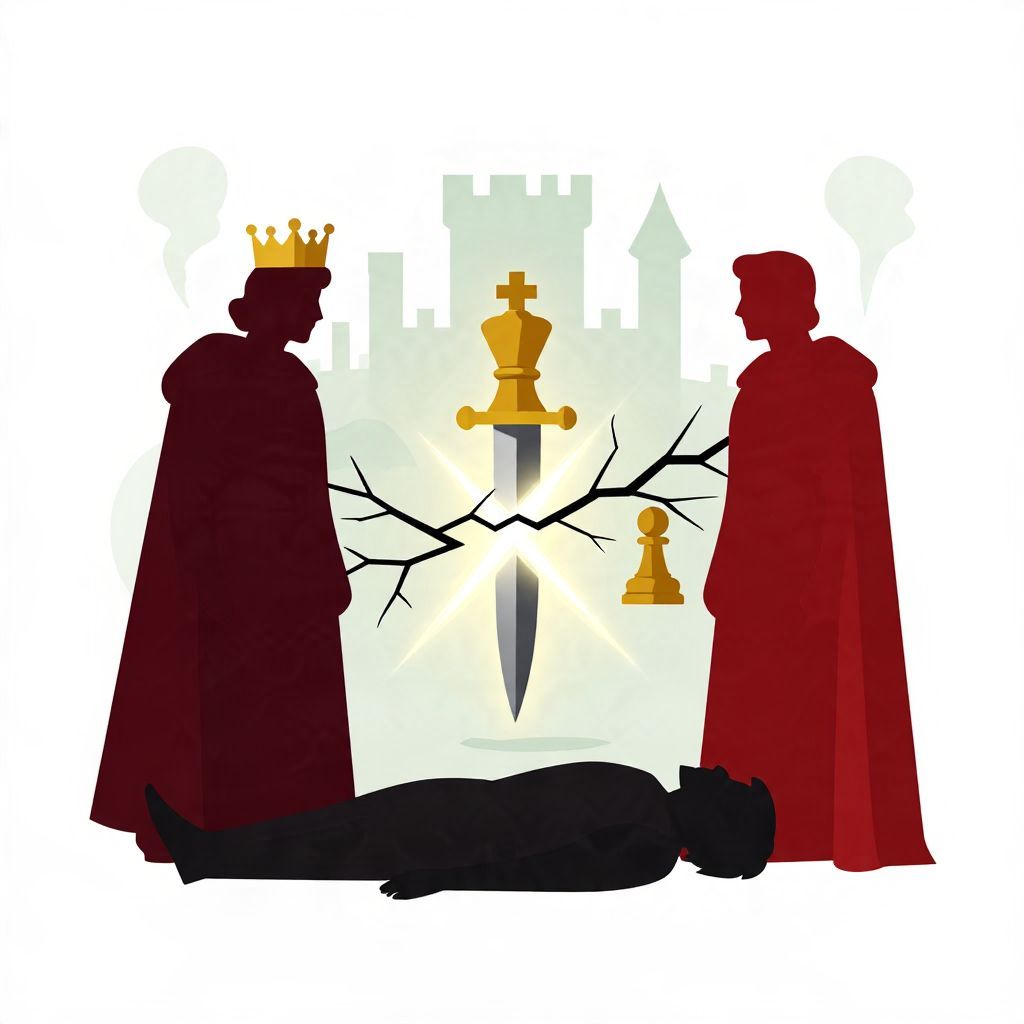
If you’re asking why Macbeth kills Banquo, the short answer is that Banquo has become a threat to Macbeth’s power. Macbeth fears Banquo’s integrity, his suspicion, and, most importantly, the witches’ prophecy that Banquo’s descendants will inherit the throne.
Shakespeare uses Banquo’s murder to show how guilt, paranoia, and political insecurity drive Macbeth deeper into tyranny. The killing is not random violence; it is a calculated attempt to protect a crown Macbeth believes he has won by murder and may lose by fate.
Why does Macbeth kill Banquo?
Macbeth kills Banquo because Banquo threatens both his conscience and his kingship. Banquo is honorable, observant, and aware of the witches’ prophecy, so Macbeth fears he may expose the truth or outlast him. Macbeth also cannot bear the idea that Banquo’s line, not his own, may inherit the throne.
What makes Banquo dangerous to Macbeth?
Banquo is dangerous not because he openly rebels, but because he represents everything Macbeth lacks: moral steadiness, self-control, and a clearer judgment. He is one of the few characters who can compare notes with Macbeth about the witches without being seduced by them.
1. Banquo knows too much
Banquo was present when the witches made their prophecy, so he shares knowledge of Macbeth’s rise. That makes him a witness to Macbeth’s ambition and, potentially, a witness to his crimes.
2. Banquo is morally resistant
Unlike Macbeth, Banquo does not immediately act on supernatural temptation. His restraint makes him a quiet contrast to Macbeth’s moral collapse, and that contrast can feel threatening to a ruler trying to justify murder.
3. Banquo’s heirs are promised the future
The biggest fear is dynastic. The witches predict that Banquo will “get kings, though he himself will not be one,” which means Macbeth’s stolen crown may ultimately serve another family. Macbeth kills Banquo to fight that prophecy, even though the act only deepens his insecurity.
Spoiler explanation: how the murder fits into the play
After Duncan’s murder, Macbeth does not become secure; he becomes more afraid. Banquo’s presence reminds him that the supernatural promise has not fully gone his way, and Macbeth starts to see everyone as a possible enemy. Banquo’s murder is the point where Macbeth shifts from guilty usurper to active tyrant.
Macbeth’s fear is both political and psychological
Politically, Macbeth wants to prevent any challenge to his rule. Psychologically, he wants to silence the part of himself that knows he has built his power on blood. Banquo’s survival keeps that anxiety alive.
The murder is planned, not impulsive
Macbeth does not kill Banquo in a fit of rage. He hires murderers to ambush Banquo and his son Fleance, which shows how far he has moved from honorable combat into secret state violence. That shift is one of the play’s clearest signs of moral decay.
Why does Macbeth target Fleance too?
Macbeth targets Fleance because the witches’ prophecy is not only about Banquo’s life, but about his descendants. If Fleance survives, the prophecy remains alive. Macbeth therefore tries to erase the future, not just the present threat.
This is why the attack matters even though Banquo dies and Fleance escapes. Macbeth cannot control the future any more than he can control fate, and the failure of the assassination reinforces the play’s sense that violence breeds more instability, not less.
How does Banquo’s death affect Macbeth?
Banquo’s death does not calm Macbeth; it intensifies his fear. Once he sees Banquo’s ghost at the banquet, the audience understands that murder has not solved his problem. It has only made his guilt visible and his mind unstable.
The banquet scene reveals Macbeth’s unraveling
Banquo’s ghost functions as a dramatic symbol of guilt and unresolved violence. Whether the ghost is supernatural or psychological, it exposes the fact that Macbeth cannot master the consequences of what he has done. Publicly, he appears unfit to rule; privately, he is haunted by what he has become.
Macbeth becomes more isolated
By murdering Banquo, Macbeth cuts himself off from one of the few noble figures who might have offered honest counsel. The result is not security but loneliness, suspicion, and a growing dependence on further violence.
What themes does Banquo’s murder develop?
Banquo’s murder is one of the play’s most important turning points because it develops several central themes at once. Shakespeare uses the event to show how ambition, fate, guilt, and moral corruption interact.
- Ambition: Macbeth wants to protect power he gained unlawfully.
- Fate versus free will: Macbeth tries to fight prophecy, but his actions seem to fulfill the tragic pattern more than escape it.
- Guilt: Banquo’s ghost and Macbeth’s fear show that violence leaves psychological scars.
- Tyranny: Macbeth increasingly rules through fear rather than legitimacy.
- Appearance versus reality: Macbeth acts like a loyal king while secretly arranging murder.
Banquo and Macbeth: why the contrast matters
Shakespeare makes Banquo a foil for Macbeth, meaning a character whose traits highlight the protagonist’s flaws. Both men hear the witches’ prophecy, but they respond differently. Macbeth acts on temptation; Banquo remains cautious.
That contrast is essential to understanding why Macbeth kills Banquo. Banquo is not simply a rival. He is a living reminder that Macbeth could have chosen differently.
Macbeth’s tragedy is partly self-made
Because Banquo resists the witches, the play suggests that prophecy does not force Macbeth’s hand. Macbeth chooses murder. Banquo’s existence therefore becomes unbearable to him, since it proves another response was possible.
Why is Banquo’s murder dramatic rather than just practical?
On a practical level, Macbeth wants to eliminate a threat. But dramatically, the murder deepens the tragedy because it shows that Macbeth is no longer trying merely to seize power; he is trying to control reality itself. He wants to silence witnesses, defeat fate, and secure a future that the play keeps slipping away from him.
That is why the scene matters so much in literary analysis. It marks the moment when Macbeth’s fear becomes policy, and private guilt becomes public disaster.
Key details to remember
- Macbeth kills Banquo because he fears Banquo’s knowledge, integrity, and descendants.
- The witches’ prophecy about Banquo’s heirs is the main long-term threat.
- Banquo’s murder is planned and deliberate, not accidental.
- Fleance escapes, so Macbeth’s attempt to stop the prophecy fails.
- Banquo’s ghost later symbolizes Macbeth’s guilt and instability.
Bottom line
Macbeth kills Banquo because Banquo stands in the way of Macbeth’s fragile claim to power and because the prophecy makes him fear the future. Shakespeare uses the murder to show that once Macbeth chooses violence to protect his crown, he becomes trapped in a cycle of paranoia that he cannot escape.
If you want to keep tracing the tragedy, you may also find these related explanations useful: how Lady Macbeth dies and how Macbeth dies.