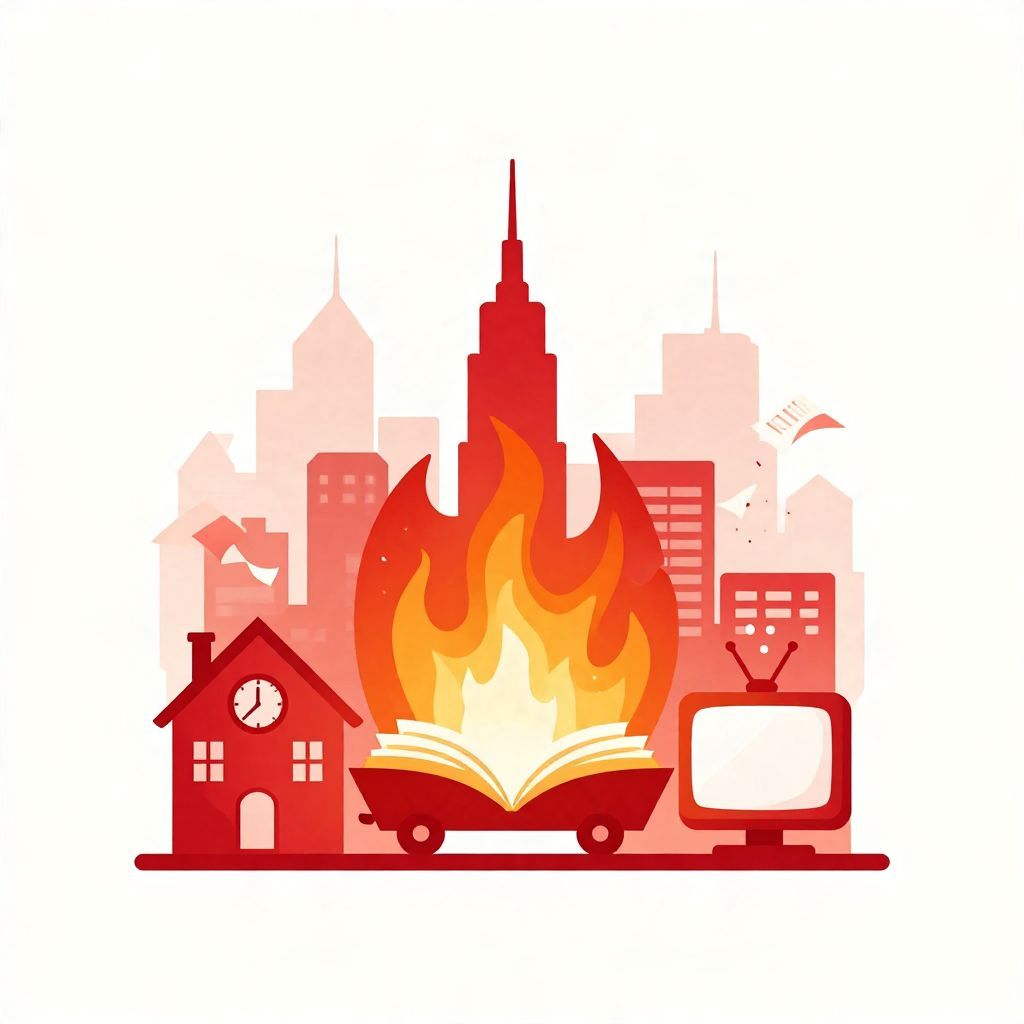
If you’re wondering when Fahrenheit 451 takes place, the short answer is that Ray Bradbury does not give the story a precise calendar year. Instead, he places it in a near-future America that feels recognizably modern but deeply distorted by censorship, distraction, and social control.
That vagueness is part of the novel’s power. Bradbury wanted the setting to feel immediate rather than distant, so the book reads less like a dated prediction and more like a warning about what can happen when a culture turns away from books, memory, and independent thought.
When does Fahrenheit 451 take place?
Fahrenheit 451 takes place in an unspecified future, usually understood as a dystopian version of mid-20th-century America. Bradbury never names an exact year in the text, but the world is clearly beyond his own time, with wall-sized screens, mechanical surveillance, and a society shaped by anti-intellectualism and state censorship.
Why Bradbury avoids a specific year
Bradbury’s choice to leave the date vague keeps the novel from becoming a simple prediction exercise. The story is not meant to be pinned to a single historical moment; it is meant to feel like a possible future that could emerge from present-day habits.
That decision also makes the book more universal. Readers from different eras can recognize the warning in their own cultural context, whether they think about mass entertainment, political pressure, shortened attention spans, or the loss of serious reading.
A future that feels both familiar and strange
The novel’s setting includes advanced technology, but it is not a sleek science-fiction future. Instead, it is a flattened, anxious world where technology often replaces reflection rather than expanding human freedom.
Because Bradbury mixes familiar domestic details with unsettling innovations, the setting feels close enough to reality to be disturbing. That is one reason the question “When does Fahrenheit 451 take place?” does not have a neat answer: the book is designed to blur the line between now and later.
What clues show the story is set in the future?
Several details signal that the novel occurs after Bradbury’s own time. These clues are never presented as a dated timeline, but together they create a clear sense of a technologically advanced dystopia.
- Wall-sized television screens dominate home life and encourage passive entertainment.
- Mechanical hounds and other automated systems suggest a highly militarized society.
- Fast-moving vehicles and dangerous roads reflect a culture of speed and carelessness.
- Book burning is institutionalized, showing that censorship has become normal policy.
- Shallow public discourse replaces sustained reading, debate, and historical memory.
These features are not just background decoration. They shape the novel’s central conflict: a society that has chosen convenience and control over complexity and truth.
How the setting shapes the novel’s themes
Censorship and conformity
The future world of Fahrenheit 451 is organized around the suppression of books because books preserve disagreement, nuance, and uncomfortable ideas. By placing the story in a future where censorship has become ordinary, Bradbury shows how easily a culture can normalize intellectual emptiness.
The setting matters because it makes censorship look systemic rather than accidental. This is not a single bad law in isolation; it is an entire social environment that rewards sameness and punishes depth.
Technology as distraction
Bradbury’s future is full of devices, but the novel is not simply anti-technology. Its concern is with technology used to numb thought, fragment attention, and keep people from asking difficult questions.
That is why the setting feels so relevant to readers today. The novel’s world is extreme, but its underlying fear is familiar: a society so saturated with stimulation that it loses the habit of contemplation.
Memory and human connection
The future setting also highlights what is missing. In a world where books are burned and conversations are shallow, memory becomes fragile, and human relationships become strained or mechanical.
Characters who preserve stories, ideas, or emotional depth stand out because the setting has made those qualities rare. The time and place of the novel are therefore not just coordinates; they are part of its moral argument.
Is Fahrenheit 451 set in America?
The novel is strongly rooted in American culture, even though Bradbury does not map the story onto a specific city or state. The language, institutions, and domestic life all suggest a future United States shaped by mass media, consumerism, and political fear.
That American setting matters because Bradbury is also commenting on his own society. The book is often read as a warning about trends visible in the postwar United States, especially the pressure toward conformity and the decline of sustained literary culture.
Publication context: when Bradbury wrote the book
Fahrenheit 451 was published in 1953, which helps explain why its future feels the way it does. Bradbury was writing in the early Cold War era, when anxieties about censorship, propaganda, and social conformity were especially intense.
The novel reflects those concerns without being limited to them. Its future setting takes mid-century fears and projects them forward, creating a dystopia that is historically specific in origin but broad in meaning.
Why the 1950s matter
The early 1950s were marked by suspicion, ideological pressure, and a growing media culture. Bradbury turned those conditions into fiction, imagining what might happen if entertainment, fear, and anti-intellectualism overwhelmed public life.
So when readers ask when the story takes place, the answer has two layers: the novel is set in an unspecified future, but it was shaped by the concerns of the 1950s.
How to think about the timeline while reading
If you are reading the novel for class or close analysis, it helps to treat the setting as a near-future dystopia rather than a carefully dated science-fiction timeline. Bradbury is less interested in worldbuilding precision than in atmosphere, symbolism, and warning.
- Notice the technological details that make the world feel advanced.
- Pay attention to how those details affect behavior and relationships.
- Track the contrast between passive mass culture and preserved literature.
- Read the setting as a social critique, not just a backdrop.
This approach makes the novel easier to interpret. The exact year is less important than the cultural pattern Bradbury is exposing.
Why the setting still feels current
One reason Fahrenheit 451 remains widely read is that its future never becomes obsolete. The novel’s world is exaggerated, but its concerns—constant distraction, shallow media consumption, and the erosion of thoughtful reading—continue to resonate.
That is why the question “When does Fahrenheit 451 take place?” leads to a bigger literary insight: the book is not trying to tell readers what year it is. It is asking them to recognize how quickly a society can drift toward intellectual passivity.
Quick answer for readers and students
If you need a concise response, say this: Fahrenheit 451 takes place in an unspecified future version of America, not in a named year. Bradbury leaves the date open so the novel functions as a timeless warning about censorship, technology, and the loss of critical thought.
For a related question about the novel’s chronology, you may also want to read what year Fahrenheit 451 takes place and, if you’re continuing through the story, what happens at the end of Fahrenheit 451.