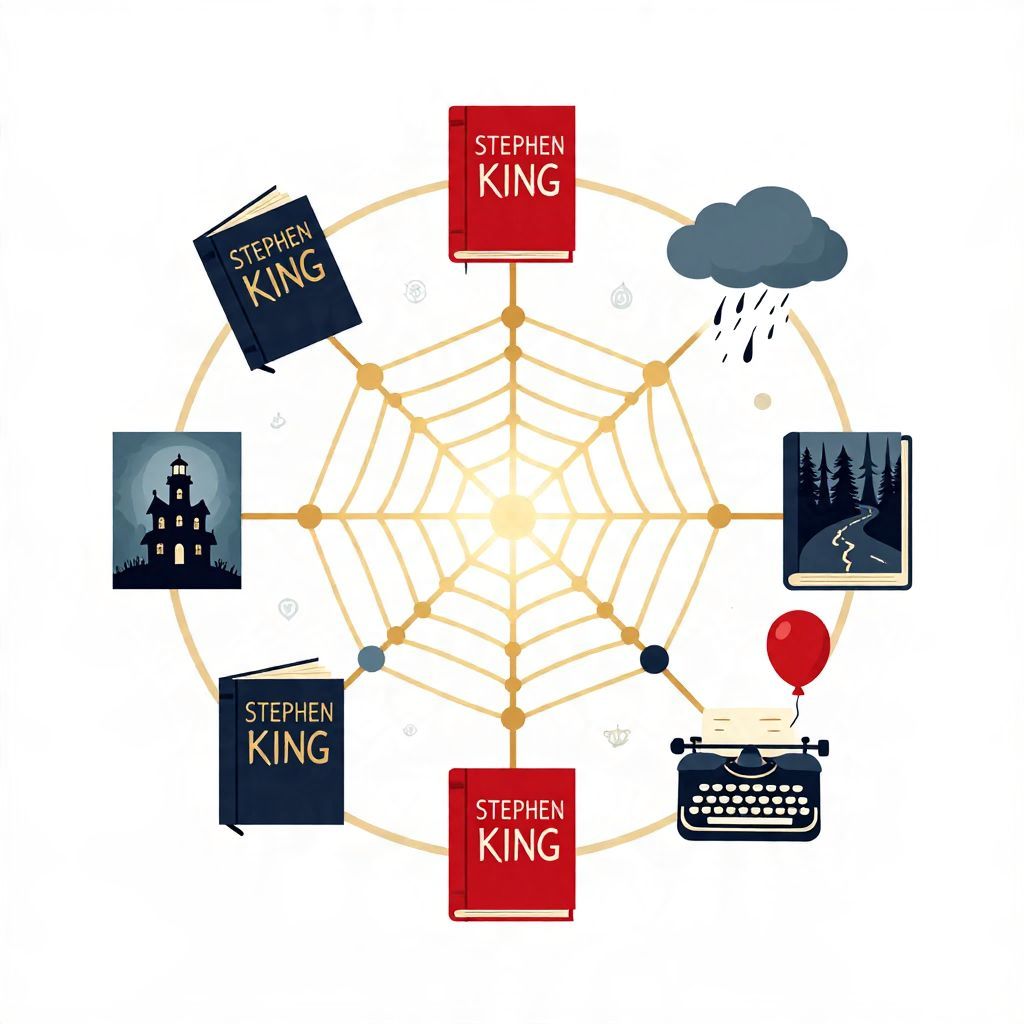
Stephen King’s fiction can feel like one giant web, which is why many readers ask whether all Stephen King books are connected. The short answer is yes, in a broad sense—but not every novel shares the same continuity in a strict, series-like way.
King builds recurring places, characters, symbols, and even a larger multiverse that links many stories while still allowing each book to stand on its own.
Are all Stephen King books connected?
Not every Stephen King book is directly connected in the way a sequel series is, but many of them belong to a shared fictional universe. Some novels and stories overlap through recurring locations, characters, references, and the idea of a multiverse, while others are only loosely linked by themes, tone, or symbolic patterns rather than plot.
How Stephen King connects his books
King’s connections work on several levels. Some are obvious, such as sequels and direct continuations, while others are subtle references that reward attentive readers without requiring them to know every other book.
1. Direct sequels and linked series
A few King books are clearly part of the same narrative chain. These include books that continue a character’s story or revisit the same fictional world in a deliberate way.
- The Dark Tower series is the clearest example of a major connected structure in King’s work.
- The Shining and Doctor Sleep are directly linked through Danny Torrance’s story.
- Some books share settings or characters in ways that make them feel like companion pieces rather than isolated novels.
2. Recurring places and fictional geography
King often returns to the same invented towns, especially in Maine, which gives his books a sense of lived-in continuity. Fictional places such as Castle Rock and Derry appear across multiple stories and create the impression that the books occupy one larger map.
These recurring settings do not always mean the plots depend on one another. Instead, they function like a literary neighborhood: each story can stand alone, but the shared geography makes the world feel bigger and more haunted.
3. Shared characters and cameo appearances
Some secondary characters reappear across different books, sometimes in major roles and sometimes only in passing. These appearances can be brief, but they help stitch the books together into a recognizable network.
King also likes to let readers notice the same names, professions, or family lines across different novels. That repetition is part of the pleasure of reading him: the books often feel as if they are in conversation with one another.
4. References, symbols, and repeated ideas
Even when two books do not share plot or characters, they may echo one another through recurring symbols and themes. King frequently returns to ideas like childhood fear, addiction, trauma, memory, artistic obsession, and the battle between ordinary life and supernatural intrusion.
Some images and concepts recur so often that they become part of King’s literary signature. Readers may notice patterns involving psychic ability, evil as a force that spreads, or the vulnerability of children and families under pressure.
The Dark Tower as the center of the web
Many readers think of The Dark Tower as the backbone of Stephen King’s connected fiction. It is not the only link between his books, but it is the clearest and most expansive one.
Why The Dark Tower matters
The series functions as a central axis for King’s multiverse, with references and crossovers reaching into many other works. It gives the sense that different books may occupy different corners of a larger reality rather than separate, sealed-off worlds.
That said, readers do not need to read every related book to understand the main story. The series can be approached on its own, though familiarity with other King novels often deepens the experience.
Books often associated with The Dark Tower
King has woven links to the series through multiple novels and stories, but the strength of those connections varies. Some are overt, while others are more like Easter eggs for devoted readers.
- The Stand is often discussed in connection with the larger King multiverse.
- Insomnia and Black House are frequently noted by readers as part of the broader web.
- Other books contain names, phrases, or concepts that resonate with the Tower mythology without becoming full crossover novels.
Do you need to read Stephen King books in order?
For most of King’s novels, no. The majority are designed to be read independently, even when they contain references to other books. A reader can usually start with the title that most interests them and still have a complete experience.
When reading order does matter
Reading order becomes more important when a book is a direct sequel or part of an obvious sequence. In those cases, earlier books provide essential character background and narrative context.
- Read the original book first if a novel is clearly labeled as a sequel.
- Consider publication order for the Dark Tower series if you want the most natural unfolding of references and reveals.
- Ignore strict order for most standalone novels unless you specifically want to follow the interconnected world-building.
Why King’s connected universe works so well
King’s connected fiction works because it is flexible. He does not build a rigid franchise with every detail locked in place; instead, he creates a living literary ecosystem where stories can overlap without becoming dependent on one another.
It mirrors the way memory works
One reason the connections feel natural is that they resemble how people remember places, events, and fears. A town can reappear in your mind years later, and a person from one chapter of life can suddenly seem linked to another.
King’s fiction often uses that same logic. His books feel connected because they share emotional and psychological terrain, not just plot mechanics.
It rewards rereading
Readers who return to King’s novels often notice more links the second time around. A name that once seemed incidental may suddenly matter, and a passing reference may reveal a larger pattern.
This rereadability is part of what makes the question “Are all Stephen King books connected?” so compelling. The answer is not a simple yes or no; it is an invitation to look more closely.
Common misunderstandings about Stephen King’s connections
Because King’s bibliography is so large, it is easy to overstate or oversimplify the links between books. A few clarifications help keep the picture accurate.
Not every reference means a shared plot
A mention of a town, character, or event does not always mean two books are part of the same direct storyline. Sometimes the reference is just a nod to attentive readers or a way of building atmosphere.
Not every connected book is part of one linear timeline
King’s multiverse is not always tidy. Some stories imply alternate realities, overlapping dimensions, or shifting versions of events rather than one straightforward chronology.
Standalone does not mean isolated
Even King’s most self-contained novels may still echo his larger body of work through theme, setting, or style. In that sense, “standalone” often means “not dependent on another book,” not “completely separate from the rest of his fiction.”
Best way to approach Stephen King if you want the connections
If you are reading for the connections, the best strategy is to begin with one or two major books and then follow the threads that interest you most. You do not need to map the entire bibliography at once.
- Start with a famous standalone novel that interests you.
- Notice recurring places, names, or themes.
- Move into a clearly linked sequel or series if you want a stronger continuity.
- Explore The Dark Tower if you want the broadest view of King’s interconnected universe.
So, are all Stephen King books connected?
In the broad literary sense, yes: Stephen King’s books are connected by recurring settings, themes, symbols, and a shared multiverse-like imagination. But in the practical reading sense, no: most of them are not direct sequels and do not require one another for understanding.
If you want the simplest takeaway, think of King’s work as a collection of stand-alone novels that occasionally open doors into the same larger haunted world. For more book-related reading, you may also enjoy how many books Stephen King has written and what the theme of The Hunger Games is.