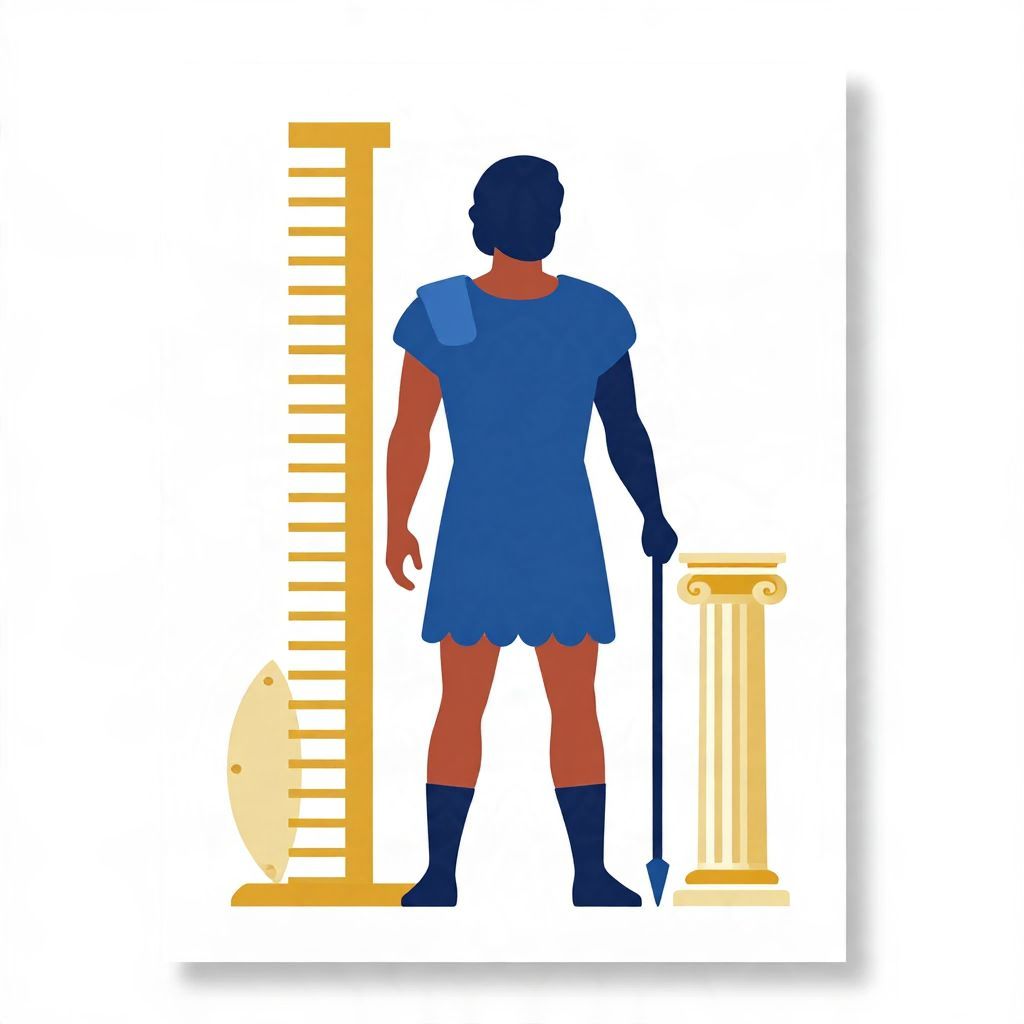
If you’re asking how tall was Odysseus, you’re really asking how Homer’s hero is imagined: as a man of striking presence, but not a giant. The ancient texts do not give a precise modern measurement, so any answer has to be cautious and interpretive rather than exact.
That uncertainty matters, because Odysseus is defined less by physical size than by intelligence, endurance, and adaptability. In the Odyssey, his stature is part of a larger literary portrait of a hero whose real power lies in wit, disguise, and self-control.
How tall was Odysseus in Homer’s Odyssey?
There is no canonical height for Odysseus in Homer. Ancient descriptions suggest he was handsome, broad-shouldered, and impressive in bearing, but not unusually towering; his authority comes from charisma and intelligence rather than sheer size. Any exact number you see online is speculative, not textually confirmed.
What the text actually says about Odysseus’s appearance
A hero marked by presence, not measurements
Homer rarely gives precise body measurements for characters in the way a modern novel might. Instead, Odysseus is described through qualities such as his posture, voice, and expression, which create an image of a man who commands attention.
When he appears in the poem, he is often recognized by his demeanor before his identity is fully revealed. That kind of description tells us more about epic heroism than about inches or centimeters.
Why readers imagine him as medium-to-tall
Later artistic traditions often portray Odysseus as physically capable and noble-looking, which can lead readers to assume he was tall. But the original epic does not support a firm conclusion beyond the idea that he had the bearing of a leader.
In other words, Odysseus is “large” in narrative importance, not necessarily in physical height.
Book summary: what The Odyssey is about
The Odyssey follows Odysseus’s long journey home after the Trojan War. The poem focuses on his struggle to return to Ithaca, where his wife Penelope and son Telemachus wait while suitors consume his household and threaten his place as king.
The story moves between Odysseus’s wanderings at sea, Telemachus’s search for news of his father, and the growing tension in Ithaca. Its central question is not just whether Odysseus will return, but what kind of man he becomes through suffering, delay, and cunning.
Without major spoilers
At a basic level, the poem is an adventure story about homecoming. But it is also a meditation on identity, loyalty, hospitality, and the cost of survival.
Why Odysseus’s physical size matters less than his character
Epic heroes are often measured by visible strength, but Odysseus complicates that model. He is a warrior, yet he is most famous for outthinking enemies, surviving disguises, and speaking carefully under pressure.
This makes him different from heroes whose greatness is mainly physical. Odysseus’s literary power comes from metis, the Greek idea of cunning intelligence, which is one of the poem’s defining values.
Strength, but also restraint
Odysseus can fight when needed, but the poem repeatedly shows that brute force alone cannot solve his problems. He succeeds by observing, planning, and waiting for the right moment.
That balance helps explain why readers continue to find him compelling: he is heroic, but not simplistic.
Main themes in The Odyssey
Homecoming and belonging
The deepest emotional force in the poem is nostos, the longing to return home. Ithaca is not just a place on a map; it represents identity, memory, and rightful order.
Odysseus’s journey tests whether home can still be recovered after years of absence and transformation.
Identity and disguise
Odysseus repeatedly hides who he is, and the poem uses disguise as both a practical tactic and a philosophical problem. If a man can change names, clothes, and roles, what remains constant?
This theme is especially important because Odysseus is a hero of performance. He survives by becoming different versions of himself.
Hospitality and social order
The poem places great importance on xenia, the sacred code of hospitality. Good hosts welcome strangers properly, while bad hosts or lawless guests create chaos.
The suitors in Ithaca violate this code, and their behavior becomes a moral sign of disorder in the household and kingdom.
Loyalty and endurance
Penelope, Telemachus, and the faithful servants each embody different forms of endurance. Their patience mirrors Odysseus’s own, but their waiting is active rather than passive.
The poem suggests that loyalty is not merely emotional; it is a discipline sustained over time.
Odysseus as a literary character
A hero of intelligence and contradiction
Odysseus is admired for his cleverness, but the poem does not make him morally simple. He can be compassionate, deceptive, proud, strategic, and stubborn, sometimes all at once.
That complexity is part of what makes him feel modern. He is not a flawless ideal; he is a person whose strengths can also become liabilities.
How Homer builds his character
Homer uses repeated epithets, speeches, and scenes of recognition to shape Odysseus’s character. The hero is often tested in moments when words matter as much as action.
These techniques allow the poem to show intelligence in motion, rather than merely telling the reader that Odysseus is clever.
Symbols and motifs connected to Odysseus
- The sea — uncertainty, danger, and the instability of human plans.
- The bow — rightful identity, skill, and restored authority.
- Disguises — survival, testing, and hidden truth.
- Home — memory, legitimacy, and emotional completion.
- The bed — marriage, permanence, and recognition.
These symbols are not decorative. They help the poem connect personal identity with social order and emotional truth.
Literary style and technique
Epic structure
The Odyssey is an epic poem, but it is unusually flexible in structure. It begins in medias res, meaning in the middle of the action, and gradually fills in earlier events through storytelling and memory.
This structure creates suspense while also emphasizing how the past continues to shape the present.
Recognition scenes
One of the poem’s most memorable techniques is the recognition scene, where identity is revealed slowly and carefully. These moments are emotionally powerful because they depend on trust, memory, and proof.
Odysseus’s height, in a sense, matters less than whether others can truly know him.
Shifts in perspective
The poem moves between different settings and viewpoints, including the gods, Telemachus, and Odysseus himself. That shifting perspective broadens the story beyond one man’s journey into a larger meditation on fate and human agency.
How to read Odysseus as a hero today
Modern readers often look for a single physical description, but Homeric characterization works differently. Odysseus is meant to be recognized through action, speech, and reputation rather than a fixed profile.
If you want a practical answer to how tall was Odysseus, the honest reply is that the poem does not say. If you want the literary answer, he is “tall” in the sense that he stands out as one of the most memorable and complex heroes in Western literature.
Who will enjoy The Odyssey?
- Readers interested in myth, epic, and ancient literature
- Students studying Greek heroism, identity, or hospitality
- Anyone who enjoys adventure stories with psychological depth
- Readers who like characters defined by wit as much as strength
If you are drawn to questions about character rather than simple plot, Odysseus is a rewarding figure to study. He is one of literature’s best examples of a hero whose mind is as important as his body.
Final takeaway
There is no reliable ancient measurement for Odysseus’s height, so the safest answer is that he was probably of impressive but ordinary heroic stature. What truly defines him is not how tall he was, but how fully Homer turns him into a symbol of intelligence, endurance, and the difficult road home.
For related reading, you may also want to explore how many suitors Odysseus killed and whether Odysseus makes it home.