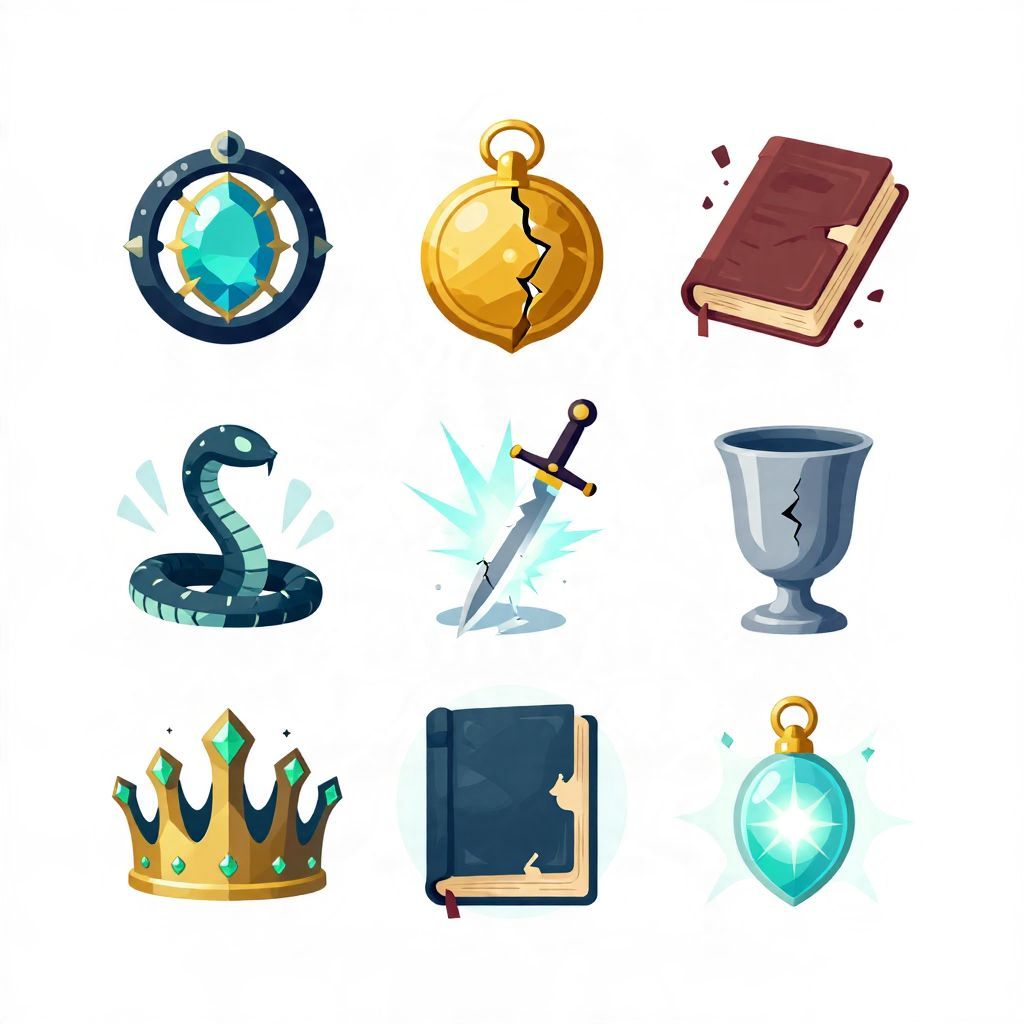
If you’re asking what the seven Horcruxes are in Harry Potter and how each one is destroyed, the short answer is that they are objects or beings used to hide pieces of Voldemort’s soul, and each must be damaged beyond repair by a substance or event powerful enough to destroy the soul fragment inside. Their destruction is one of the central mechanisms of the series’ final conflict.
Understanding the Horcruxes also means understanding how J. K. Rowling uses them as a literary device: they externalize Voldemort’s fractured identity, make immortality morally horrifying, and turn the hunt for hidden objects into a structure for the last books’ suspense.
What are the seven Horcruxes in Harry Potter, and how are they destroyed?
The seven Horcruxes are Tom Riddle’s diary, Marvolo Gaunt’s ring, Salazar Slytherin’s locket, Helga Hufflepuff’s cup, Rowena Ravenclaw’s diadem, Nagini, and—unintentionally—Harry Potter. Each is destroyed by a specific force that can permanently damage the container and the soul fragment within, such as basilisk venom, fiendfyre, or a killing curse aimed at the soul fragment in Harry.
The seven Horcruxes and their destruction
1. Tom Riddle’s diary
The diary is destroyed in Harry Potter and the Chamber of Secrets when Harry stabs it with a basilisk fang. This matters because basilisk venom is one of the few substances known to destroy Horcruxes completely.
2. Marvolo Gaunt’s ring
Dumbledore destroys the ring with the Sword of Gryffindor after the ring has already been damaged by basilisk venom. The sword has absorbed basilisk venom, which makes it capable of destroying Horcruxes.
3. Salazar Slytherin’s locket
The locket is destroyed by Ron Weasley using the Sword of Gryffindor in Deathly Hallows. Before that, it is weakened by basilisk venom from the sword, then finally split open by Ron’s decisive strike.
4. Helga Hufflepuff’s cup
Hermione Granger destroys the cup with a basilisk fang in the Chamber of Secrets after the fang has been brought to the Horcrux hunt. Like the diary, the cup can only be permanently destroyed by a substance that can reach and ruin the soul fragment.
5. Rowena Ravenclaw’s diadem
The diadem is destroyed by fiendfyre in the Room of Requirement. Fiendfyre is magical fire so destructive that it consumes Horcruxes, though it is extremely dangerous and difficult to control.
6. Nagini
Nagini is killed by Neville Longbottom with the Sword of Gryffindor during the Battle of Hogwarts. Her destruction removes the final living Horcrux protecting Voldemort’s mortal remains.
7. Harry Potter
Harry is not deliberately made a Horcrux, but a fragment of Voldemort’s soul attaches to him when the Killing Curse rebounds in Godric’s Hollow. That fragment is destroyed when Voldemort casts the Killing Curse on Harry in the Forbidden Forest, because Harry chooses to return and the curse destroys the piece of soul within him rather than Harry himself.
Why Horcruxes matter in the story
Horcruxes are not just plot devices; they are the series’ clearest symbol of moral disintegration. Voldemort’s attempt to defeat death literally splits his soul, suggesting that the pursuit of power through cruelty leaves a person less whole, not more secure.
They also give the final books their quest structure. Instead of a single battle, the heroes must uncover, locate, and destroy hidden fragments of evil, which turns the climax into a mystery, a treasure hunt, and a moral test at once.
How the Horcrux concept works in literary terms
A symbol of fragmentation
In literary analysis, Horcruxes function as an externalized metaphor for divided selfhood. Voldemort’s soul is not merely hidden; it is broken, scattered, and dependent on objects outside himself, which mirrors the emotional and ethical fragmentation that defines him.
Death, immortality, and the limits of control
Rowling uses the Horcrux idea to challenge the fantasy of total control over death. Voldemort seeks immortality through concealment and violence, but the books insist that such control is unstable, parasitic, and ultimately self-defeating.
The hero’s counter-ethic
Harry’s role is significant because he does not defeat Voldemort through domination. He survives by sacrifice, loyalty, and acceptance of mortality, which gives the series a moral contrast between love and fear, wholeness and division.
Common points of confusion about the seven Horcruxes
- Harry is not a planned Horcrux. Voldemort never intended to make him one.
- The soul fragment in Harry is destroyed, not Harry himself. Harry survives because the protective conditions in the Forest and the nature of Voldemort’s curse preserve his life.
- Horcrux destruction is not all the same. Different objects require different methods, but the destruction must be irreversible.
- Not every magical attack works. Ordinary damage is not enough; the object must be ruined in a way that destroys the soul fragment.
Why the Horcrux hunt is so effective as a narrative device
The Horcrux hunt slows the pace of the final book while raising the stakes. Each object reveals more about Voldemort’s past, so the quest is both action-driven and character-driven: the heroes are not only destroying evil, they are reconstructing the history that made him.
That structure also deepens the theme of inheritance. The Horcruxes are tied to founders, family lines, and relics, which lets the series connect ancient magical history to the present-day struggle between Harry and Voldemort.
Quick reference: the seven Horcruxes and how they are destroyed
- Tom Riddle’s diary — destroyed by a basilisk fang.
- Marvolo Gaunt’s ring — destroyed by the Sword of Gryffindor after basilisk venom damage.
- Salazar Slytherin’s locket — destroyed by the Sword of Gryffindor.
- Helga Hufflepuff’s cup — destroyed by a basilisk fang.
- Rowena Ravenclaw’s diadem — destroyed by fiendfyre.
- Nagini — destroyed by the Sword of Gryffindor.
- Harry Potter — the soul fragment is destroyed by Voldemort’s Killing Curse in the Forbidden Forest.
Takeaway
The seven Horcruxes are central to both the plot and the meaning of Harry Potter: they are the scattered pieces of Voldemort’s soul, and their destruction marks the undoing of his attempt to outrun death. If you’re reading the series for the first time, the Horcrux storyline is where Rowling’s fantasy, mystery, and moral symbolism come together most clearly.
If you’d like to explore more book and series analysis, you can continue with related articles on fantasy literature, character symbolism, and major series themes.