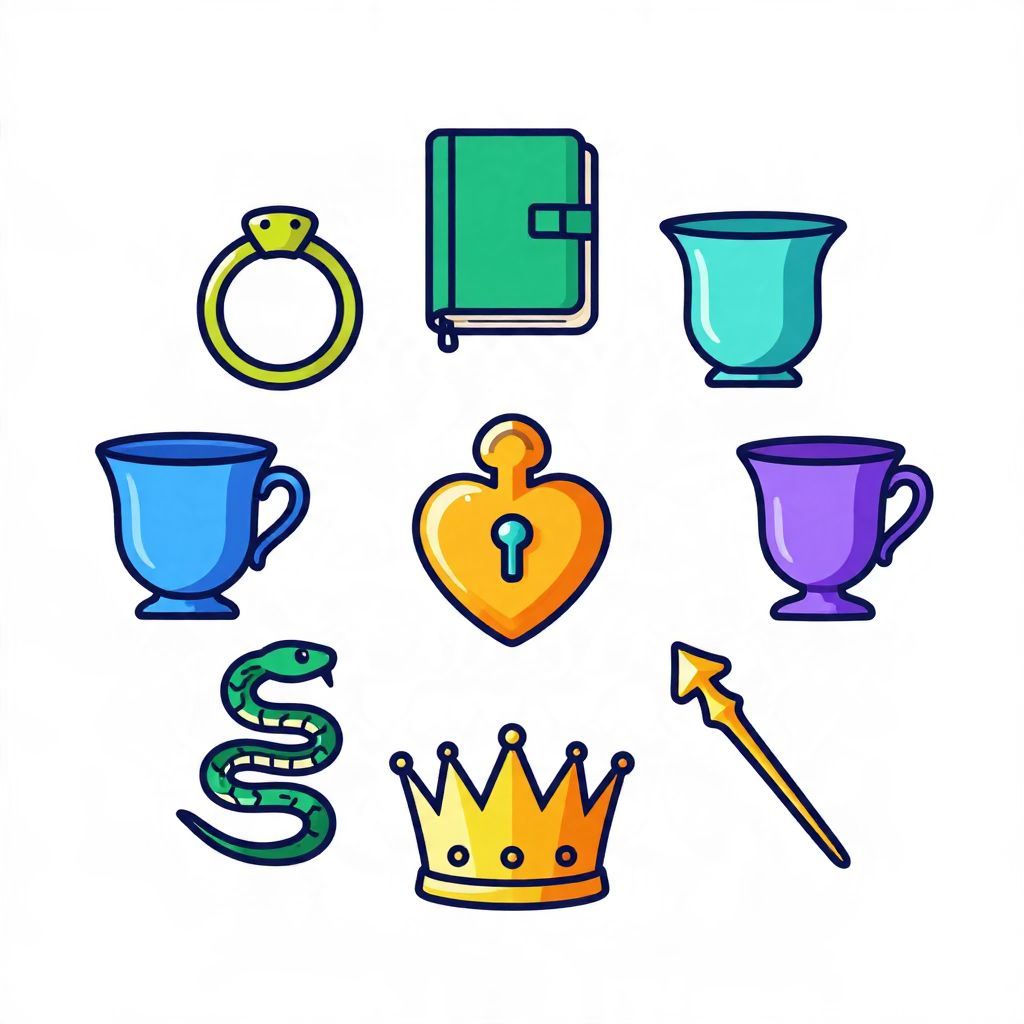
Readers often ask what the seven Horcruxes are because the term sits at the center of one of modern fantasy’s darkest ideas: a soul deliberately broken to preserve life. In Harry Potter, Horcruxes are not just magical objects but symbols of moral corruption, fear of death, and the cost of choosing power over humanity.
Understanding them helps make sense of Voldemort’s character, the series’ structure, and the final conflict. It also shows how J. K. Rowling uses a fantasy device to explore memory, identity, and the possibility of redemption.
What are the seven Horcruxes in Harry Potter?
The seven Horcruxes are objects or beings used by Voldemort to hide fragments of his soul, making him harder to kill. In the series, they are Tom Riddle’s diary, Marvolo Gaunt’s ring, Salazar Slytherin’s locket, Helga Hufflepuff’s cup, Rowena Ravenclaw’s diadem, Nagini, and Harry Potter himself, though Harry is an unintended Horcrux.
What a Horcrux means in the series
A Horcrux is a magical object created when someone commits murder and then uses dark magic to split the soul. The hidden fragment anchors the creator to life, but at a terrible ethical and spiritual cost. Rowling presents the practice as one of the darkest forms of magic in the wizarding world.
Why Voldemort made Horcruxes
Voldemort’s obsession with immortality drives the entire plot. He fears death more than anything else, and Horcruxes are his attempt to defeat it through fragmentation rather than acceptance. That fear shapes his choices, his cruelty, and his eventual downfall.
Why the number seven matters
The number seven carries strong symbolic weight in literature and mythology, often associated with completeness or magical significance. Voldemort intended to divide his soul into seven parts, though the plan becomes more complicated because one fragment remains in his body and one is accidentally lodged in Harry.
The seven Horcruxes and their literary significance
1. Tom Riddle’s diary
The diary is the first Horcrux revealed to readers. It functions as both a magical object and a narrative device, allowing Voldemort’s younger self to manipulate Ginny Weasley and expose the danger of preserved memory turned malicious.
2. Marvolo Gaunt’s ring
The ring connects Voldemort to his family history and to the Gaunt line, which gives him both a bloodline and a legacy of decay. It also contains the Resurrection Stone, making it especially important in the series’ larger meditation on death and temptation.
3. Salazar Slytherin’s locket
The locket symbolizes corrupted inheritance. It passes through several hands before becoming a Horcrux, and its presence in the story emphasizes how objects can carry history, prejudice, and hidden violence across generations.
4. Helga Hufflepuff’s cup
The cup links Voldemort’s dark magic to the school founders, suggesting that even revered symbols of magical tradition can be violated. Its concealment in Gringotts also highlights the contrast between public security and private corruption.
5. Rowena Ravenclaw’s diadem
The diadem represents lost knowledge and intellectual ambition. As a Horcrux, it twists the idea of wisdom into something hollow, showing how the pursuit of greatness can be emptied of its moral center.
6. Nagini
Nagini is the only living Horcrux besides Harry. Her role deepens the series’ use of the uncanny: she is both companion and vessel, a reminder that Voldemort’s power extends into the living world in disturbing ways.
7. Harry Potter
Harry is not deliberately made into a Horcrux, but a fragment of Voldemort’s soul attaches to him when the killing curse rebounds in Godric’s Hollow. This accidental bond gives the series one of its most distinctive ideas: the hero carries part of the villain inside him without becoming the villain.
How the Horcruxes shape the story
The Horcrux hunt turns the final books into a quest narrative. Instead of defeating Voldemort through a single duel, Harry, Ron, and Hermione must uncover hidden objects, interpret clues, and destroy pieces of a soul scattered across the wizarding world.
A structure of discovery
Each Horcrux reveals a new layer of Voldemort’s past. The search is not only physical but historical, requiring the characters to piece together family lines, old magical artifacts, and buried secrets. In that sense, the Horcrux plot works like a literary puzzle.
A theme of moral fragmentation
Horcruxes externalize Voldemort’s inner damage. He has literally split himself apart, and the series uses that magical fact to reflect a psychological truth: cruelty, denial, and the refusal of empathy leave a person spiritually divided.
Horcruxes as symbols in literary analysis
In literary terms, Horcruxes are more than fantasy objects. They function as symbols of memory, trauma, and the danger of trying to preserve the self at any cost. Rowling uses them to dramatize the difference between survival and living fully.
Immortality versus humanity
Voldemort wants existence without vulnerability, but the books argue that such a goal destroys the very qualities that make life meaningful. The Horcruxes preserve him physically while eroding his humanity, making him less whole, not more powerful in a meaningful sense.
The body, soul, and identity
The series treats the soul as something real, fragile, and morally significant. By splitting it, Voldemort turns identity into a broken mechanism. That idea gives the books a spiritual dimension while remaining accessible to readers who approach the story as fantasy adventure.
How readers usually encounter the Horcrux reveal
For many readers, the Horcrux concept becomes central in the later books, especially once the search for them begins. Earlier volumes plant clues through the diary, the Chamber of Secrets, and Voldemort’s backstory, but the full pattern only becomes clear as the series moves toward its conclusion.
Best way to understand them while reading
- Notice how each Horcrux is tied to a meaningful object or creature.
- Track what each item reveals about Voldemort’s past.
- Pay attention to how destruction of a Horcrux often requires courage, sacrifice, or insight.
- Think about the contrast between preserving life and preserving power.
Common questions about the seven Horcruxes
Are all seven Horcruxes equal?
Not exactly. They are all containers for soul fragments, but they differ in symbolism, concealment, and narrative function. Some are tied to family history, some to Hogwarts founders, and one is a living being, which makes the set especially varied and thematically rich.
Is Harry really a Horcrux?
Yes, in the sense that a piece of Voldemort’s soul unintentionally attaches to him. However, Harry is not a true Horcrux in Voldemort’s planned sense, since the creation was accidental and Harry remains fully himself.
Why do the Horcruxes matter to the ending?
Voldemort cannot be fully defeated until the soul fragments are destroyed. The Horcruxes therefore make the ending more than a duel of spells: they turn the climax into a moral and symbolic reckoning with everything Voldemort has tried to deny.
Takeaway
The seven Horcruxes are the key to understanding Voldemort’s immortality scheme, but they also reveal the deeper concerns of the Harry Potter series: the cost of fear, the damage of cruelty, and the possibility that wholeness must be chosen, not seized. If you want a closer look at the objects themselves, see how the seven Horcruxes are destroyed and a fuller explanation of what a Horcrux is.