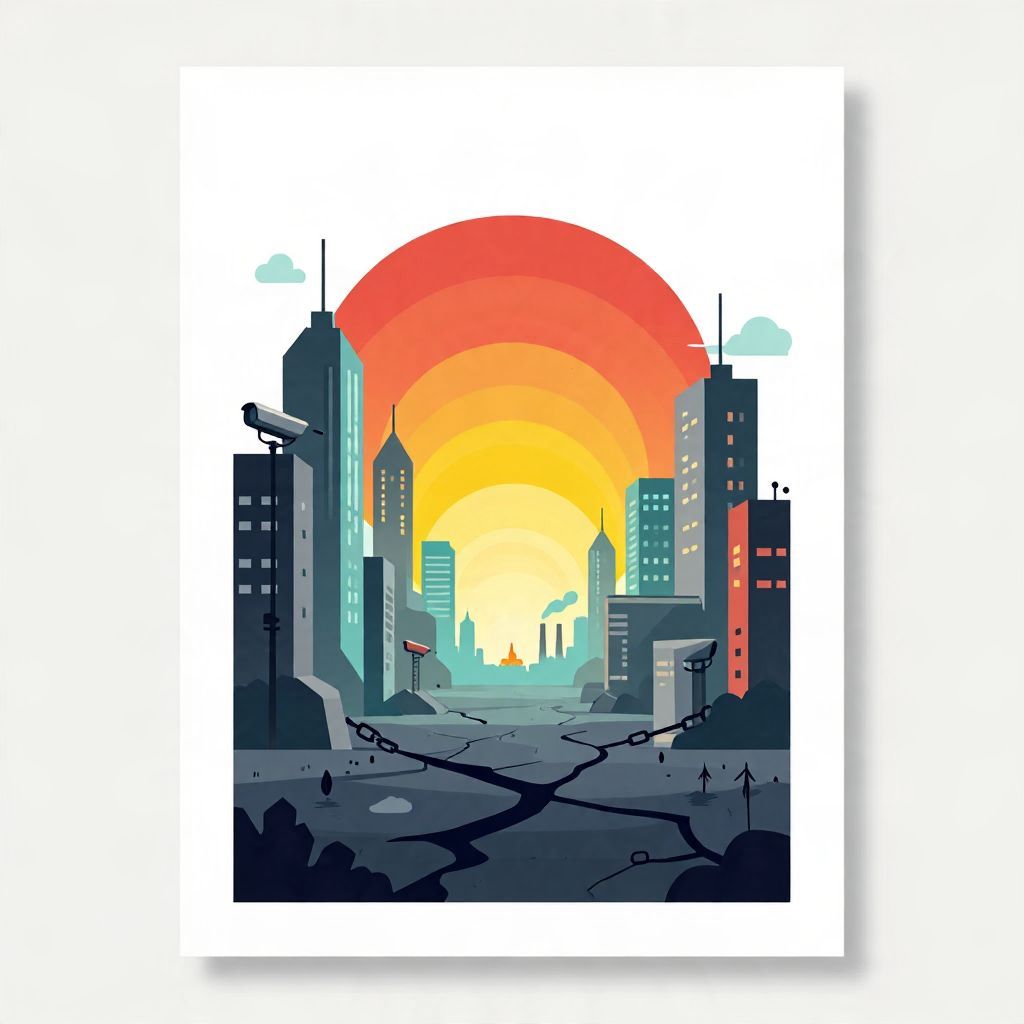
If you’ve ever wondered why certain novels feel unsettlingly close to reality, you’re already thinking about dystopian fiction. This genre imagines societies that have gone wrong in systematic ways, using invented worlds to expose political, social, or technological fears.
Dystopian fiction is popular because it turns abstract anxieties into vivid stories about power, surveillance, conformity, and resistance. It can be thrilling, tragic, satirical, or cautionary, but it almost always asks the same question: what happens when a society’s worst tendencies become the norm?
What is dystopian fiction?
Dystopian fiction is a genre of speculative literature that depicts an imagined society marked by oppression, fear, control, or collapse. Instead of showing an ideal future, it presents a world where institutions have become harmful or dehumanizing, often to warn readers about real-world political, social, or technological dangers.
How dystopian fiction works as a literary genre
Dystopian stories usually begin with a recognizable world taken to an extreme. The setting may be a totalitarian state, a corporate-controlled future, a ruined environment, or a society shaped by rigid class systems and constant surveillance.
The genre is not just about bleak scenery. Its deeper purpose is to reveal how ordinary systems can become oppressive when fear, propaganda, inequality, or unchecked authority go too far.
Common features of dystopian fiction
- Authoritarian control through governments, corporations, or other powerful institutions
- Restricted freedom, including censorship, surveillance, or social conditioning
- Dehumanization through loss of identity, language, memory, or privacy
- Environmental or technological crisis that shapes daily life
- Resistance or rebellion by characters who question the system
- Cautionary tone that warns readers about present-day trends
What themes are common in dystopian fiction?
Dystopian fiction often explores themes that are both literary and political. Because the genre is built around social breakdown, it gives writers a flexible way to examine power, ethics, and human behavior under pressure.
Power and control
Many dystopian novels focus on who gets to make rules, who benefits from them, and how power is maintained. Control may appear through law, violence, propaganda, technology, or even entertainment.
Surveillance and privacy
Watching and being watched is one of the genre’s most recognizable concerns. Dystopian fiction often imagines societies where privacy has disappeared, making independent thought difficult or dangerous.
Conformity versus individuality
Characters frequently struggle to preserve their identity in systems that reward obedience. In many stories, simply thinking differently is treated as a threat.
Memory, truth, and language
Some of the strongest dystopian works show how controlling information can reshape reality. When language is limited, history is rewritten, or facts are manipulated, people lose the tools they need to resist.
Hope and resistance
Even in grim settings, dystopian fiction often asks whether change is possible. Resistance may be dramatic or small-scale, but it usually matters because it preserves the possibility of moral choice.
What are some famous literary examples of dystopian fiction?
Several well-known novels helped define the genre and remain widely read because their warnings still feel relevant. These books are often taught in schools and discussed in relation to censorship, propaganda, surveillance, and state power.
1984 by George Orwell
Orwell’s novel is one of the most influential dystopian texts in English literature. It imagines a society ruled by constant surveillance, political manipulation, and the rewriting of truth, making it a foundational work for understanding the genre.
Brave New World by Aldous Huxley
Huxley presents a different kind of dystopia: one built not only on force, but also on pleasure, conditioning, and social stability. The novel is often read as a warning about a society that trades freedom for comfort.
The Handmaid’s Tale by Margaret Atwood
Atwood’s novel depicts a theocratic regime that strips women of autonomy and identity. It is especially significant for its focus on gender, reproduction, and the political use of religious authority.
Fahrenheit 451 by Ray Bradbury
Bradbury’s novel centers on censorship, anti-intellectualism, and the destruction of books. It remains a major example of dystopian fiction because it shows how a society can suppress thought by making reading itself dangerous.
The Hunger Games by Suzanne Collins
Although often associated with young adult fiction, this series is also a strong example of dystopian storytelling. It combines spectacle, inequality, and political coercion in a world where power is maintained through fear and public performance.
How is dystopian fiction different from utopian fiction?
Utopian fiction imagines a perfect or ideal society, while dystopian fiction imagines a damaged or oppressive one. The two genres are closely related because both use invented societies to test political and moral ideas.
In practice, many dystopian novels contain traces of utopian thinking. A regime may claim to have solved poverty, conflict, or instability, but the cost of that “solution” is usually freedom, dignity, or truth.
What literary techniques are common in dystopian fiction?
Dystopian writers rely on techniques that make the world feel both believable and disturbing. The best works do not simply describe a terrible future; they create a structure that helps readers understand how such a future could emerge.
World-building
Careful world-building is essential. Writers reveal social rules, technologies, punishments, and rituals in ways that make the setting feel coherent, even when it is unsettling.
Irony
Irony is especially important in dystopian fiction because official slogans or public ideals often contradict the reality characters live in. This gap between appearance and truth creates much of the genre’s tension.
Symbolism
Objects and institutions often carry symbolic weight. Books, walls, uniforms, screens, and cameras may represent knowledge, confinement, conformity, or surveillance.
Restricted point of view
Many dystopian narratives stay close to one character’s perspective. This limited viewpoint helps readers discover the world gradually and feel the uncertainty that the character experiences.
Satire and exaggeration
Some dystopian works use satire to criticize present-day habits by pushing them to extremes. Even when the tone is serious, exaggeration can sharpen the social critique.
Why do readers keep returning to dystopian fiction?
Dystopian fiction stays popular because it makes large social fears personal. Instead of discussing abstract systems in theory, it shows how those systems shape daily life, family relationships, language, memory, and choice.
Readers also turn to the genre during periods of uncertainty. When political conflict, surveillance technology, environmental anxiety, or censorship feel especially urgent, dystopian stories can seem less like fantasy and more like warning signs.
What should beginners look for when reading dystopian fiction?
If you’re new to the genre, it helps to read dystopian fiction with a few questions in mind. Doing so can make the story richer without reducing it to a simple message.
- What problem does this society claim to solve?
- What is sacrificed in the process?
- How are people controlled?
- Who benefits from the system?
- What forms of resistance are possible?
You may also want to notice how the author builds tension. Dystopian fiction often depends on small acts of defiance, hidden knowledge, or the slow realization that a “normal” world is deeply broken.
What books are often recommended after reading dystopian fiction?
Readers who enjoy dystopian fiction often move toward related speculative genres, especially novels that explore social systems, censorship, or ethical conflict. Depending on your interests, you might also try science fiction, political satire, or post-apocalyptic fiction.
- If you want a classic warning about censorship, try books often discussed alongside Fahrenheit 451.
- If you want a broader sense of how speculative fiction differs from realism, compare genre boundaries and narrative purpose.
- If you want more stories about surveillance, propaganda, and resistance, look for modern political dystopias as well as classic works.
For a helpful next step, you may also want to read about the difference between fiction and nonfiction or explore why Fahrenheit 451 is banned.
Final takeaway
Dystopian fiction is more than a dark future setting. It is a literary tool for examining how power works, how freedom can erode, and why truth matters. When a dystopian novel succeeds, it leaves readers not only unsettled, but more alert to the world they live in now.