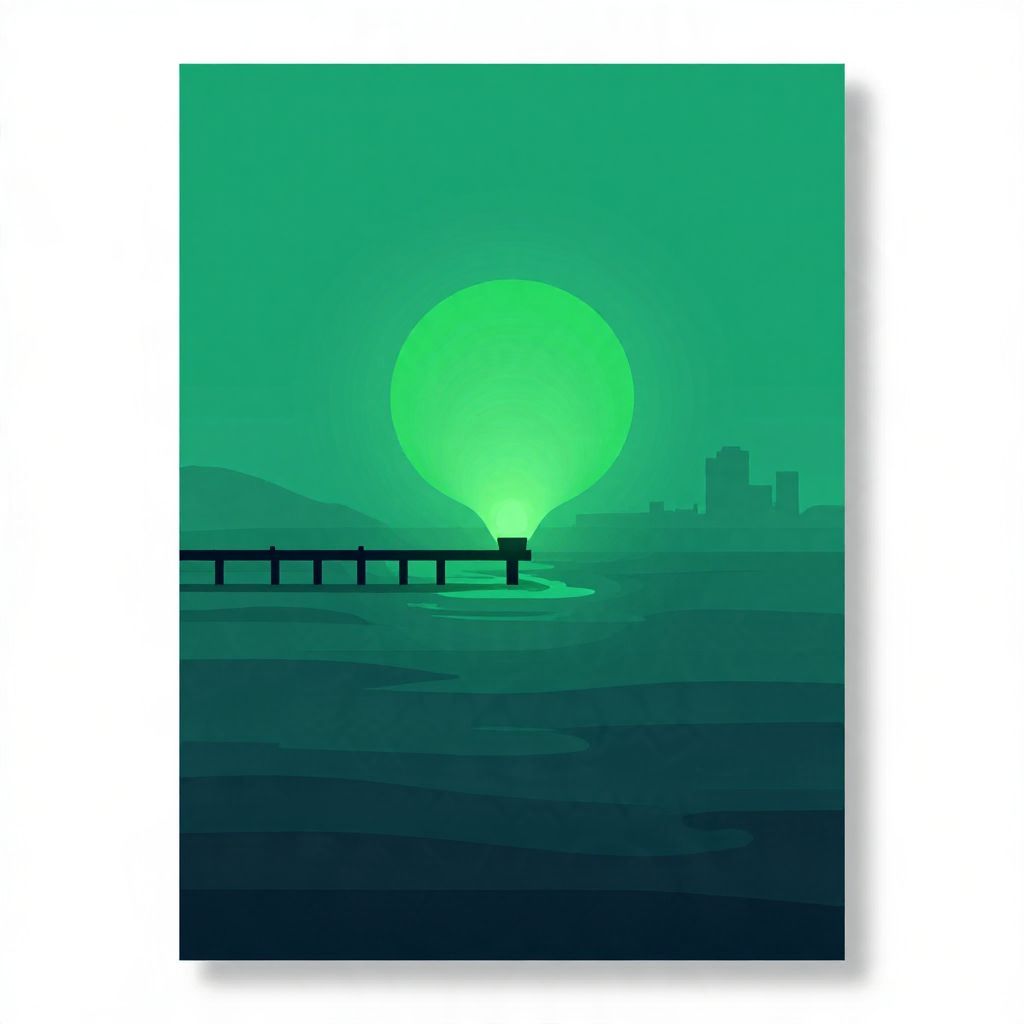
If you’re asking what the green light in The Great Gatsby means, you’re really asking how Fitzgerald turns a small, simple image into one of American literature’s most famous symbols. The green light appears across the bay from Gatsby’s mansion and becomes tied to longing, ambition, and the distance between desire and reality.
It is both a literal object in the novel and a layered literary symbol. Gatsby reaches toward it, but its meaning keeps shifting: hope, wealth, the future, and the impossibility of recovering the past.
What is the green light in The Great Gatsby?
The green light is a beacon visible from Gatsby’s dock, located across the water near Daisy Buchanan’s home. In the novel, it functions as a symbol of Gatsby’s yearning for Daisy and, more broadly, his dream of a better life. Fitzgerald uses it to show how desire can be powerful, idealized, and ultimately out of reach.
Why is the green light so important?
The green light matters because it condenses the novel’s central themes into one image. Gatsby’s dream is not only romantic; it is also social, emotional, and historical. The light represents the future Gatsby imagines, but it also reveals how he mistakes an ideal for something he can actually possess.
Gatsby’s longing for Daisy
On the most immediate level, the green light stands for Daisy herself. Gatsby has built much of his life around the hope of winning her back, and the light marks the physical direction of that hope. It is a visual reminder that Daisy is close enough to see, but not close enough to reach.
The American Dream
The symbol also extends beyond romance. Gatsby’s reinvention, wealth, and social ambition connect the green light to the broader idea of the American Dream. Fitzgerald suggests that the dream promises possibility, but it can become distorted by illusion, class barriers, and self-deception.
The future versus the past
Gatsby looks at the green light as though it contains a future he can claim. Yet the novel repeatedly shows that he is trying to recover the past rather than move into a new one. The light therefore becomes a symbol of forward-looking hope that is secretly rooted in nostalgia.
How Fitzgerald introduces the symbol
Fitzgerald first presents the green light early in the novel, when Nick notices Gatsby reaching toward it across the water. That gesture is crucial: it shows Gatsby as a man defined by desire before the reader fully understands his story. The symbol arrives before the full explanation, which gives it mystery and emotional weight.
A distant, visual image
Because the light is seen from afar, it naturally suggests separation. Fitzgerald does not describe it in a plain or practical way; instead, he makes it part of the novel’s atmosphere. The water, darkness, and distance all contribute to the sense that Gatsby’s dream is beautiful but fragile.
A symbol that grows over time
The green light does not mean only one thing. As the novel develops, its meaning expands from Daisy to aspiration itself. By the end of the book, it becomes a symbol of human striving, especially the tendency to reach for something just beyond our grasp.
Literary examples of the green light’s meaning
Fitzgerald uses the green light in several key ways throughout the novel. These moments do not simply repeat the same idea; they deepen it.
1. Gatsby reaching toward it
One of the most famous images in the novel is Gatsby standing alone at night, stretching toward the light across the bay. This moment captures the essence of his character: hopeful, romantic, and unaware of how impossible his dream may be. The gesture is small, but it carries enormous symbolic force.
2. The light near Daisy’s dock
Because the light is tied to Daisy’s property, it becomes linked to class and geography as well as emotion. Gatsby can see the world he wants, but he cannot simply cross into it. The bay becomes a boundary between aspiration and possession.
3. The final reflection on human striving
Near the end of the novel, the green light is no longer just Gatsby’s private obsession. Fitzgerald broadens it into a meditation on human desire, suggesting that people keep pursuing dreams even when those dreams are unreachable. In this sense, the light becomes one of the novel’s most philosophical symbols.
What the green light does not mean
It is easy to oversimplify the symbol, but the green light is not just “Daisy” and nothing else. It is also not merely a sign of money, though wealth is part of its meaning. Fitzgerald gives the image enough openness to support multiple interpretations without making it vague.
Not a straightforward happy symbol
The green light is often associated with hope, but the novel does not treat hope as purely positive. Gatsby’s hope is powerful, yet it is also based on illusion. That tension is what makes the symbol memorable: it is beautiful because it is tragic.
Not a guarantee of success
Gatsby’s dream is not fulfilled simply because he can see the light. In fact, the symbol often highlights the gap between seeing and having. Fitzgerald uses that gap to show how imagination can create emotional truth even when reality refuses to cooperate.
How the green light connects to major themes
The symbol sits at the center of the novel’s larger concerns. It helps Fitzgerald explore love, class, time, and illusion in a single recurring image.
- Desire: Gatsby’s longing is intense, focused, and almost spiritual.
- Class division: The light marks the distance between Gatsby’s world and Daisy’s inherited privilege.
- Illusion: Gatsby projects meaning onto the light, turning it into a dream object.
- Time: The symbol reflects Gatsby’s wish to recover what has already passed.
- Hope: Even when the dream is impossible, the act of reaching still matters.
Why the green light still resonates with readers
The green light endures because it captures a feeling many readers recognize: wanting something that seems just beyond reach. Fitzgerald gives that feeling a physical form, which makes it easier to see and harder to forget. The symbol works because it is both specific to Gatsby and universal in meaning.
A symbol of modern longing
In modern literature, symbols often carry psychological as well as social meaning. The green light does both. It reflects Gatsby’s inner life while also pointing to a culture built on aspiration, reinvention, and dissatisfaction.
Why it is so often discussed in class
Teachers and students return to the green light because it is an accessible entry point into the novel’s deeper ideas. It is easy to identify, but difficult to exhaust. That combination makes it ideal for literary analysis, essays, and discussion.
How to read the green light in context
If you want to understand the symbol well, it helps to read it in relation to Nick’s narration and the novel’s ending. Fitzgerald does not isolate symbols from character or plot; he embeds them in the emotional movement of the story.
- Notice when Gatsby looks at the light and what he seems to feel.
- Pay attention to how distance and water shape the image.
- Track how the light’s meaning changes as Gatsby’s dream becomes less realistic.
- Compare the symbol’s early meaning with its final, broader significance.
Quick definition
In The Great Gatsby, the green light is a symbol of Gatsby’s desire for Daisy and his larger dream of fulfillment. It also represents the American Dream, the passage of time, and the painful distance between imagination and reality.
Final takeaway
The green light matters because Fitzgerald makes one small image carry the emotional weight of the whole novel. It is a sign of hope, but also of limitation; a dream, but also a reminder that dreams can remain forever across the water.
If you want to keep exploring Fitzgerald’s ending and its meaning, you may also like how The Great Gatsby ends. For another look at symbolic storytelling in contemporary fiction, see our guide to The Eyes Are the Best Part.