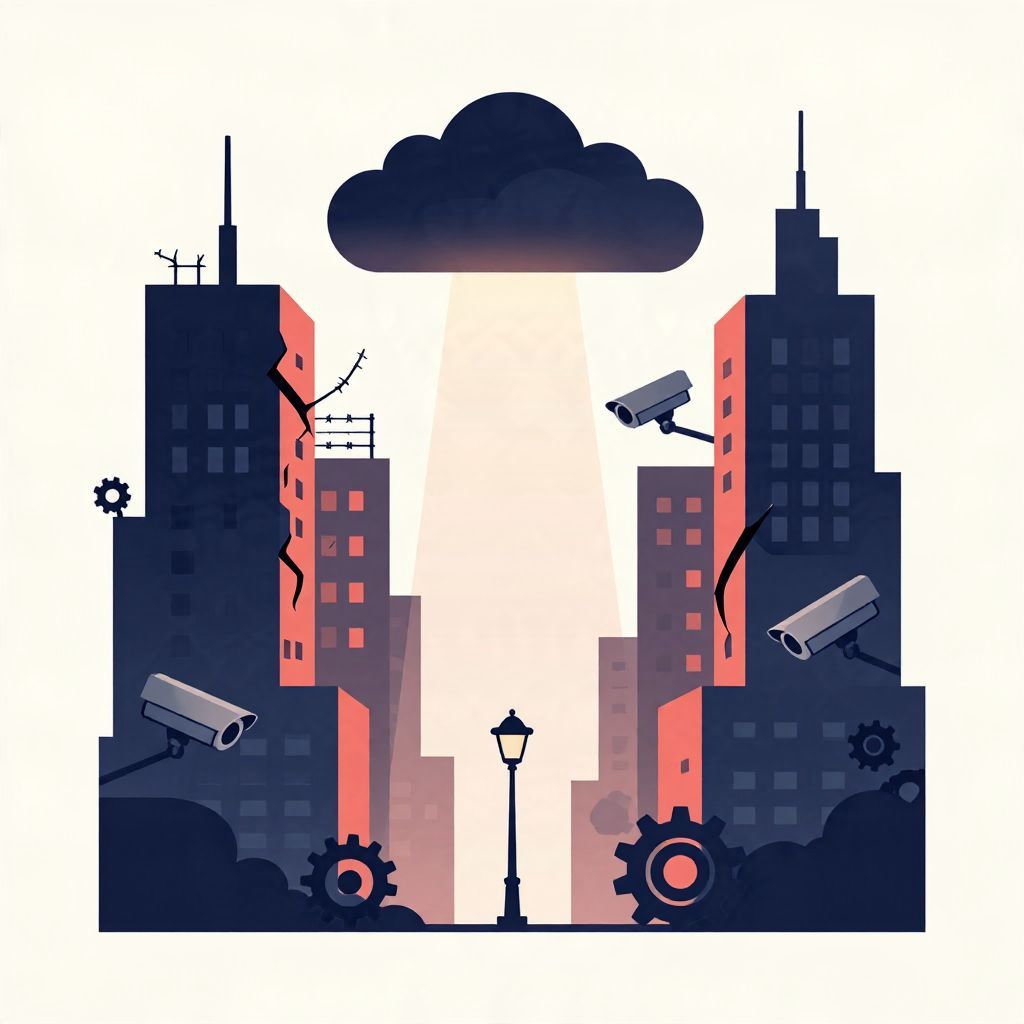
Have you ever wondered why some novels imagine futures that feel unsettlingly close to the present? A dystopian novel does exactly that: it builds a bleak imagined society to expose the dangers of political oppression, environmental collapse, social control, or unchecked technology.
These books are often suspenseful, but their deeper purpose is critical rather than escapist. They ask what happens when fear, surveillance, inequality, or propaganda become normal—and what it costs to resist.
What is a dystopian novel?
A dystopian novel is a work of fiction set in a society that appears flawed, oppressive, or dehumanizing, often under the control of a government, corporation, or social system that restricts freedom. Instead of imagining an ideal world, dystopian fiction shows how a society can go wrong and uses that setting to critique real-world problems.
How dystopian fiction works
Dystopian novels usually begin with a recognizable world that has been pushed to an extreme. The setting may feature constant surveillance, censorship, rigid class systems, environmental disaster, or the loss of personal identity.
What makes the genre powerful is that the imagined society rarely feels random. It is usually an exaggerated version of existing fears, which is why dystopian stories can feel both speculative and disturbingly familiar.
Common features of a dystopian novel
- Oppressive control by the state, elite class, or another powerful system
- Restricted freedom of speech, movement, thought, or choice
- Surveillance and propaganda used to maintain order
- Social inequality or strict class divisions
- A damaged environment or post-crisis world
- A protagonist who questions the system and faces consequences for doing so
Dystopian novel vs. utopian novel
Utopian fiction imagines a perfect or near-perfect society, while dystopian fiction presents the collapse, corruption, or dark underside of social order. In practice, the two genres are often connected: a dystopia may begin as a promised utopia that has gone wrong, or it may expose the hidden costs of a society that claims to be ideal.
This tension is one reason dystopian novels are so effective. They reveal how “order” can become oppression when it is enforced without freedom, empathy, or accountability.
Where did dystopian fiction come from?
Dystopian fiction developed as a modern literary genre alongside anxieties about industrialization, totalitarianism, war, and mass society. While earlier works imagined flawed societies, the genre became especially prominent in the twentieth century, when writers responded to censorship, authoritarian politics, and rapid technological change.
Many readers encounter dystopian fiction through major twentieth-century novels, but the genre continues to evolve. Contemporary dystopias often focus on climate crisis, media manipulation, genetic engineering, digital surveillance, and unequal access to resources.
Important literary context
- Political anxiety: fear of authoritarian rule, propaganda, and state violence
- Technological anxiety: concern about machines, data, and control systems
- Social critique: commentary on class, race, gender, conformity, or consumer culture
- Speculative warning: a future setting used to question present-day choices
Famous literary examples of dystopian novels
Several novels are especially important in the history of dystopian fiction. They are not the only examples, but they are among the most frequently studied because they show how flexible the genre can be.
1984 by George Orwell
Orwell’s novel is one of the best-known dystopian works in English literature. It depicts a totalitarian society built on surveillance, historical revision, and the control of language, making it a foundational text for discussions of political oppression and propaganda.
The novel’s lasting influence comes partly from its warning that power can reshape reality itself if it controls information, memory, and speech.
Brave New World by Aldous Huxley
Huxley’s novel presents a different kind of dystopia: one based less on fear and violence than on pleasure, conditioning, and conformity. Its society looks stable on the surface, but that stability depends on the suppression of individuality, deep emotion, and genuine freedom.
This contrast makes the novel especially useful for thinking about how comfort and entertainment can also function as tools of control.
Fahrenheit 451 by Ray Bradbury
Bradbury’s novel centers on censorship, anti-intellectualism, and the destruction of books. It remains a key dystopian text because it links the suppression of literature with the loss of independent thought and cultural memory.
Its central concern is not only that books are banned, but that a society can gradually lose the desire to read, question, or think deeply.
The Handmaid’s Tale by Margaret Atwood
Atwood’s novel imagines a theocratic regime that strips women of rights, identity, and bodily autonomy. It is often discussed as a feminist dystopia because it shows how power can be organized through reproduction, language, and religious ideology.
The novel’s impact lies in how carefully it connects private life to political domination.
The Hunger Games by Suzanne Collins
Although often read as young adult fiction, this series is also a dystopian critique of spectacle, inequality, and state power. Its world is divided by class and controlled through fear, entertainment, and public ritual.
The series helped bring dystopian fiction to a wider audience by combining political themes with fast-moving plot and a strong first-person perspective.
What themes do dystopian novels explore?
Dystopian fiction is not only about bleak settings. It uses those settings to explore ideas that matter in real life, especially the relationship between power and personhood.
Major themes in dystopian literature
- Freedom vs. control
- Individual identity vs. conformity
- Truth vs. propaganda
- Memory and history
- Technology and surveillance
- Violence, fear, and obedience
- Resistance and rebellion
Many dystopian novels also ask whether resistance is possible at all. Some end with hope, others with ambiguity, and some with defeat, but all of them test the limits of human agency under pressure.
Typical characters in a dystopian novel
Dystopian fiction often relies on a few recognizable character types, though individual novels vary widely in style and complexity.
Common character roles
- The dissenter: a protagonist who begins to question the system
- The enforcer: a character who helps uphold the regime
- The mentor: someone who reveals hidden truths or history
- The rebel group: a collective resisting oppression
- The symbol of the system: a leader, institution, or authority figure representing power
These roles are not formulas so much as tools. They help the author dramatize how people respond differently to fear, comfort, coercion, and moral compromise.
Symbols and literary techniques in dystopian fiction
Dystopian novels often depend on symbolism and controlled style to make their worlds feel coherent and unsettling. The details of setting are rarely decorative; they usually carry thematic meaning.
Common symbols
- Books as memory, freedom, or forbidden knowledge
- Eyes, cameras, or screens as surveillance
- Walls, fences, and borders as exclusion and confinement
- Uniforms as conformity and loss of individuality
- Fire, darkness, or silence as destruction, ignorance, or repression
Common techniques
- World-building that reveals the rules of the society gradually
- Irony, especially when official language hides cruelty
- Restricted narration that limits what the reader knows, mirroring the character’s uncertainty
- Allegory or political symbolism
- Satire in works that criticize social habits through exaggeration
Because the genre often focuses on systems rather than private life alone, dystopian writing can feel both intimate and political at the same time.
Why readers are drawn to dystopian novels
Dystopian fiction can be unsettling, but it remains popular because it turns abstract fears into vivid stories. Readers are often drawn to the genre for its suspense, moral urgency, and the way it makes social questions feel immediate.
These novels also invite comparison: they ask readers to think about what freedoms are easy to take for granted and what happens when institutions prioritize stability over humanity.
How to recognize a dystopian novel quickly
If you are unsure whether a book is dystopian, ask a few simple questions. Does the story imagine a society that is clearly worse than the present? Is that society controlled by fear, surveillance, censorship, or rigid rules? Does the plot involve a character discovering the truth about that system?
If the answer is yes to most of those questions, the book is likely dystopian or strongly dystopian in flavor.
Final takeaway
A dystopian novel is more than a dark future story. It is a literary warning, a political critique, and often a study of how people survive when freedom is narrowed and truth is threatened. That is why the genre continues to matter: it helps readers see the present more clearly by imagining what could happen if troubling trends go unchecked.
If you want to explore the genre further, you may also like what dystopian fiction is and why Fahrenheit 451 was banned.