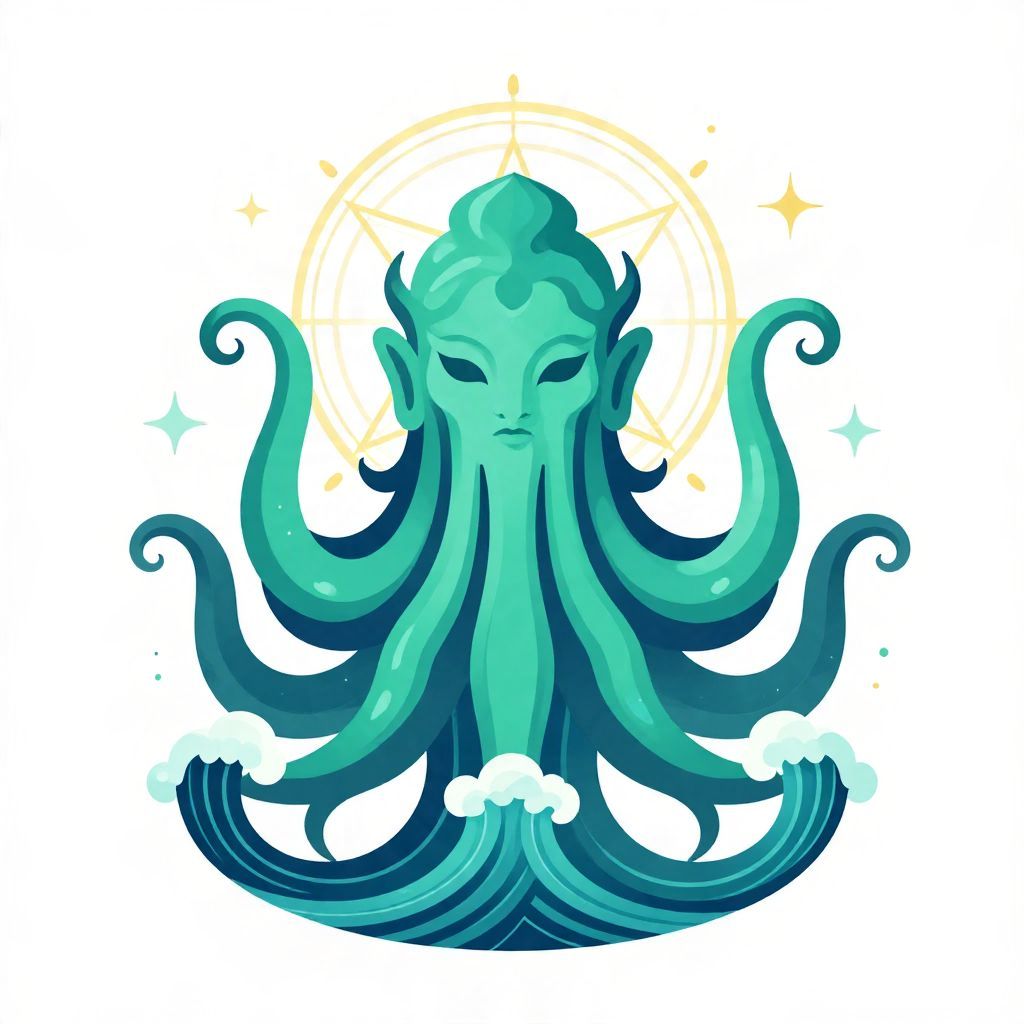
People often ask what Cthulhu is because the name appears everywhere in horror, gaming, and internet culture. The figure comes from H. P. Lovecraft’s fiction and has become shorthand for cosmic dread, ancient powers, and the feeling that humanity is small in a vast, indifferent universe.
In literary terms, Cthulhu is both a monster and a symbol. He is one of Lovecraft’s most famous creations, but the idea attached to him matters as much as the creature itself: forbidden knowledge, unstable reality, and terror that lies beyond human understanding.
What is Cthulhu in literature?
Cthulhu is a fictional cosmic entity created by H. P. Lovecraft, first introduced in the 1928 story “The Call of Cthulhu.” He is usually described as an ancient, sleeping being connected to a larger mythos of alien gods and cults. In literary analysis, Cthulhu represents the limits of human knowledge and the fear of encountering something utterly beyond comprehension.
Where did Cthulhu come from?
Cthulhu entered modern horror through Lovecraft’s short fiction, especially “The Call of Cthulhu,” which was published in Weird Tales. The story helped define what later readers and writers came to call the Cthulhu Mythos, a loose body of shared names, themes, and entities associated with Lovecraft and later authors.
Lovecraft’s literary context
Lovecraft wrote in the early twentieth century, when pulp magazines gave writers a place to experiment with strange, sensational, and unsettling stories. His fiction blended Gothic atmosphere, science-fiction ideas, and antiquarian detail, but his most lasting contribution was a new kind of horror: not the fear of ghosts or monsters alone, but the fear that reality itself is fragile.
Why the name became so famous
Cthulhu is memorable because the creature is never presented as a simple villain. The name has a strange, almost alien sound, and the being is linked to ancient ruins, secret cults, and dreams that disturb the mind. That combination made Cthulhu easy to adapt into later horror, parody, games, and popular culture.
What does Cthulhu look like?
Lovecraft’s descriptions present Cthulhu as a vast, hybrid creature with features that resist ordinary classification. He is often imagined with a humanoid outline, wings, tentacles, and a monstrous, nonhuman face, though the exact image is intentionally unstable. That instability is part of the effect: the reader is meant to feel that language cannot fully capture what is seen.
A creature beyond normal categories
Rather than fitting neatly into mythological or zoological language, Cthulhu is described through fragments and comparisons. This technique makes him feel less like a fantasy beast and more like an intrusion from outside human systems of thought.
What role does Cthulhu play in “The Call of Cthulhu”?
In Lovecraft’s story, Cthulhu is not introduced through direct confrontation alone but through a chain of clues: documents, testimony, dreams, and reports of strange cult activity. The narrative builds dread by suggesting that multiple people, separated by distance and experience, are circling the same terrifying truth.
Nonlinear storytelling
Lovecraft uses an investigative structure, piecing together the creature’s existence from archives and eyewitness accounts. This method gives the story a pseudo-documentary feel, as if the horror were discovered rather than invented, which strengthens its realism and suspense.
Dreams and hidden knowledge
Dreams matter in the story because they blur the line between inner life and cosmic event. Cthulhu is associated with psychic influence, suggesting that knowledge of the creature leaks into human consciousness before the creature itself is fully understood.
What themes are connected to Cthulhu?
Cthulhu is famous not just as a monster but as a literary symbol. Lovecraft’s work uses him to explore several recurring themes that define cosmic horror.
- Human insignificance — people are not the center of the universe.
- Forbidden knowledge — learning too much can destroy sanity or certainty.
- Ancient power — older forces exist outside human history.
- Unreliable perception — what people see or record may be incomplete or distorted.
- Cosmic indifference — the universe does not care about human morality or survival.
Cosmic horror explained simply
Cosmic horror differs from ordinary monster horror because the threat is not just physical. The deeper fear is metaphysical: the realization that humanity may be tiny, temporary, and unable to understand the true structure of reality.
Why is Cthulhu important in literary history?
Cthulhu became one of the defining images of twentieth-century horror because he helped establish a new vocabulary for dread. Later writers, filmmakers, game designers, and artists borrowed Lovecraft’s idea of ancient entities, secret cults, and reality-breaking knowledge. Even when they do not use Cthulhu directly, they often echo the style of horror he represents.
The Cthulhu Mythos
The term Cthulhu Mythos refers to the broader fictional universe associated with Lovecraft and later contributors. It is not a single tightly controlled series, but a network of related beings, books, places, and motifs. Cthulhu sits near the center of that network because he is one of the most recognizable and influential entities in it.
Influence beyond Lovecraft
Writers after Lovecraft expanded the mythos, while popular culture transformed Cthulhu into both a serious horror icon and a symbol of absurdity. That dual life is unusual: he can represent deep existential terror in one context and playful parody in another.
How should readers approach Cthulhu today?
If you want to understand Cthulhu as a literary figure, it helps to read him as an idea as much as a character. The creature matters because he dramatizes the fear that human beings are not equipped to comprehend everything they encounter.
Good entry points
- “The Call of Cthulhu” — the essential starting point for the character.
- Other Lovecraft stories with cosmic horror elements — useful for seeing how his themes develop across different works.
- Later mythos-inspired fiction — helpful for understanding how other writers adapted and reimagined the idea.
What to notice while reading
Pay attention to how Lovecraft builds atmosphere, withholds certainty, and uses scholarly or archival language to make the impossible seem plausible. Also notice how often the real horror comes from implication rather than action.
Cthulhu in comparison with similar literary figures
Cthulhu is sometimes compared with other supernatural or mythic beings, but he belongs to a distinct tradition. Unlike a traditional dragon, demon, or ghost, Cthulhu is not mainly a moral adversary. He is closer to a force of nature, except that he is intelligent, ancient, and profoundly alien.
How he differs from traditional monsters
- He is not defined by a single heroic conflict.
- He is tied to knowledge, dreams, and ancient history.
- He symbolizes scale, mystery, and cosmic instability.
Why readers still respond to him
Cthulhu remains powerful because he captures a modern anxiety: the fear that science, history, and perception may not be enough to make the world fully legible. That idea continues to resonate in literature because it turns uncertainty itself into the source of horror.
So, what is Cthulhu?
Cthulhu is Lovecraft’s iconic cosmic being, a fictional entity that embodies the terror of the unknown and the insignificance of humanity. He is best understood as both a creature in a story and a lasting literary symbol. If you read him in that way, you can see why he became one of horror’s most enduring names.
For readers interested in related literary mysteries and mythic horror, you may also enjoy what “The King in Yellow” means in literature and the story behind H. P. Lovecraft’s cat’s name.