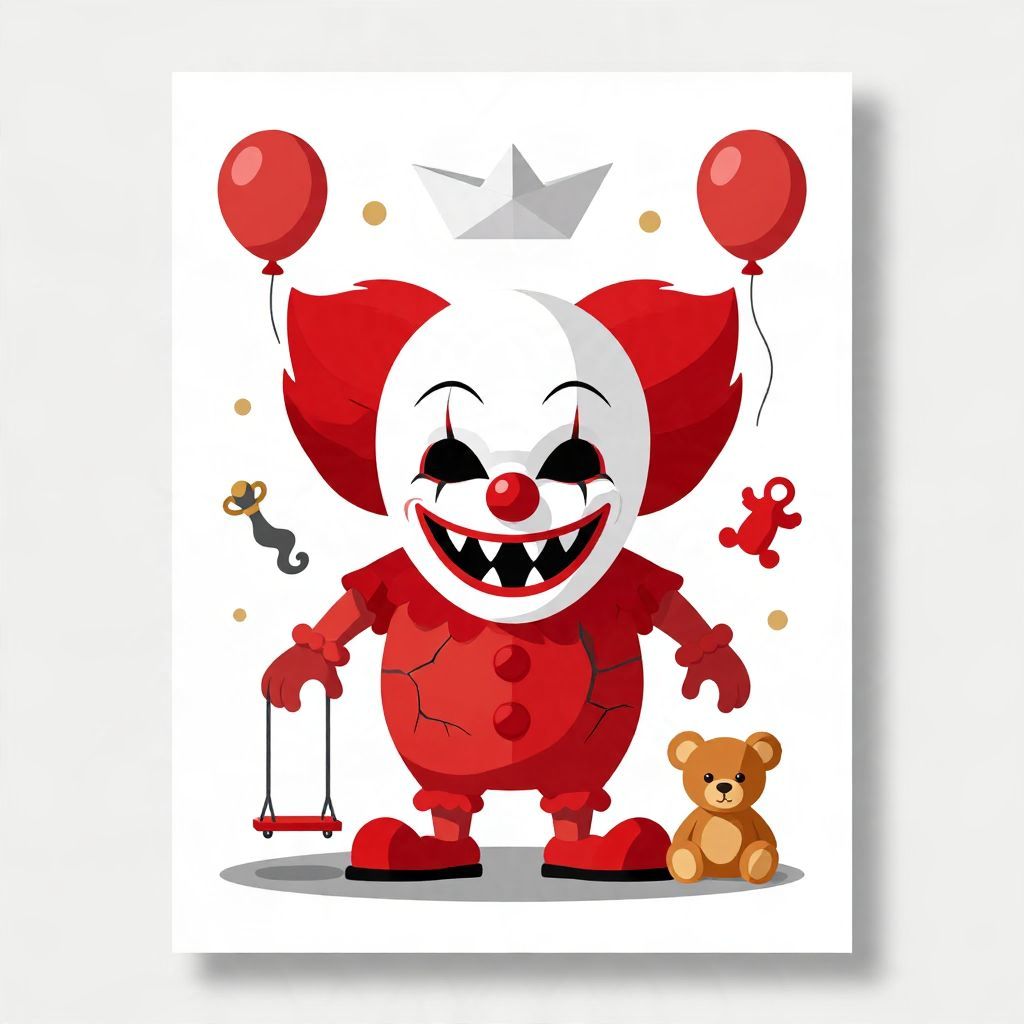
Readers often ask why Pennywise targets children so relentlessly in Stephen King’s It. The short answer is that the creature feeds on fear, and children are especially vulnerable to it. But the deeper answer is literary as well as monstrous: Pennywise chooses kids because they are easier to isolate, easier to terrify, and central to the novel’s themes of innocence, trauma, and the struggle to name what frightens us.
King turns that predatory logic into a larger story about growing up, memory, and the way evil hides inside ordinary life. Pennywise is not just a clown; it is a shape-shifting force that exploits weakness, and childhood fear gives it the strongest opening.
Why does Pennywise kill kids?
Pennywise kills children because they are the easiest and most emotionally powerful prey for IT, the ancient entity behind the clown disguise. In the novel, children’s fears are vivid, personal, and easier to manipulate, which lets Pennywise feed on terror while also weakening the bonds that could protect its victims.
What Pennywise wants from fear
In It, fear is not just a reaction; it is the creature’s food source. Pennywise draws power from panic, confusion, and the private terrors each child carries, which is why its attacks are so individualized and psychologically cruel.
Fear as nourishment
Stephen King presents IT as a predator that does not simply kill for survival in a human sense. It feeds on the emotional experience of fear first, then often destroys the victim afterward, making the fear itself the main point of the hunt.
Why children produce stronger fear
Children in the novel are still forming their understanding of the world, so their fears can feel enormous and inescapable. A basement, a drain, a photograph, or a clown can become a doorway into terror because a child’s imagination has fewer defenses against the unknown.
Why children are easier targets than adults
Pennywise’s attacks on kids are not random. King builds a world in which adults are often distracted, dismissive, or unable to see what is happening, while children are emotionally exposed and socially isolated.
Adults do not always notice the danger
One of the novel’s most unsettling ideas is that grown-ups frequently fail to register the threat at all. That failure makes children vulnerable, because the people who should protect them are often absent, skeptical, or trapped in their own routines.
Children are easier to separate from one another
Pennywise works best when its victims feel alone. The creature often uses shame, secrecy, and intimidation to cut children off from peers and adults, because isolation makes fear louder and resistance weaker.
Imagination cuts both ways
King also suggests that children’s imaginations make them both vulnerable and capable. Their fear is intense, but so is their ability to perceive the uncanny, which is why the Losers’ Club can recognize patterns that adults miss.
The role of childhood in It
The novel is not only about a monster attacking children. It is also about the experience of childhood itself: the mix of wonder, helplessness, cruelty, friendship, and sudden awareness that the world can be dangerous.
Coming-of-age and loss of innocence
Pennywise’s violence marks the point where childhood innocence is broken. The children in Derry are forced to confront realities that adults would rather ignore, and that confrontation becomes part of their passage into adulthood.
Memory and trauma
King uses the split structure of the novel to show how childhood trauma can be buried and then return years later. The adults who once fought Pennywise must remember what happened, and that act of remembering is tied to both pain and survival.
Friendship as protection
The Losers’ Club is crucial because it gives the children something Pennywise cannot easily break: collective trust. Their loyalty, shared language, and willingness to believe one another form the novel’s emotional counterforce to the creature’s isolation tactics.
Spoilers: what Pennywise really is
Major spoiler warning: Pennywise is only one form taken by IT, an ancient, otherworldly entity that predates the town’s modern history. The clown appearance is a mask chosen because it appeals to children and makes the creature seem approachable before it turns horrifying.
Why the clown disguise matters
The Pennywise persona is effective because it twists something meant to be playful into something predatory. Clowns are already associated with performance, masks, and exaggerated emotion, which makes the disguise especially disturbing in a story about hidden danger.
Shape-shifting and psychological attack
IT appears in forms that match each victim’s deepest fear. That means the clown is not the only terror in the book; it is simply the most recognizable face of a much larger threat that adapts itself to the mind it wants to break.
Why King makes the victims children specifically
From a literary standpoint, children are the ideal subjects for a horror story about fear because they make vulnerability visible. King uses that vulnerability to heighten suspense, but he also uses it to explore how evil preys on the powerless.
The contrast between innocence and corruption
The horror becomes sharper when it targets the young. By placing a monstrous force in the path of children, King emphasizes the violation at the heart of the story: something innocent is being invaded by something ancient, cruel, and hungry.
The town as a failed protector
Derry is not just a setting; it behaves like a system that allows harm to continue. The town’s indifference, denial, and cyclical forgetting create the conditions in which Pennywise can keep killing children over time.
Key themes connected to Pennywise’s killings
Pennywise’s attacks are tied to several of the novel’s most important themes. These themes help explain why the question “Why does Pennywise kill kids?” is really a question about the whole structure of It.
- Fear: the creature feeds on terror and uses each child’s private anxieties against them.
- Innocence: children represent a stage of life before the full understanding of evil.
- Isolation: Pennywise tries to separate victims from support, making them easier to destroy.
- Memory: the adults’ forgotten childhood experiences show how trauma can be buried and return later.
- Community: the Losers’ Club survives by trusting one another when the wider world fails them.
How Pennywise’s violence shapes the novel’s structure
King does not use Pennywise’s killings only for shock. The attacks create the emotional rhythm of the novel, moving between childhood and adulthood, memory and recurrence, fear and partial understanding.
Two timelines, one wound
The novel’s dual timeline shows that Pennywise’s threat does not end when the children grow up. Instead, the past remains active, and the adults must revisit what they once survived in order to confront it fully.
Horror as a way of showing buried pain
By making the killings both literal and symbolic, King turns horror into a language for trauma. Pennywise is frightening because it is a monster, but also because it externalizes the hidden fears people carry from childhood into adult life.
Why the question still matters to readers
People keep asking why Pennywise kills kids because the story feels more disturbing than a standard monster tale. The answer lies in the combination of supernatural appetite and human vulnerability: the creature wants fear, and children are where fear is most raw, most visible, and most painfully tied to innocence.
That is why Pennywise remains such an enduring figure in horror fiction. The clown is memorable, but the deeper reason for the killings is the novel’s central idea that evil often targets those least able to explain what is happening to them.
If you want to go deeper into Pennywise’s nature and family-like mythology, you may also like what Pennywise’s true form is and whether Pennywise has a daughter.