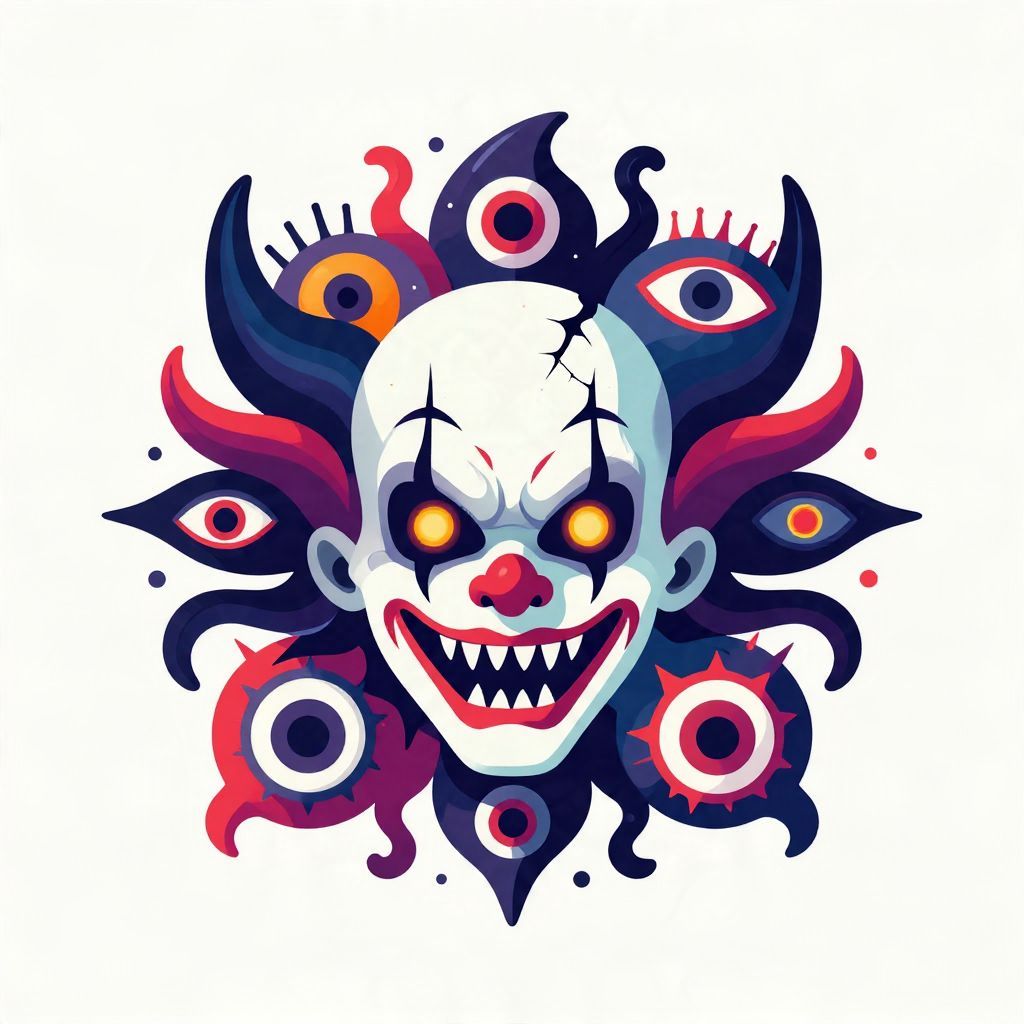
Readers often ask what Pennywise really is because the clown mask is only the surface of Stephen King’s monster. In It, Pennywise is a shape-shifting entity that feeds on fear, and the “true form” is less a fixed body than a cosmic, almost incomprehensible presence.
That ambiguity is part of the horror. King withholds a fully stable image of the creature, so every glimpse of its deeper nature feels partial, symbolic, and terrifying rather than neatly explained.
What is Pennywise’s true form in It?
Pennywise’s true form is not simply a clown, but an ancient, otherworldly entity often called It that can take many shapes. The clown persona is a lure designed to attract children, while its deeper nature is presented as something beyond ordinary human understanding, associated with fear, predation, and cosmic evil.
How Stephen King presents Pennywise’s real nature
King never reduces Pennywise to a single, ordinary monster. Instead, the novel frames the creature as a being that exists partly outside human reality, which is why its “true form” is difficult to describe in conventional terms.
The clown as a mask
Pennywise the Dancing Clown is the most recognizable face of the entity, but it is only one of many forms. The mask matters because it is approachable, familiar, and deceptively childish, making the horror more intimate.
The deeper entity behind the disguise
Behind the clown is a being that appears to draw power from terror itself. In the novel’s mythology, It is ancient, malevolent, and not fully knowable by human minds, which is why descriptions of its real form often feel fragmented or surreal.
Why the “true form” is so hard to define
Part of the answer lies in King’s use of cosmic horror. In this tradition, the most frightening forces are not those that can be neatly cataloged, but those that exceed human categories and resist complete explanation.
Fear as a shape-shifting principle
Pennywise does not merely choose disguises at random. It appears to manifest whatever will unsettle a victim most, which means the creature’s form is tied to psychology as much as to biology or anatomy.
Human limits of perception
When characters confront the creature’s deeper reality, their minds struggle to process it. That limitation is important: the novel suggests that the true form may be too vast, alien, or abstract for ordinary language to contain.
Literary examples of Pennywise’s shifting forms
Because the novel emphasizes transformation, Pennywise’s “true form” is best understood through examples of what it becomes. These shifts are not just plot devices; they reveal how the creature operates as a literary symbol.
- The clown — a friendly, childlike disguise that hides predation.
- Monstrous animals or creatures — forms that turn familiar life into threat.
- Personalized fears — manifestations shaped by a victim’s private anxieties.
- Abstract or incomprehensible visions — moments that suggest something beyond ordinary physical form.
What these forms mean
Each shape shows that Pennywise is less a single monster than a system of terror. The creature’s power comes from adaptability, which makes it feel omnipresent and impossible to fully defeat by ordinary means.
Spoiler note: the novel’s deeper revelation
Spoilers ahead. In the later parts of It, the story implies that Pennywise’s visible forms are only partial expressions of a much larger being. The full truth is intentionally strange and difficult to visualize, reinforcing the idea that the creature belongs to a realm beyond human comprehension.
The significance of the revelation
This revelation matters less as a literal monster manual than as a thematic statement. King uses the uncertainty of Pennywise’s form to stress that evil can be both personal and cosmic: it can wear a clown face, yet still feel ancient and immeasurable.
Why Pennywise works so well as a literary monster
Pennywise endures because the character combines several powerful horror traditions. The clown image is culturally unsettling on its own, but King deepens it by linking it to memory, childhood vulnerability, and a force that seems to predate the town of Derry itself.
Symbolism of childhood fear
Clowns are supposed to entertain, which makes Pennywise especially disturbing. The disguise twists something meant to be safe and playful into a source of danger, turning innocence into a trap.
Symbolism of hidden corruption
Pennywise also reflects one of King’s recurring concerns: the idea that evil can hide beneath ordinary surfaces. The monster’s true form is therefore not just a physical mystery, but a symbol of concealed violence and social denial.
Pennywise in the context of horror literature
King’s creature belongs to a long literary tradition of monsters that cannot be fully seen or named. Like other great horror figures, Pennywise becomes more frightening because the text leaves room for the reader’s imagination.
Cosmic and psychological horror combined
The novel blends external menace with internal fear. Pennywise is terrifying not only because it attacks bodies, but because it exploits memory, guilt, trauma, and childhood dread.
Why the lack of a fixed image matters
A fully detailed monster can sometimes lose power once explained. King avoids that trap by keeping Pennywise’s true form unstable, which preserves the sense that the creature is always larger than any one description.
Common questions readers ask about Pennywise
Is Pennywise’s true form a clown?
No. The clown is a disguise, not the creature’s essential nature. It is one of the forms Pennywise uses to lure victims, especially children.
Does the novel ever fully describe Pennywise’s real body?
Not in a simple, definitive way. The book suggests a deeper, alien reality, but it deliberately resists a neat visual description.
Is Pennywise human?
No. Pennywise is portrayed as a nonhuman entity, far older and stranger than a person in costume.
What readers should take from Pennywise’s true form
The most important thing to understand is that Pennywise’s true form is conceptual as much as physical. King uses the monster to explore fear, disguise, and the limits of human understanding, so the uncertainty is part of the design.
If you are comparing horror monsters in literature, Pennywise is a strong example of how a villain can be both memorable on the surface and deliberately unknowable underneath. For related reading on symbolic hidden forces in fiction, you may also enjoy what a Horcrux is and what transcendentalism is.