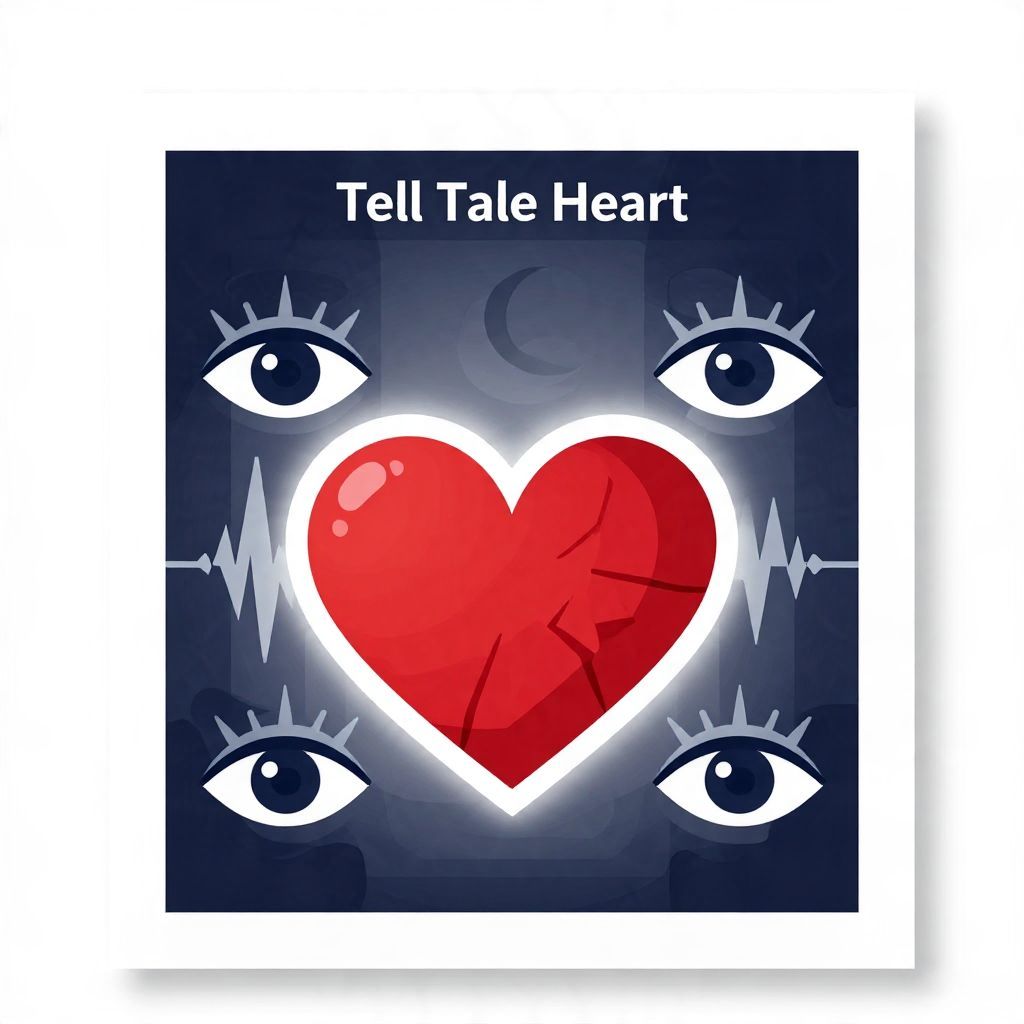
If you’re asking what is the theme of “The Tell-Tale Heart”, you’re really asking what Edgar Allan Poe is trying to reveal about guilt, madness, and the unstable mind of a narrator who insists he is sane. The story is short, but its power comes from the way it turns a murder confession into a psychological study.
Poe’s tale is often read as a classic example of Gothic fiction and psychological horror. Its central meaning is not just about a crime, but about the way guilt can distort perception, language, and self-justification.
What is the theme of “The Tell-Tale Heart”?
The main theme of The Tell-Tale Heart is guilt and psychological collapse. Poe shows how obsession, fear, and conscience can overwhelm a person’s mind, making the narrator unreliable and increasingly irrational. The story also explores the danger of trying to control what cannot be controlled: guilt, memory, and inner truth.
The central themes in “The Tell-Tale Heart”
Guilt and conscience
The narrator repeatedly insists that he is not mad, yet his frantic voice suggests the opposite. His confession becomes a dramatic example of guilt taking shape as sound, sensation, and panic. Even if the old man’s heart is not literally beating, the narrator experiences guilt as if it were audible and inescapable.
This is why the story feels so intense: Poe does not present guilt as a quiet feeling. He turns it into a force that grows louder until it destroys the narrator’s composure.
Madness and unreliable perception
Another major theme is madness, especially the breakdown of rational thought. The narrator claims that his heightened senses prove his sanity, but Poe uses that claim to show how distorted his thinking really is. He interprets ordinary details as signs of menace and treats his own obsession as evidence of control.
The story invites readers to question everything the narrator says. Because the tale is told entirely through his voice, the reader must separate his version of events from the likely reality behind them.
Obsession and fixation
The narrator’s fixation on the old man’s eye drives the plot. That obsession is less about the eye itself than about the narrator’s inability to tolerate what he imagines it represents. Poe uses this fixation to show how a single idea can dominate the mind and lead to violence.
Obsession in the story is not romantic or heroic; it is corrosive. It narrows the narrator’s world until all that remains is surveillance, fear, and murder.
Appearance versus reality
Poe also builds the story around the gap between appearance and reality. The narrator presents himself as calm, methodical, and intelligent, but his words reveal instability. Likewise, the old man appears harmless, yet the narrator projects menace onto him without clear justification.
This tension is one reason the story remains so effective in literary study. It asks readers to notice how easily appearances can be manipulated, both by characters and by language itself.
Why the story is considered a psychological horror classic
The Tell-Tale Heart is not frightening because of ghosts or monsters. It is frightening because the threat seems to come from inside the human mind. Poe creates horror through the narrator’s voice, which becomes more agitated, repetitive, and unstable as the story progresses.
The result is a deeply psychological form of terror. Instead of focusing on external danger, Poe makes the reader experience the narrator’s mental unraveling from the inside.
The unreliable narrator
The story is one of the best-known examples of an unreliable narrator. The narrator wants the reader to believe him, but his own language undermines his credibility. He overexplains, contradicts himself, and grows increasingly defensive.
That unreliability is not just a trick; it is the method through which the theme is delivered. The narrator’s inability to tell the truth about himself becomes the story’s central dramatic tension.
Sound as a symbol of guilt
Sound plays a crucial symbolic role in the story. The narrator hears the old man’s heart, or believes he hears it, and that sound becomes the final pressure that forces his confession. Whether the heartbeat is real or imagined, it functions as a symbol of guilt that cannot be silenced.
Poe’s use of sound also heightens the story’s emotional rhythm. The repeated references to hearing, listening, and noise make the narrator’s mind feel trapped by its own sensations.
Literary devices that support the theme
First-person narration
Poe tells the story in the first person, which places readers directly inside the narrator’s disturbed perspective. This technique creates intimacy, but it also limits what the reader can trust. We only know what the narrator chooses to reveal, and his version is shaped by fear and self-defense.
Repetition and escalating intensity
The narrator repeats key ideas and phrases, especially when trying to prove his sanity. That repetition creates a sense of strain, as if he is trying to convince himself as much as the reader. The language becomes more frantic as the story moves toward its ending.
Imagery of darkness and concealment
Darkness, secrecy, and hidden spaces reinforce the story’s mood. The murder is planned in the night, and the narrator carefully conceals the body beneath the floorboards. These details support the theme that guilt cannot truly be buried, even when a crime is physically covered up.
Irony
There is strong dramatic irony in the narrator’s certainty that he is rational. Readers can see that his “proofs” of sanity actually suggest the opposite. Poe uses this irony to make the story unsettling and intellectually sharp at the same time.
What does the old man’s eye symbolize?
The old man’s eye is one of the story’s most discussed symbols. It is often interpreted as a projection of the narrator’s fear, hatred, or paranoia rather than a literal source of evil. The narrator never gives a convincing reason for his fixation, which suggests that the eye matters less as an object than as a trigger for his disturbed imagination.
Some readers also see the eye as a symbol of judgment or exposure. The narrator may feel watched, seen, or morally judged, and his violence becomes a twisted attempt to escape that feeling.
How the ending reinforces the theme
The ending of The Tell-Tale Heart is essential to its meaning. After the murder, the narrator believes he has hidden every trace of the crime, but the sound of the beating heart overwhelms him and drives him to confess. The ending suggests that guilt is not erased by secrecy or cleverness.
It also confirms the story’s psychological focus. The final breakdown is not just a plot twist; it is the culmination of the narrator’s mental disintegration.
Does the heart really beat?
The story leaves that question open, and that ambiguity is part of its power. The sound may be supernatural, imagined, or a manifestation of the narrator’s conscience. Poe does not settle the issue because the uncertainty itself is thematically important: guilt can feel as real as any physical sensation.
Historical and literary context
Edgar Allan Poe published “The Tell-Tale Heart” in the 1840s, during a period when he was developing many of the techniques that would make him famous: compressed suspense, psychological intensity, and narrators whose minds cannot be fully trusted. The story fits squarely within Gothic literature, but it also anticipates modern psychological fiction.
Its lasting influence comes from that blend of atmosphere and analysis. Poe is not only telling a chilling story; he is examining what happens when fear and conscience take over the mind.
Common classroom interpretations of the theme
In school and literary study, the story is often discussed through a few recurring interpretive lenses:
- Guilt as punishment — the narrator punishes himself through confession.
- Madness as self-destruction — obsession leads to mental collapse.
- Unreliable narration — the narrator’s voice shapes and distorts the truth.
- Psychological projection — the narrator may project inner fear onto the old man’s eye.
These interpretations are not mutually exclusive. In fact, the story is strongest when read as a combination of all four.
Why the theme still matters today
The theme of The Tell-Tale Heart still resonates because it captures a very human fear: that we cannot fully escape our own minds. Poe shows how guilt can become louder than reason and how a person can construct a false sense of control while unraveling internally.
That is why the story remains widely taught and reread. Its horror is not only in the murder, but in the frightening possibility that the mind can become its own witness and judge.
Quick answer: what should readers remember?
If you need the theme in one sentence, it is this: “The Tell-Tale Heart” is about guilt, madness, and the destructive power of obsession. Poe uses an unreliable narrator, symbolic sound, and psychological suspense to show that hidden guilt eventually surfaces, whether as conscience, paranoia, or confession.
For more literary analysis, you may also enjoy a closer look at the theme of “The Tell-Tale Heart” and the themes of “The Cask of Amontillado”.