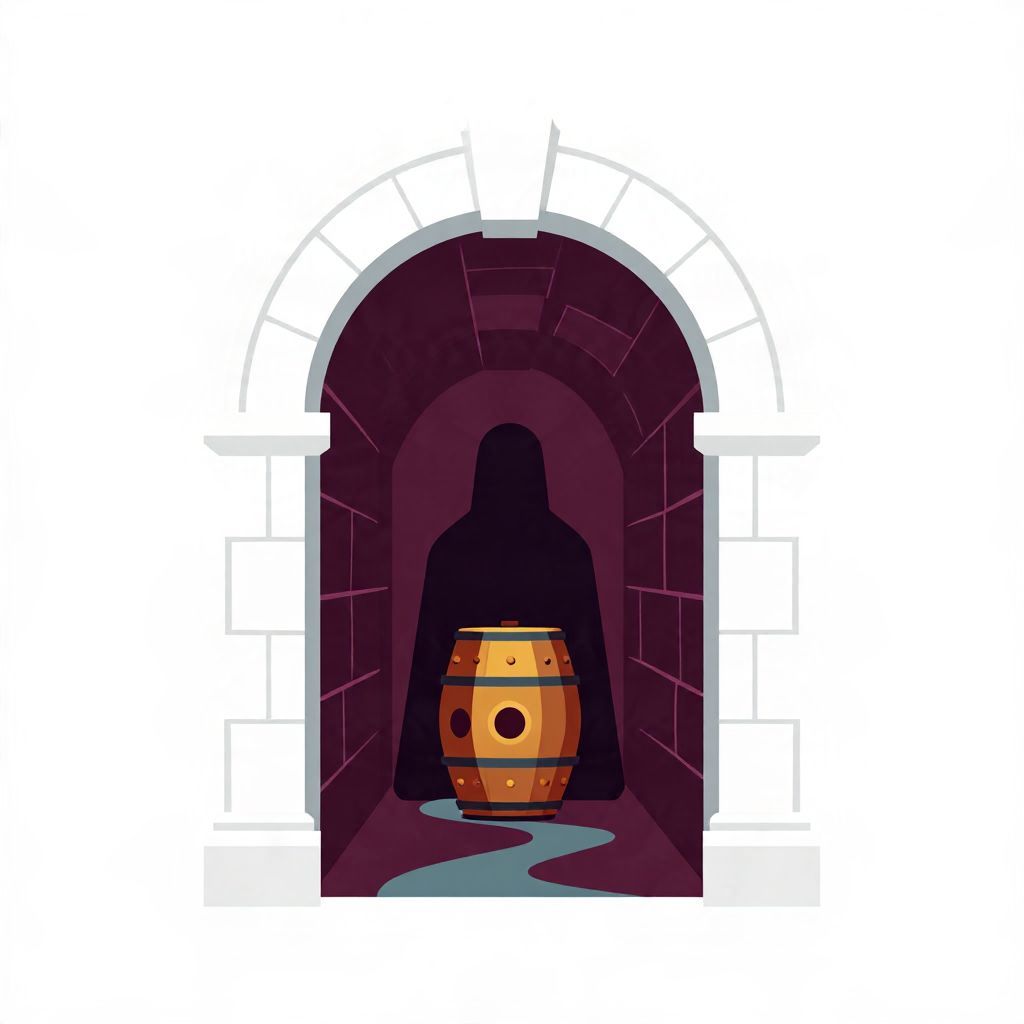
If you’re asking what is the theme of The Cask of Amontillado, the short answer is that Edgar Allan Poe’s story explores revenge, pride, deception, and the dark consequences of unchecked resentment. It is a tightly controlled tale in which every detail serves the narrator’s plan and the story’s chilling moral atmosphere.
Because the story is so compact, its theme emerges through symbolism, irony, and the narrator’s voice rather than through direct explanation. Poe leaves readers to weigh not only what happens, but why it happens—and what that reveals about human nature.
What is the theme of The Cask of Amontillado?
The central theme of The Cask of Amontillado is revenge consumed by pride. Montresor’s desire to punish Fortunato grows out of a perceived insult, and the story shows how obsession with vengeance can distort judgment, erase empathy, and turn a grievance into a moral catastrophe.
The main themes in Poe’s story
Revenge and its moral cost
Revenge drives the entire plot. Montresor does not seek justice through law or reconciliation; instead, he carefully engineers a private punishment that becomes increasingly cruel.
Poe presents revenge not as satisfying, but as corrosive. Montresor’s triumph is cold and final, yet the story’s atmosphere suggests spiritual and psychological ruin rather than victory.
Pride and wounded vanity
Pride shapes both men. Fortunato is proud of his connoisseurship and easily lured by the promise of rare wine, while Montresor seems deeply offended by an unnamed insult to his honor.
The story suggests that pride makes both characters vulnerable: Fortunato cannot resist proving himself, and Montresor cannot let humiliation go. Their vanity helps create the trap.
Deception and manipulation
Deception is one of the story’s most important themes because Montresor’s revenge depends on performance. He smiles, flatters, and pretends to act in friendship while leading Fortunato toward death.
This duplicity makes the story especially unsettling. Poe shows how language itself can become a weapon when trust is exploited for harm.
Isolation and psychological darkness
Much of the story takes place underground, in catacombs that mirror the moral descent of the narrator. The setting reinforces the theme of isolation: once Fortunato enters the vaults, he is cut off from help, and Montresor is cut off from conscience.
The physical descent into darkness reflects a deeper inward collapse. The story’s final image leaves readers with a sense of emotional and spiritual entombment.
How the story develops its theme
The unreliable narrator
Montresor tells the story himself, and that matters. He presents his actions as justified, but he never fully explains the insult he claims to avenge, which makes his account morally suspect.
Because readers hear only his version, they must judge his motives and credibility. This unreliability is essential to the theme, since it exposes how self-justification can mask cruelty.
Irony
Poe uses irony throughout the story. Fortunato believes he is being honored and consulted as an expert, when in fact he is being lured to his death.
The title itself is ironic, too. A cask of fine wine should suggest pleasure, taste, and celebration, but in the story it becomes a baited promise that leads to horror.
Symbolism
The catacombs symbolize burial, secrecy, and the hidden consequences of vengeance. The repeated references to dampness, bones, and darkness create a setting that feels like a physical manifestation of Montresor’s mind.
Even Fortunato’s costume, with its jester-like bells, can be read symbolically. It makes him look foolish and underscores how completely Montresor has turned him into a victim of mockery.
Key literary examples that reveal the theme
Montresor’s careful planning
Montresor’s detailed preparation shows that revenge is not impulsive here; it is deliberate and patient. He chooses the carnival season, when confusion and disguise are natural, and uses that social chaos to conceal his intentions.
This planning makes the theme more disturbing. The story is not about a moment of rage, but about sustained malice.
Fortunato’s weakness for flattery
Montresor repeatedly appeals to Fortunato’s vanity by pretending to doubt his expertise. Fortunato, eager to prove himself, insists on continuing deeper into the vaults despite signs of danger.
This dynamic illustrates how pride can be manipulated. Fortunato’s confidence becomes the very tool used against him.
The final walling-up
The most famous action in the story is the entombment itself. Montresor’s methodical sealing of the niche turns revenge into a literal act of burial, making the theme concrete and unforgettable.
The ending is horrifying not only because of the violence, but because it is so controlled. Poe emphasizes the chilling emptiness of revenge when it is carried through without remorse.
Why the ending matters to the theme
The ending is crucial because it reveals the emotional truth of the story. Montresor completes his revenge, but the narrative offers no sense of healing, justice, or closure—only silence.
His final words, spoken years later, suggest that the memory still lingers, but Poe does not clearly tell us whether that memory is guilt, pride, or both. That ambiguity keeps the theme open to interpretation while preserving the story’s moral unease.
Common interpretations of the theme
Revenge as self-destruction
One common reading is that Montresor’s revenge destroys him as much as it destroys Fortunato. Even if he survives physically, his identity becomes bound to the act of murder and the memory of it.
The instability of honor culture
Another interpretation focuses on honor and insult. In this view, Poe criticizes a social code in which reputation matters more than human life, making violence seem like an acceptable response to offense.
The pleasure of cruelty
Some readers see the story as exposing a sadistic streak in Montresor. His calmness, his patience, and his relish in controlling Fortunato suggest that revenge may be less about injury than about power.
These interpretations are not mutually exclusive. Poe’s story is rich enough to support several readings at once, which is part of why it remains so memorable.
Characters and what they represent
- Montresor represents calculated vengeance, wounded pride, and the dangers of self-justification.
- Fortunato represents vanity, vulnerability, and the danger of overconfidence.
- The unnamed insult functions as a narrative gap, reminding readers that Montresor’s motive may be exaggerated or distorted.
Because the story is so short, the characters are less like fully developed psychological portraits and more like forces in a moral drama. That compression is part of Poe’s power.
Why The Cask of Amontillado still matters
Poe’s story endures because it captures a universal human problem: how easily hurt feelings can harden into obsession. Its theme remains relevant in any context where resentment, pride, and the desire to “get even” override empathy.
It is also a masterclass in short-story craft. In a few pages, Poe builds suspense, develops character through dialogue, and delivers a theme that feels both specific and timeless.
Quick takeaway
If you need a concise answer, the theme of The Cask of Amontillado is that revenge, when fueled by pride and deception, becomes a destructive force that dehumanizes both the victim and the avenger. Poe makes that idea vivid through irony, symbolism, and an unreliable narrator.
If you’d like to compare Poe’s revenge story with other classic works built around moral tension and deadly conflict, you may also enjoy what is the theme of “The Lottery” and what is the theme of “The Most Dangerous Game”.