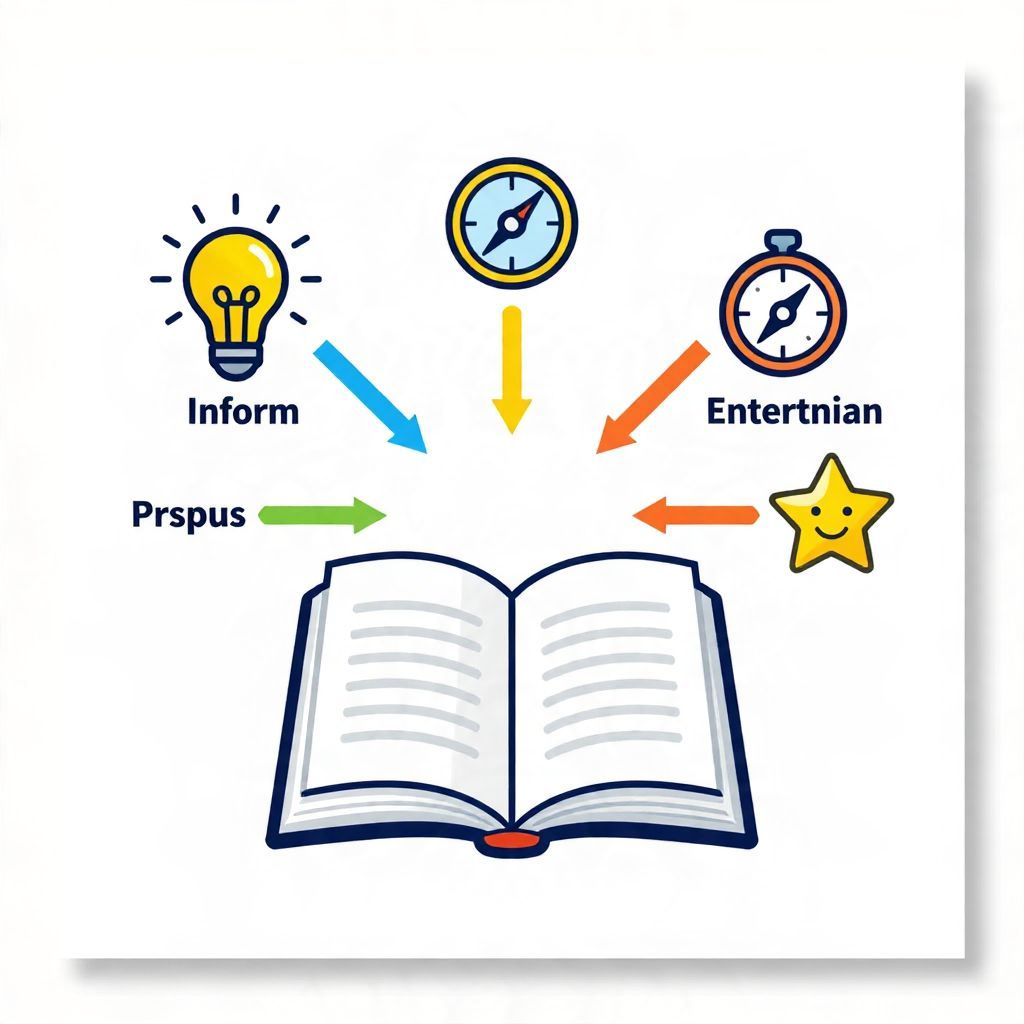
If you’ve ever wondered what a writer is trying to do beyond simply telling a story, you’re really asking about author’s purpose. It’s one of the most useful ideas in reading and literary analysis because it helps explain why a text exists, what it aims to achieve, and how its language and structure support that aim.
In plain terms, author’s purpose is the reason an author writes a text. That purpose may be to inform, persuade, entertain, explain, criticize, or explore an idea, and many works combine several purposes at once.
What does author’s purpose mean?
Author’s purpose means the writer’s main goal in creating a text. In literature, it refers to the intended effect on the reader and the larger reason the work was written, whether that is to share information, shape opinion, tell a story, or express a theme.
Why author’s purpose matters in reading
Understanding purpose helps readers move beyond “what happens” and into “why it matters.” It can reveal why an author chooses a certain tone, point of view, structure, or genre.
For students, this idea is especially important because it connects reading comprehension with literary analysis. Once you identify purpose, you can better explain how the text works and why particular details are included.
Common reasons authors write
- To inform — to present facts, ideas, or explanations.
- To persuade — to influence the reader’s beliefs or actions.
- To entertain — to engage, amuse, or emotionally involve the reader.
- To explain — to clarify a process, concept, or viewpoint.
- To express — to communicate feelings, experiences, or artistic vision.
- To critique — to question, challenge, or comment on society, politics, or human behavior.
How to identify an author’s purpose
There is no single formula, but several clues usually point to purpose. Look at the title, genre, audience, tone, structure, and repeated ideas. Ask what the author seems to want the reader to think, feel, understand, or do.
Questions to ask while reading
- What is the text mainly trying to accomplish?
- Is the author more interested in facts, feelings, arguments, or storytelling?
- What tone does the writer use: serious, humorous, urgent, reflective, critical?
- What ideas or messages are repeated?
- Who seems to be the intended audience?
Text features that reveal purpose
Writers often signal purpose through their choices. A persuasive essay may use evidence and emotional appeals, while a novel may use character conflict, symbolism, and setting to explore a theme.
Even nonfiction can have a literary purpose beyond information. A memoir, for example, may aim to record events, but it may also examine identity, memory, or loss.
Author’s purpose in different kinds of writing
In nonfiction
In nonfiction, author’s purpose is often easier to spot because the writer may be trying to teach, explain, report, or argue. Still, nonfiction can be shaped by voice and perspective, so purpose is not always purely factual.
In fiction
In fiction, purpose is often layered. A novel may entertain readers while also exploring moral questions, social issues, or the complexity of human relationships.
For example, a story about a family conflict may not be only about the plot itself. It may be examining forgiveness, class, generational change, or the limits of communication.
In poetry
Poetry often has a more concentrated purpose. A poem may aim to capture a mood, compress an insight, or create a striking emotional or sensory experience.
Because poetry is often indirect, readers may need to pay close attention to imagery, rhythm, repetition, and metaphor to understand what the poet is trying to do.
Author’s purpose and theme: what’s the difference?
These two terms are related, but they are not the same. Author’s purpose is the writer’s reason for creating the text, while theme is the central idea or message that emerges from the work.
For example, an author may write a novel to entertain readers and to explore the theme of ambition. The purpose is the broader intention; the theme is one of the ideas the text communicates.
A simple way to tell them apart
- Purpose = why the author wrote it.
- Theme = what the work says about life, people, or society.
Examples of author’s purpose in action
It is helpful to think of purpose as something visible in the text rather than as a hidden secret. You can infer it from patterns in language and structure.
Example 1: A historical article
A historical article may be written to inform readers about an event, explain its causes, and place it in context. If the author also highlights the consequences of that event, the purpose may include encouraging deeper understanding of history’s impact.
Example 2: A persuasive speech
A speech about environmental protection may aim to persuade listeners to change behavior or support a policy. The writer might use statistics, vivid examples, and emotional appeals to strengthen that purpose.
Example 3: A novel
A novel about a young person leaving home may entertain through plot and character, but it may also explore independence, identity, and the tension between personal desire and family expectation.
How author’s purpose shapes literary techniques
Purpose influences nearly every craft decision a writer makes. The choice of narrator, the pacing of scenes, the use of symbols, and the level of detail all help support what the author wants the text to do.
Common techniques linked to purpose
- Point of view — shapes what the reader knows and how closely they experience events.
- Tone — guides the reader’s emotional response.
- Imagery — creates atmosphere and deepens meaning.
- Symbolism — adds layers of interpretation.
- Repetition — emphasizes key ideas.
- Structure — controls how information or emotion unfolds.
When readers ask about author’s purpose, they are often noticing these techniques without naming them yet. Literary analysis gives those observations a vocabulary.
Author’s purpose in classroom reading
Teachers often ask students to identify author’s purpose because it builds close reading skills. It encourages readers to support interpretations with evidence rather than relying on first impressions alone.
In many assignments, the best answer is not just one word like “to entertain” or “to inform.” Strong responses explain how the text combines purposes and how specific details support that reading.
A stronger response includes evidence
Instead of saying, “The author’s purpose is to persuade,” a more complete answer might say, “The author’s purpose is to persuade readers to care about the issue by using emotional examples, direct address, and repeated warnings.”
Common mistakes when identifying author’s purpose
One common mistake is confusing the author’s purpose with the reader’s reaction. A text may make you laugh, but that does not mean its only purpose is humor.
Another mistake is assuming every text has just one purpose. Many works are multi-layered, especially literature, which can entertain, question, and reveal at the same time.
Watch out for these oversimplifications
- Assuming nonfiction is always objective and fiction is always symbolic.
- Reducing a complex novel to a single message.
- Ignoring tone, audience, and genre.
- Confusing theme, purpose, and moral.
Why author’s purpose is useful beyond school
This concept matters in everyday reading too. It helps you evaluate news, social media, advertisements, essays, and books more carefully.
When you can ask why a text was written, you become a more attentive reader. You are less likely to accept language at face value and more able to notice bias, emphasis, and rhetorical strategy.
Quick summary: what author’s purpose means
In short, author’s purpose is the reason a writer creates a text and the effect they hope to have on readers. It may be to inform, persuade, entertain, explain, express, or critique, and it often works alongside theme, tone, and literary technique.
Once you know how to identify it, author’s purpose becomes a powerful tool for understanding both simple texts and complex literature. It turns reading into a more active, thoughtful process.
For more on how writers shape meaning, you may also enjoy what storytelling means in literature and ethos in literature.