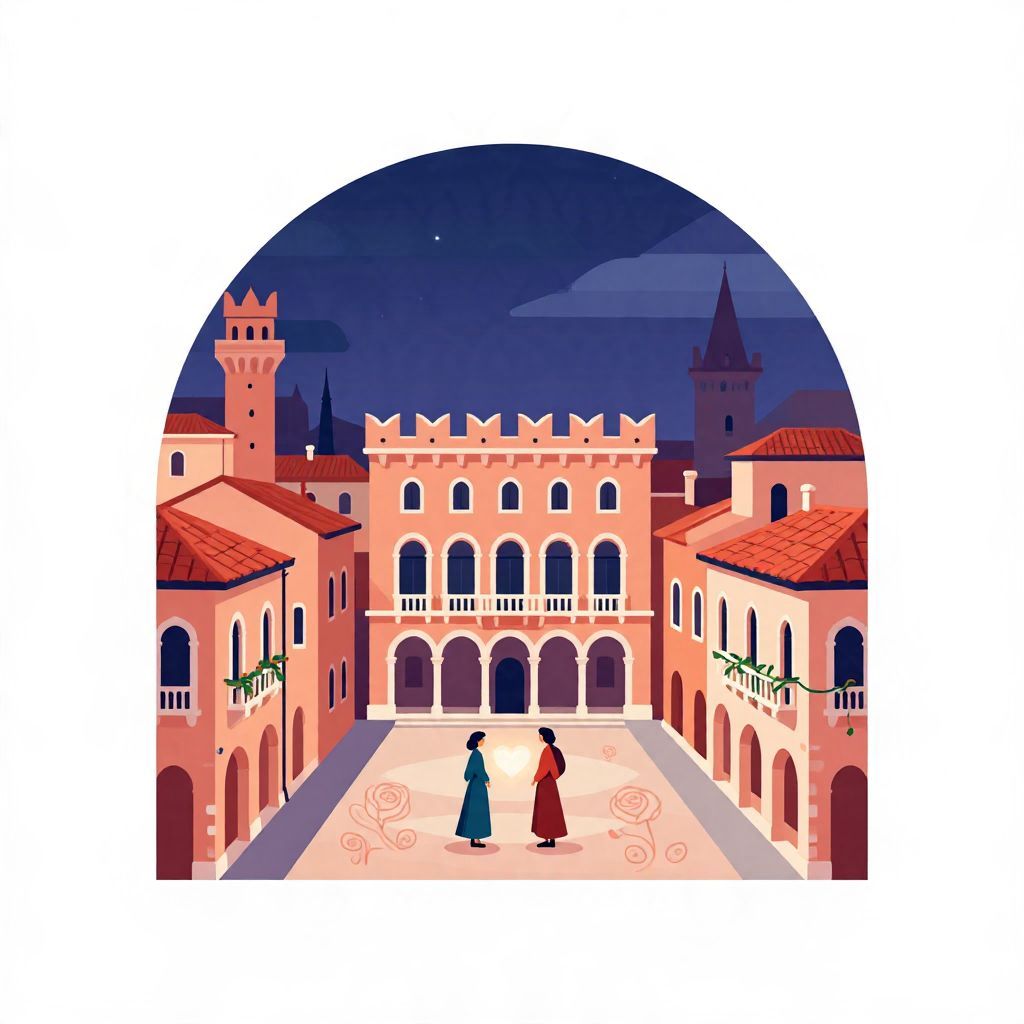
When readers ask where Romeo and Juliet take place, they are usually looking for the story’s setting as well as the real-world inspiration behind it. Shakespeare places the tragedy in Verona, Italy, with key scenes also set in nearby Mantua. The play’s setting is both specific and stylized, blending a recognizable Italian city with dramatic fiction.
That mix matters because the location shapes the play’s mood, conflict, and sense of fate. Verona is not just a backdrop; it is a city divided by family hatred, public violence, and private longing.
So, where did Romeo and Juliet take place?
Romeo and Juliet takes place mainly in Verona, Italy, with a later section in Mantua. Shakespeare sets the feud between the Montagues and Capulets in Verona’s streets, homes, and public spaces, then moves Romeo to Mantua after he is banished. The setting helps create the play’s tension between love, danger, and social conflict.
Why Verona matters in the play
A city of public conflict
Verona is the center of the feud, so the setting is not neutral. The city’s streets become places where private family hatred spills into public life, especially in the opening scenes with servants, citizens, and the feuding households.
Shakespeare uses the city to show how violence spreads beyond the two families. Even ordinary spaces feel unstable because the social order has been weakened by repeated conflict.
A setting that supports the tragedy
Because the lovers live in a city ruled by rivalry, every meeting carries risk. Verona’s structure as a crowded, divided urban space makes secrecy necessary and raises the stakes of each encounter.
The setting also reinforces the play’s tragic irony: the lovers are surrounded by people, yet they are isolated by circumstance. Their love grows in a place that does not allow it to flourish openly.
What parts of the story happen in Verona?
Key Verona locations in the play
- Public streets — where the feud erupts and the conflict becomes visible to the wider community.
- The Capulet home — site of the party where Romeo and Juliet first meet.
- Friar Laurence’s cell — a private space for plans, advice, and secret marriage.
- Juliet’s chamber — where some of the play’s most intimate and emotionally intense scenes occur.
These locations show how the play moves between public danger and private love. Shakespeare repeatedly contrasts noisy, hostile spaces with quiet, hidden ones.
Why does the play move to Mantua?
Romeo’s banishment changes the geography of the story
After Romeo kills Tybalt and is banished from Verona, he goes to Mantua. This shift matters because it physically separates him from Juliet and turns distance into one of the play’s central obstacles.
Mantua functions less as a vivid social setting and more as a place of exile. It represents separation, uncertainty, and the fragile hope that the lovers might still reunite.
How Mantua affects the ending
The tragedy deepens because communication between Verona and Mantua fails. Messages are delayed, and Romeo receives false news that leads him back to Verona under tragic circumstances.
In this sense, the move to Mantua is not just a change of location. It is a structural device that drives the final catastrophe.
Is Verona a real place or a fictional one?
Verona is a real city in northern Italy, and Shakespeare chose a real location rather than inventing a completely imaginary one. However, the play’s Verona is not a documentary portrait of the city. It is a dramatic version shaped to serve the story.
That means readers should think of the setting as historically inspired, not strictly realistic. Shakespeare uses Italy as a recognizable and evocative backdrop, but the play is more interested in emotional truth than geographic accuracy.
Historical and literary background of the setting
Why Shakespeare may have chosen Italy
Italian settings were common in Renaissance literature and drama. They often suggested passion, political tension, and social complexity, all of which suit Romeo and Juliet very well.
Italy also carried literary prestige for English audiences familiar with stories of love and conflict set there. Verona, in particular, gave Shakespeare a strong urban setting associated with family honor and civic unrest.
The source tradition behind the play
Shakespeare did not invent the basic story from scratch. The tale of two lovers from feuding families had appeared in earlier versions before his play, and he adapted that material into a more emotionally powerful tragedy.
The setting of Verona helped anchor the story in a believable world while allowing Shakespeare to heighten the drama through language, pacing, and contrast.
How the setting shapes the play’s themes
Love versus social division
One of the play’s strongest themes is the clash between personal feeling and social structure. Verona is divided by family loyalty, and that division makes the lovers’ relationship seem both urgent and impossible.
The setting therefore becomes symbolic. The city itself reflects a world where inherited conflict controls individual lives.
Fate, timing, and confinement
The geography of the play also supports the theme of fate. Characters are often trapped by where they are, who they can reach, and how quickly information travels.
Streets, walls, doors, and distance all matter. In a story where timing is crucial, the physical setting becomes part of the tragedy.
Public life versus private desire
Shakespeare repeatedly places intimate emotions in public or semi-public spaces. The lovers try to create a private world inside a city that keeps intruding on them.
This tension makes the setting feel active rather than decorative. Verona is not just where the story happens; it is one of the forces working against the couple.
Common questions about the setting
Was the play set in medieval Verona?
Shakespeare does not give a precise historical date, and the play should not be read as a careful historical reconstruction. It draws on an Italian past that feels medieval or Renaissance-like, but the exact period is not the focus.
Does the setting affect the mood?
Yes. Verona contributes to the play’s atmosphere of beauty mixed with danger. The city feels romantic, but that romance is shadowed by violence, secrecy, and loss.
Why do readers remember the setting so strongly?
Because the setting and the action are tightly linked. The feud, the secret marriage, the banishment, and the final misunderstanding all depend on place. The story would feel very different if it were not rooted in Verona and Mantua.
Quick takeaway
Romeo and Juliet takes place mainly in Verona, Italy, with Mantua as Romeo’s place of exile. Shakespeare uses these locations to intensify the feud, isolate the lovers, and turn geography into part of the tragedy. If you want to explore more about the play’s timeline and characters, you may also like when Romeo and Juliet takes place and how old Romeo and Juliet are.