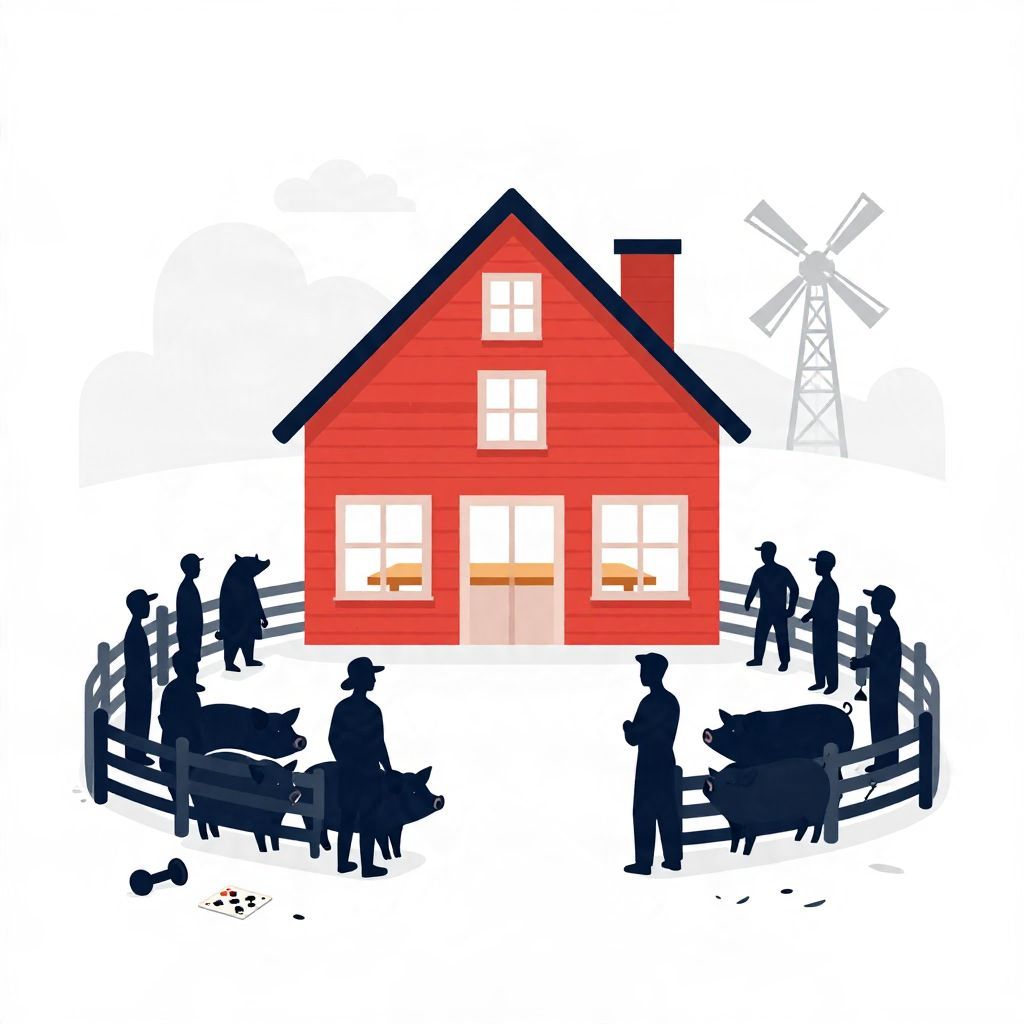
If you’re asking how does Animal Farm end, the short answer is that the pigs fully take over the farm, abandon the revolutionary ideals they once promised, and become indistinguishable from the humans they replaced. George Orwell’s ending is deliberately bleak: it shows how power can corrupt a political movement until its language, values, and leaders are transformed beyond recognition.
The final chapter is not just a plot twist; it is the book’s sharpest warning. Orwell uses the ending to expose betrayal, propaganda, and the fragility of collective memory, making Animal Farm one of the most enduring political allegories in modern literature.
How does Animal Farm end?
At the end of Animal Farm, the pigs have become the new ruling class and are no longer meaningfully different from the humans. Napoleon and the other pigs walk on two legs, dress like people, trade with human farmers, and even change the farm’s laws to suit themselves. The novel closes with the animals looking from pig to human and back again, unable to tell them apart.
Spoiler-filled ending summary
Major spoilers ahead. By the final chapters, the Seven Commandments have been steadily rewritten, and the pigs justify every betrayal as necessary for the farm’s survival. Boxer, the loyal workhorse, has already been taken away after collapsing from overwork, and his fate confirms how completely the leadership has abandoned the animals it claimed to protect.
The pigs and humans meet at the final banquet
In the closing scene, the pigs host a dinner with neighboring human farmers. They drink, gamble, and negotiate as equals, which is exactly what the rebellion once rejected. Napoleon announces that the farm will now be called The Manor Farm again, symbolically restoring the old order.
This reversal matters because it shows that the revolution has not merely failed; it has recreated the same hierarchy under a new name. Orwell’s point is that revolutions can be emptied of their ideals when leaders become self-serving and unaccountable.
The last commandment is effectively erased
Earlier in the novel, the commandments were meant to preserve equality among the animals. By the end, however, the rules have been altered so often that they no longer protect anyone except the pigs. The famous final statement—“All animals are equal, but some animals are more equal than others”—captures the absurd logic of authoritarian power.
That line is the novel’s most famous example of ironic language. It sounds like a law, but it is actually a contradiction, revealing how propaganda can make oppression seem normal.
The final image: pigs and men are the same
The ending image is one of Orwell’s most memorable. The animals outside the farmhouse watch the pigs and humans play cards, then look from one to the other and can no longer distinguish them. The revolution has come full circle.
This final scene functions as a circular structure: the story begins with oppression by humans and ends with oppression by pigs. The change in rulers does not produce freedom, only a new version of domination.
What the ending means
Power corrupts revolutionary ideals
The ending suggests that political ideals are not enough on their own. Without accountability, education, and resistance, a revolution can be captured by those who are most willing to manipulate it. Napoleon’s rise shows how a leader can use fear, force, and misinformation to concentrate power.
Orwell does not argue that all revolutions are doomed in exactly the same way, but he does warn that slogans and promises can be hollow if the people in charge control the truth.
Propaganda replaces memory
Throughout the novel, the pigs rewrite history and reshape language to keep the other animals obedient. By the end, many animals are too exhausted or confused to remember how the rebellion began. That loss of memory is crucial: if the animals cannot compare the present to the past, they cannot recognize betrayal.
This is why Squealer is so important to the ending. He helps turn lies into official truth, showing how propaganda works best when people are tired, isolated, or afraid.
The ending is tragic, not surprising
Although the final scene is shocking, it is also carefully prepared. The pigs’ small privileges grow gradually, the commandments are quietly changed, and dissent is crushed early. Orwell builds the ending step by step so that the final betrayal feels inevitable.
That slow escalation is part of the novel’s power. The ending does not come out of nowhere; it reveals the full meaning of everything that came before it.
Key characters in the ending
Napoleon
Napoleon is the central figure in the ending and the clearest symbol of authoritarian rule. By the final chapter, he has moved far beyond the original rebellion’s principles and rules through intimidation rather than persuasion.
Squealer
Squealer acts as the regime’s mouthpiece. He explains away contradictions, softens bad news, and turns obvious exploitation into something supposedly necessary for the common good.
Boxer
Boxer’s absence is felt strongly in the ending. His fate represents the betrayal of the working class: he gave everything to the farm, yet the system used him up and discarded him.
The other animals
The sheep, hens, Clover, Benjamin, and the rest of the animals each reflect different responses to oppression—confusion, compliance, cynicism, or reluctant awareness. Their inability to stop the pigs is part of the novel’s tragedy.
Symbols and motifs in the final chapters
The farmhouse
The farmhouse becomes a symbol of corruption and privilege. What was once the human ruling space is gradually occupied by the pigs, showing how power reproduces the very system it once opposed.
Alcohol and gambling
In the ending, the pigs drink and play cards with humans, activities that suggest indulgence, vanity, and political compromise. These details are not random; they signal the pigs’ complete adoption of the habits they once condemned.
The commandments
The commandments represent law, memory, and revolutionary promise. Their gradual alteration is one of Orwell’s most effective symbols of political manipulation, because the animals can see the rules changing but cannot stop it.
Why the ending is so effective
It uses irony to expose hypocrisy
Orwell’s ending is built on dramatic irony: readers can see the pigs’ corruption clearly, while many of the animals cannot. That gap between what is known and what is believed creates the novel’s sharp satirical edge.
It turns a fable into political warning
Animal Farm is written like a fable, with animals standing in for social and political forces. But the ending refuses a neat moral lesson. Instead of restoring justice, it leaves readers with a disturbing image of power’s ability to remake truth itself.
It is simple on the surface, complex in meaning
The ending is easy to summarize, yet it carries multiple layers: historical, political, and psychological. It can be read as a critique of revolution betrayed, a study of propaganda, and a warning about how institutions can normalize inequality.
Common questions about the ending
Does anyone stop Napoleon at the end?
No. By the final chapter, opposition has been effectively destroyed. The animals are too divided, too frightened, or too disillusioned to challenge him.
Is the ending hopeful at all?
Not in a conventional sense. The ending is intentionally pessimistic, though some readers find hope in the fact that Orwell exposes the mechanics of corruption so clearly. The warning itself can be seen as a call to vigilance.
Why does Orwell end with the pigs and humans looking identical?
Because the image captures the novel’s central idea: when power becomes the main goal, the new rulers can become just like the old ones. The visual sameness makes the moral sameness impossible to ignore.
Final thoughts
Animal Farm ends as a devastating satire of political betrayal. The pigs’ transformation into human-like rulers, the erasure of the commandments, and the final scene of indistinguishable faces all reinforce Orwell’s warning that revolutions can be corrupted from within.
If you want to dig deeper into the novel’s symbolism, you may also enjoy what the Seven Commandments in Animal Farm mean and who Squealer represents in Animal Farm.