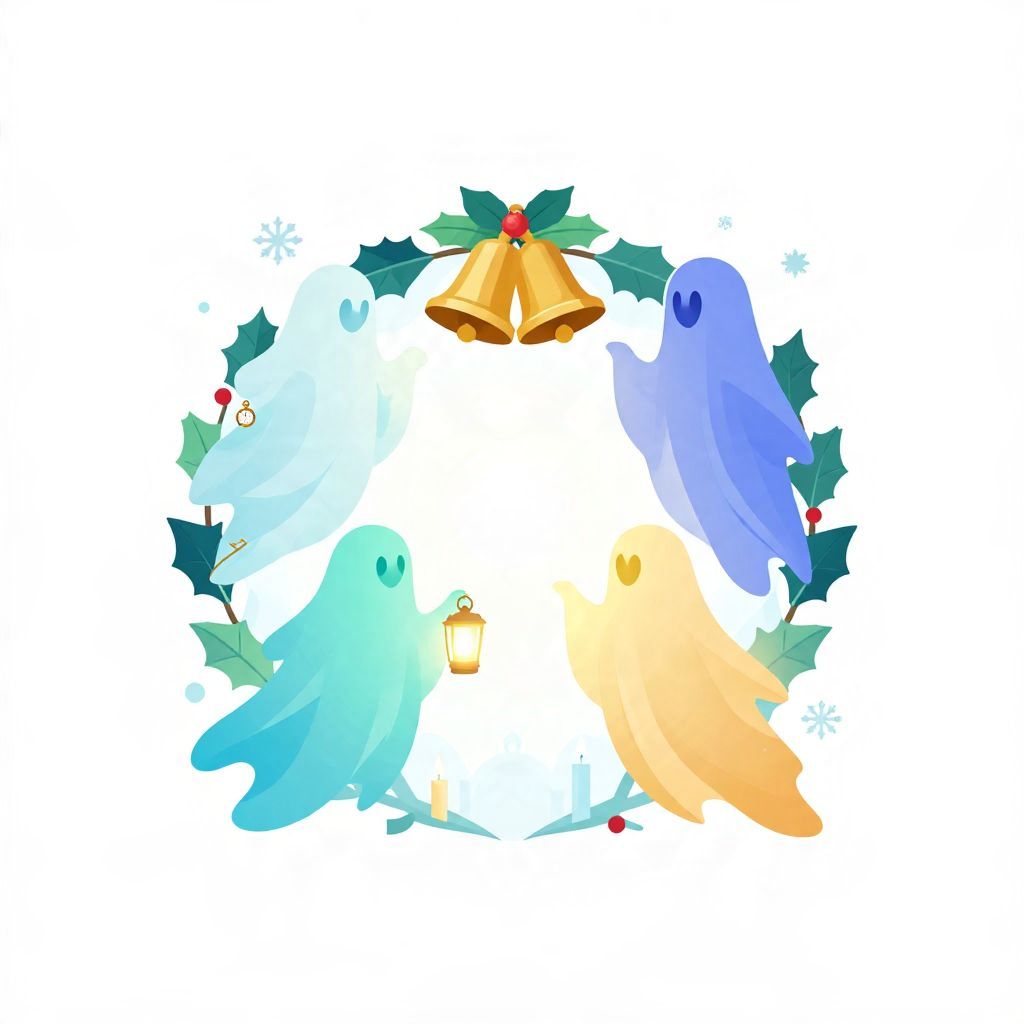
If you’re asking how many ghosts are in A Christmas Carol, the short answer is four: Jacob Marley and the three Spirits of Christmas Past, Present, and Yet to Come. Dickens uses them to guide Ebenezer Scrooge through memory, moral reckoning, and the possibility of change.
That simple count opens the door to a richer reading of the novella. The ghosts are not just spooky figures; they are the structure of the story, the engine of Scrooge’s transformation, and a central part of why the book remains such a lasting Christmas classic.
How many ghosts are in A Christmas Carol?
There are four ghostly figures in Charles Dickens’s A Christmas Carol: Jacob Marley, who appears first as Scrooge’s dead business partner, and the three Christmas Spirits who visit Scrooge on Christmas Eve. Each spirit represents a different stage of reflection: the past, the present, and the future.
Who are the ghosts in the novella?
1. Jacob Marley
Marley is not one of the three Christmas Spirits, but he is the first supernatural visitor. He is crucial to the story because he warns Scrooge that a life devoted only to profit and selfishness leads to spiritual suffering.
Marley’s chains are one of the novella’s most famous symbols. They suggest that a person’s choices can become a burden carried into the afterlife.
2. The Ghost of Christmas Past
This spirit takes Scrooge back through his earlier life, showing him scenes of loneliness, regret, and lost possibility. The visit helps explain how Scrooge became the cold man he is at the start of the novella.
Rather than simply punishing him, the spirit invites self-knowledge. Dickens presents memory as painful, but also as the beginning of moral renewal.
3. The Ghost of Christmas Present
The second spirit reveals how other people are living on Christmas Day, including the Cratchit family and many others in the city. This ghost broadens Scrooge’s perspective and exposes the human cost of his attitudes.
It is also the most generous and abundant of the three spirits, embodying warmth, community, and festive life. Dickens uses this figure to contrast social connection with Scrooge’s isolation.
4. The Ghost of Christmas Yet to Come
The final spirit is the most unsettling. Silent and shadowy, it shows Scrooge scenes from a future shaped by neglect, greed, and indifference.
Because this ghost does not speak, the meaning of the scenes must be read by Scrooge himself. That silence makes the experience especially powerful: the future is not fixed, but it is a warning.
Why Dickens uses ghosts in A Christmas Carol
Ghosts as moral teachers
The ghosts function as guides rather than monsters. Each one teaches Scrooge something he has refused to understand on his own.
In that sense, the novella is less about haunting than about education. The supernatural gives Dickens a vivid way to dramatize conscience, regret, and reform.
Ghosts as symbols of time
The three spirits divide time into past, present, and future, turning Scrooge’s life into a moral timeline. This structure makes the novella easy to follow and deeply memorable.
It also reflects one of Dickens’s major concerns: people are shaped by what they remember, how they live now, and what they are becoming.
Ghosts as a way to make social criticism vivid
Dickens was writing in a period of sharp social inequality, and the ghosts help him expose suffering that Scrooge has ignored. The supernatural visits make poverty, loneliness, and neglect impossible to dismiss.
By showing these realities through a haunted Christmas tale, Dickens turns social criticism into a story readers can feel as well as understand.
What the ghosts reveal about Scrooge
Scrooge begins as a man defined by withdrawal, suspicion, and money-mindedness. The ghosts gradually break that pattern by forcing him to see his life from outside himself.
Each encounter changes him in a different way:
- Marley creates fear and urgency.
- Christmas Past awakens memory and regret.
- Christmas Present awakens empathy.
- Christmas Yet to Come awakens responsibility.
Together, they move Scrooge from denial to recognition, and from recognition to action.
Are Marley and the spirits all “ghosts” in the same sense?
Not exactly. Marley is a dead human being returned as a warning, while the three Christmas Spirits are more like allegorical beings or personified forces. Dickens blurs the line between literal ghost story and moral fable.
That blending is part of the novella’s power. It feels like a supernatural tale, but it also reads as a symbolic journey through conscience.
How the ghost story shape supports the book’s themes
Redemption
The central theme of A Christmas Carol is redemption, and the ghosts make redemption possible. Scrooge is not changed by abstract advice alone; he changes because he confronts the truth of his life.
Memory and regret
The Ghost of Christmas Past shows that memory can be painful, but it can also lead to healing. Dickens suggests that people cannot improve unless they are willing to face what they have avoided.
Compassion and social responsibility
The Ghost of Christmas Present especially emphasizes human connection. The Cratchits, Tiny Tim, and other working-class characters remind Scrooge that wealth has moral obligations attached to it.
Mortal fear and moral urgency
The Ghost of Christmas Yet to Come gives the story its darkest edge. The fear it creates is not meant to be cruel; it is meant to make Scrooge understand that time is limited and choices matter.
Why the number of ghosts matters to readers
Knowing that there are four ghosts helps readers see how carefully Dickens built the novella. The sequence is not random: one warning, three lessons, one complete transformation.
If you are reading the book for class or discussion, that structure is a useful way to organize your thoughts. You can track how each ghost contributes to Scrooge’s change and to the novella’s larger message.
Quick reading guide for first-time readers
- Start with Marley’s warning as the inciting supernatural event.
- Watch how each spirit changes the tone from eerie to reflective to compassionate to ominous.
- Notice the contrast between isolation and community throughout the novella.
- Pay attention to symbols such as chains, light, food, clocks, and darkness.
- Read the ending as transformation, not just surprise: Scrooge’s change is the point of the ghostly journey.
Common questions about the ghosts in A Christmas Carol
Is Marley one of the three spirits?
No. Marley appears before the three Christmas Spirits and serves as the messenger who prepares Scrooge for their visits.
Why are there three Christmas ghosts?
The three spirits correspond to time: past, present, and future. This gives the novella a clear moral and narrative progression.
Which ghost is the scariest?
Readers often find the Ghost of Christmas Yet to Come the most frightening because it is silent and shows the consequences of a life left unchanged.
Are the ghosts real or symbolic?
They are presented as real within the story, but they also work symbolically. Dickens uses them to represent conscience, memory, social awareness, and the future.
Why A Christmas Carol still matters
The novella endures because it combines a memorable ghost story with a clear human message: people can change, and kindness matters. The ghosts give that message dramatic force.
Even readers who know the plot often return to it because Dickens makes moral awakening feel urgent, emotional, and vivid. The story is brief, but its structure is remarkably rich.
If you’re interested in how stories use structure and symbolism to shape meaning, you may also enjoy what storytelling is and how it works. For another reading guide, see how many books are in the Harry Potter series.