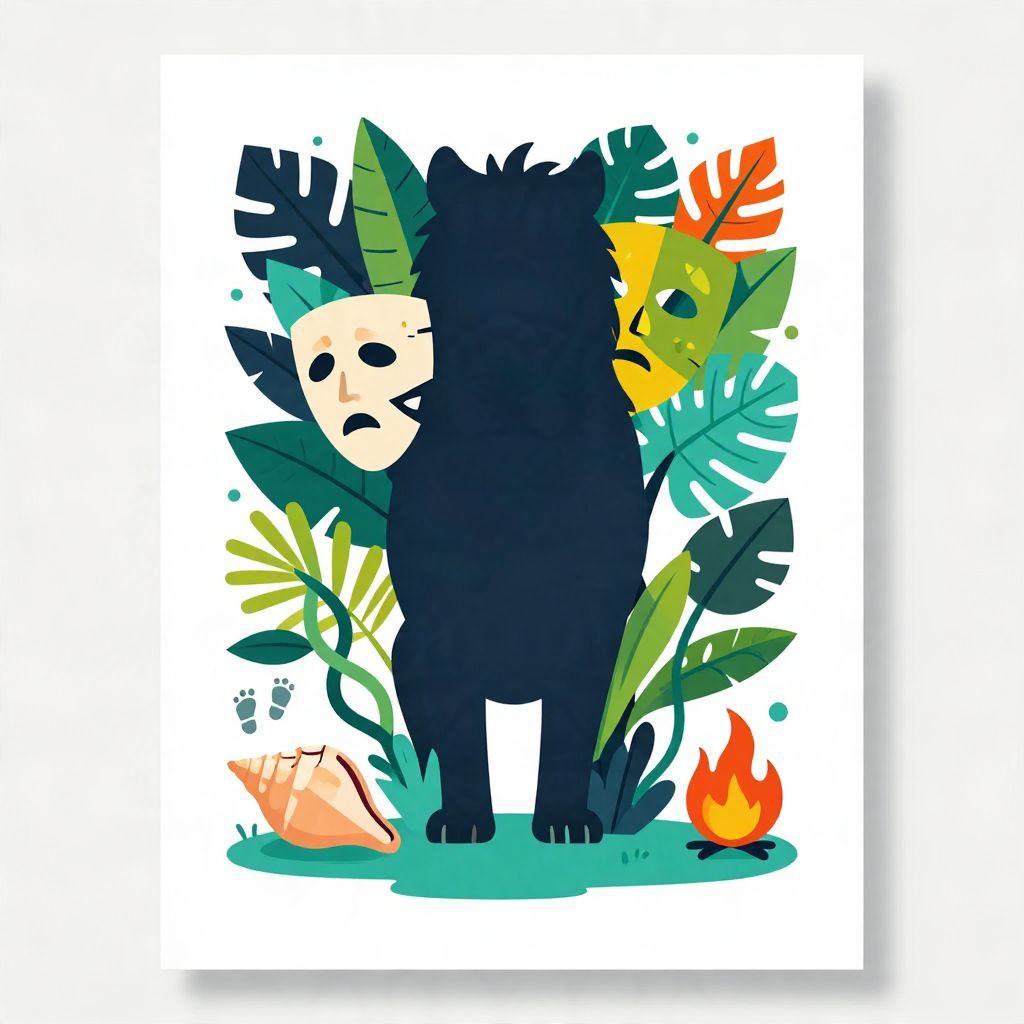
If you’re asking what the beast symbolizes in Lord of the Flies, you’re really asking what the boys are most afraid of. In William Golding’s novel, the beast is not just a creature on the island; it becomes a shifting symbol for fear, violence, and the darkness inside human beings.
Golding uses the beast to show how quickly imagination can turn fear into power. As the boys lose order and confidence, the beast grows from a childish rumor into a force that shapes their choices, their leadership, and their descent into savagery.
What does the beast symbolize in Lord of the Flies?
The beast symbolizes the boys’ inner fear and the capacity for evil that exists within human nature. At first it seems like an outside threat, but the novel gradually reveals that the real danger is not a monster on the island. It is the fear, violence, and loss of self-control the boys carry within themselves.
Why the beast matters in the novel
Golding does not present the beast as a simple symbol with one fixed meaning. Instead, it changes shape as the story develops, reflecting how fear works in a group. The more frightened the boys become, the more real the beast feels to them.
This makes the beast one of the novel’s most important symbols because it connects several major ideas at once: innocence lost, social breakdown, superstition, and the collapse of reason. The boys do not merely fear the beast; they use it to explain their own confusion and cruelty.
The beast as fear made visible
One of the clearest ways to understand the beast is as a symbol of fear itself. The boys arrive on the island without adults, rules, or reassurance, so anxiety quickly fills the gap. The beast gives that anxiety a name and a shape.
In this sense, the beast is useful to the boys because it turns an invisible feeling into something they can talk about. But once fear has a name, it can spread more easily, and that fear begins to control the group.
The beast as the darkness inside human nature
Golding’s deeper point is that the beast represents the violent impulses people try to hide from themselves. The boys want to believe that danger comes from outside, from some unknown animal or enemy. The novel suggests instead that the most frightening thing on the island is what the boys themselves are capable of doing.
This is why the beast is tied to the novel’s broader view of human nature. Golding implies that civilization is thin and fragile, and when social restraints disappear, selfishness and brutality can emerge.
How the meaning of the beast changes through the story
The beast begins as a rumor, then becomes a shared obsession, and finally turns into a kind of spiritual and psychological truth for the boys. Each stage reveals something different about their minds and the island society they are building.
At first: a childish fear
Early in the novel, the beast sounds like a vague childhood nightmare. It is uncertain, half-imagined, and difficult to describe. That uncertainty matters because it shows how fear can grow even when there is no evidence.
The younger boys are especially vulnerable to this kind of fear, but the older boys are not immune. Once the idea takes hold, it begins to influence everyone.
Then: a tool for power
As the boys become more divided, the beast stops being only a fear and starts becoming a political tool. Jack, in particular, uses the boys’ anxiety to strengthen his own authority. By promising protection from the beast, he helps make fear useful for control.
This is an important part of the symbol’s meaning. The beast is not just psychological; it also becomes social. It helps create loyalty, panic, and obedience.
Finally: a symbol of internal corruption
By the later stages of the novel, the beast is less about an animal than about moral collapse. The boys’ actions show that the real threat is not external. The beast has effectively entered the group through their behavior, their violence, and their surrender to instinct.
In that sense, the beast symbolizes the way evil can feel supernatural when it is actually human. Golding makes the boys’ fear seem real because their fear helps create the very savagery they dread.
The beast and the novel’s major themes
The beast connects directly to the central themes of Lord of the Flies. It is one of the novel’s main ways of exploring how people behave when order disappears.
Civilization versus savagery
The beast highlights the struggle between civilized behavior and primitive impulse. As the boys become less disciplined, the beast becomes more believable to them. That shift suggests that civilization depends on shared rules, not on human nature alone.
When those rules weaken, the boys do not become freer in a noble sense; they become more vulnerable to fear and violence.
Innocence and loss of childhood
The beast also symbolizes the end of innocence. At the beginning, the boys still think in terms of adventure and play. But the beast introduces a darker reality: the world is not safe, and neither are they.
That loss of innocence is not only about discovering danger outside. It is also about discovering the capacity for harm within themselves.
Leadership and manipulation
Different characters respond to the beast in different ways, and those responses reveal their leadership styles. Ralph tries to keep order and calm. Jack exploits fear. Piggy relies on reason, but reason has limited power against panic.
The beast therefore becomes a test of leadership. Who can interpret fear honestly, and who can use it to dominate others?
Important scenes that shape the beast’s symbolism
Several moments in the novel make the beast’s meaning clearer. These scenes show how fear moves from rumor to obsession.
- The younger boys’ stories: Their vague reports create the first sense that something unknown is on the island.
- The boys’ discussions at assembly: Fear becomes public, and the group begins to argue over whether the beast is real.
- The dead parachutist: The boys mistake a human corpse for a monster, showing how fear distorts perception.
- The “Lord of the Flies” scene: The pig’s head, surrounded by flies, becomes a powerful image of corruption and inner darkness.
- The final hunt: The boys’ violent behavior proves that the beast has become part of their own actions.
Is the beast real or imaginary?
In a literal sense, the beast is not a single monster stalking the island. The novel repeatedly shows that the boys mistake ordinary or natural things for something terrifying. But symbolically, the beast is very real because its effects are real: fear, division, cruelty, and death.
That double meaning is part of Golding’s craft. The beast may be imaginary as a creature, but it is real as a force in the boys’ minds and in the society they create.
Why Golding uses a beast instead of a direct explanation
Golding could have simply stated that human beings are capable of evil, but the beast makes that idea dramatic and memorable. Symbolism allows the novel to show fear in action rather than explain it abstractly.
The beast also works because it is flexible. Readers can understand it as fear, evil, superstition, or psychological projection, and all of those readings fit the novel. That richness is part of why the symbol remains so discussed in classrooms and literary analysis.
Quick summary of the beast’s meaning
- Fear: The beast gives shape to anxiety and uncertainty.
- Inner evil: It represents the violent impulses inside human beings.
- Loss of innocence: It marks the boys’ movement from childhood into moral darkness.
- Social breakdown: It helps spread panic and weaken order.
- Manipulation: It becomes a tool for control, especially in Jack’s hands.
Conclusion
So, what does the beast symbolize in Lord of the Flies? It symbolizes the fear and darkness that already exist within the boys, and by extension within humanity. Golding uses the beast to show that the most dangerous “monster” is not on the island at all, but in the human heart when reason and restraint disappear.
If you want to explore another major symbol in the novel, you may also find what the conch symbolizes in Lord of the Flies useful, along with an explanation of how Simon dies.