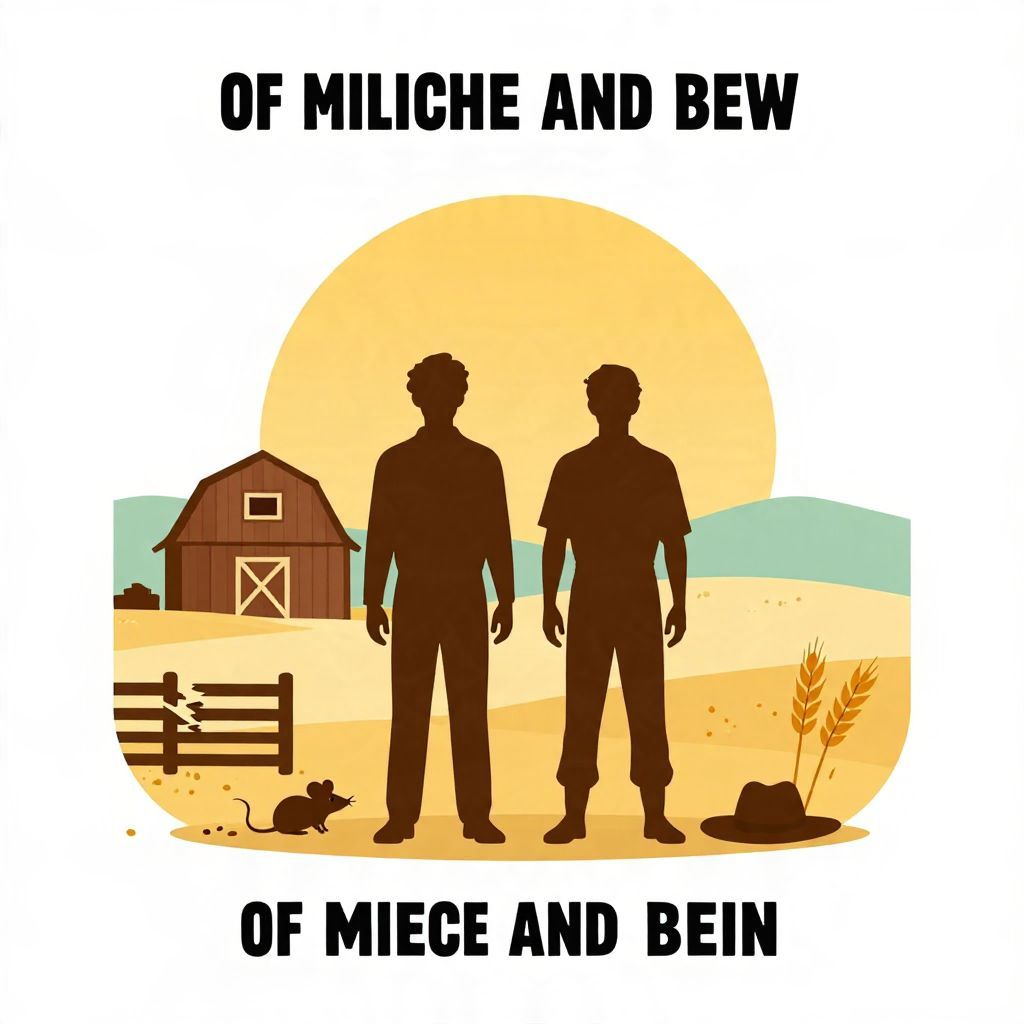
If you’re wondering what Of Mice and Men is about, the short answer is that it follows two migrant workers trying to survive during the Great Depression while holding onto a fragile dream of stability. John Steinbeck uses their story to explore loneliness, power, friendship, and the difficulty of pursuing hope in a harsh world.
The novella is brief, but its emotional and literary impact is lasting. It is often read in schools because it combines an accessible plot with rich symbolism, memorable characters, and themes that invite close analysis.
What Is Of Mice and Men About?
Of Mice and Men is a novella by John Steinbeck about two displaced laborers, George Milton and Lennie Small, who work on ranches in California and dream of someday owning land of their own. The story shows how economic hardship, social isolation, and human vulnerability shape their lives, turning a simple dream into a powerful tragedy.
Plot Overview of Of Mice and Men
The central friendship
George and Lennie are unusual because they travel together. In Steinbeck’s world, many workers are alone, so their companionship immediately stands out as both comforting and precarious.
George is small, quick-witted, and practical. Lennie is physically strong but intellectually disabled, and he depends on George for guidance and protection.
The dream of the farm
Like many workers during the Depression, the men hope to save enough money to buy a small farm. Their dream is not just about property; it represents independence, dignity, and a life shaped by their own choices.
Steinbeck gives this dream emotional weight by repeating it throughout the novella. That repetition makes it feel both hopeful and increasingly fragile.
Life on the ranch
Once George and Lennie arrive at the ranch, they meet other workers who each reveal a different form of loneliness or frustration. The ranch becomes a microcosm of a society where companionship is rare and power is unevenly distributed.
Curley, the boss’s aggressive son, immediately creates tension. His wife, who is never given a name in the text, is isolated and misunderstood, and her presence adds to the sense that nearly everyone in the story is trapped by circumstance.
Spoiler note: the ending
As the novella progresses, Lennie’s lack of control leads to a tragic crisis. The ending is one of the most discussed in American literature because it forces readers to confront the collision between compassion, responsibility, and impossible dreams.
Rather than offering a neat resolution, Steinbeck ends by showing how vulnerable people can be destroyed by fear, misunderstanding, and social pressure.
Main Characters and What They Represent
George Milton
George is the practical center of the novella. He acts as Lennie’s protector, but he is also a man worn down by responsibility and by the knowledge that survival often requires sacrifice.
He represents intelligence, caution, and the painful burden of care.
Lennie Small
Lennie is one of Steinbeck’s most memorable characters because his strength and innocence exist side by side. He loves soft things, simple routines, and the idea of a safe future, but he cannot always understand the consequences of his actions.
He represents vulnerability, innocence, and the tragic limits of desire.
Candy
Candy is an aging ranch worker whose fear of being discarded reflects the insecurity of old age and disability in an unforgiving economy. His hope of joining George and Lennie’s dream gives the farm fantasy a wider social meaning.
Crooks
Crooks, the Black stable hand, is isolated by racism as well as by the general loneliness of ranch life. His character gives the novella one of its clearest statements about exclusion and the human need for belonging.
Curley’s wife
Although she is often seen only through the eyes of the men around her, Curley’s wife is a crucial figure. She reflects gendered isolation and the limited options available to women in the world Steinbeck depicts.
Major Themes in Of Mice and Men
Loneliness
Loneliness is one of the novella’s strongest themes. Most of the characters have no real community, and the ranch setting emphasizes how easily people can be cut off from one another.
George and Lennie’s friendship matters because it is rare. Their bond highlights how unusual and precious human connection can be in a world built on temporary labor and constant movement.
The American Dream
Steinbeck presents the American Dream not as a guarantee but as a fragile hope. The dream of owning land is emotionally powerful, yet the novella shows how economic reality can make that dream nearly impossible for working-class people.
This is one reason Of Mice and Men remains relevant: it asks whether hope can survive when social conditions are stacked against it.
Power and weakness
The novella repeatedly contrasts physical strength with social power. Lennie is strong enough to cause harm, but he is powerless in practical terms. Curley has status and aggression, but his authority depends on the ranch hierarchy.
Steinbeck suggests that power is often unstable, and that weakness can take many forms.
Compassion and responsibility
George’s relationship with Lennie raises difficult questions about care. What does it mean to protect someone who cannot fully protect himself? How much responsibility can one person reasonably bear?
The novella does not answer these questions neatly, which is part of its enduring force.
Symbols and Literary Techniques
Dreams and repetition
Steinbeck uses repetition to make the dream farm feel both comforting and increasingly heartbreaking. Each time George and Lennie describe it, the dream becomes more than a plan; it becomes a ritual of survival.
Animals and fragility
Animal imagery appears throughout the novella, especially in relation to Lennie. Steinbeck uses this imagery to underline instinct, innocence, and the danger of misread intentions.
The title itself comes from Robert Burns’s poem “To a Mouse,” which reflects the idea that even carefully made plans can go wrong. That literary allusion deepens the novella’s sense of human fragility.
Setting as social commentary
The ranch is more than a backdrop. It functions as a pressure chamber where class, race, gender, age, and disability all shape the characters’ lives.
By keeping the setting relatively contained, Steinbeck intensifies the social conflicts and makes the novella feel almost theatrical in structure.
Simple language, layered meaning
One reason the book is so widely taught is Steinbeck’s style. The prose is clear and direct, but the simplicity hides complex emotional and social meaning.
That balance makes the novella accessible to new readers while still rewarding close literary analysis.
Historical and Literary Context
Of Mice and Men was published in 1937, during the Great Depression, when many Americans faced unemployment, poverty, and migration in search of work. Steinbeck drew on the realities of itinerant labor to create a story that feels rooted in a specific historical moment.
At the same time, the novella reaches beyond its period. Its concerns with exclusion, aspiration, and human dignity continue to resonate because they are not limited to one era.
Why Readers Keep Returning to the Book
Readers often return to Of Mice and Men because it is short, emotionally concentrated, and open to multiple interpretations. It can be read as a social novel, a tragedy, a study of friendship, or a critique of the American Dream.
It is also a strong introduction to Steinbeck’s fiction because it shows his interest in ordinary people, moral complexity, and the pressures of economic life.
What to Look for When Reading It
- How George and Lennie speak to each other and what their dialogue reveals about dependence and care.
- How the dream farm changes in meaning as the story moves forward.
- How each supporting character reflects a different kind of isolation.
- How Steinbeck uses setting and symbolism to make a small-scale story feel universal.
In Short
Of Mice and Men is about two men trying to survive hardship while holding onto a dream that may never come true. Its power lies in the way Steinbeck turns a simple premise into a moving study of friendship, loneliness, and the cost of hope.
If you’d like to compare Steinbeck’s novella with other classic works, you may also enjoy what East of Eden is about or what A Tale of Two Cities is about.