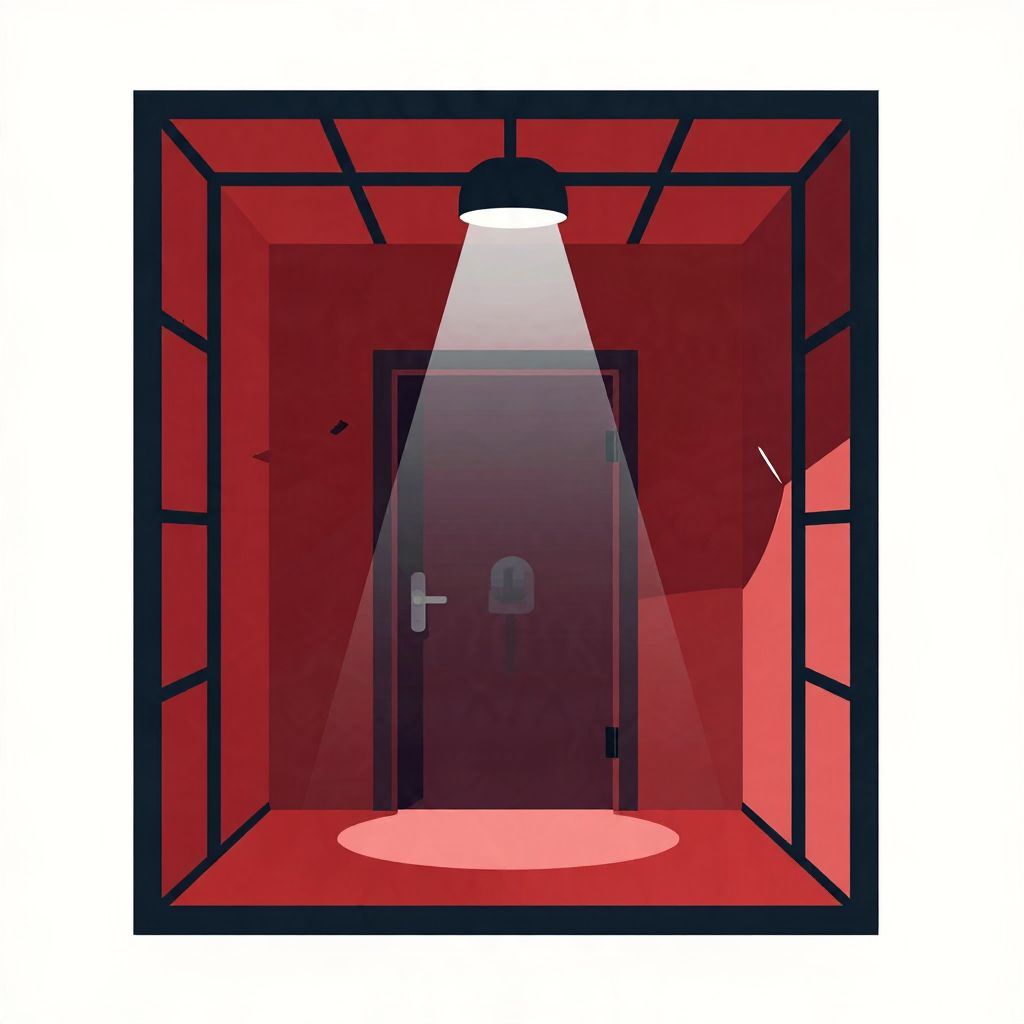
If you’re wondering what Room 101 means in 1984, the short answer is that it is the novel’s ultimate instrument of psychological torture. In George Orwell’s dystopia, Room 101 is where the state confronts each prisoner with their deepest fear until resistance collapses.
It is one of the most famous symbols in modern literature because it turns private terror into political control. Orwell uses it to show how totalitarian power reaches beyond the body and into the mind.
What is Room 101 in 1984?
Room 101 is the place in the Ministry of Love where Oceania’s authorities break prisoners by exposing them to their worst fear. In Winston Smith’s case, the threat is not merely pain but total psychological surrender. The room represents the state’s ability to make a person betray even their deepest loyalties and convictions.
How Room 101 works in the novel
By the time Winston reaches Room 101, he has already endured surveillance, interrogation, and physical torture. Room 101 is different because it targets the mind at its most vulnerable point. The Party does not simply want obedience; it wants inner submission.
The logic of fear
Orwell suggests that fear is more effective than force alone. Physical pain can be resisted for a time, but the terror of a personal phobia can override reason, memory, and affection. Room 101 is therefore a mechanism for destroying individuality from the inside out.
Why it is so effective
- It is personalized, not generic.
- It exploits instinct rather than ideology.
- It makes betrayal feel like survival.
- It leaves the victim psychologically dependent on the state.
What does Room 101 symbolize?
Room 101 is a symbol of state power at its most intimate and absolute. It stands for the point at which political oppression becomes personal annihilation. Orwell uses it to show that authoritarian systems do not merely censor speech or punish dissent; they aim to reshape the self.
Fear as a tool of control
The room symbolizes the idea that the most powerful form of domination is not visible violence but the ability to manipulate what people love, dread, and value most. In that sense, Room 101 is less a literal room than a metaphor for the collapse of human autonomy.
The destruction of loyalty
One of the novel’s central concerns is whether private loyalty can survive a totalitarian regime. Room 101 answers that question bleakly. It shows how the Party can force a person to choose self-preservation over love, friendship, and truth.
Room 101 and Winston Smith
Winston’s experience in Room 101 is the climax of his psychological defeat. Up to this point, he has tried to preserve some inner independence through memory, writing, and love. In Room 101, that fragile resistance is broken.
Why Winston breaks
The scene matters because Orwell does not portray Winston as weak in any simple sense. Instead, he is shown as human. His collapse demonstrates the novel’s grim argument: even a determined rebel can be reduced when the state understands exactly how to weaponize fear.
The emotional cost
What makes the scene especially disturbing is that Winston’s surrender is not only political. It is emotional and moral. He is pushed into betraying the person he loves, which makes the victory of the Party feel complete and devastating.
Room 101 in the context of Orwell’s themes
Room 101 is closely tied to the major themes of 1984, especially surveillance, truth, language, and power. It is one of the novel’s clearest demonstrations that control over reality begins with control over the human mind.
Power and domination
Orwell presents power not as an end in itself, but as a force that seeks total mastery. Room 101 reveals the final stage of that ambition: the state does not just want citizens to obey; it wants them to internalize obedience.
Truth and selfhood
Throughout the novel, Winston struggles to hold onto objective truth. Room 101 destroys the possibility of a stable inner self by proving that fear can make a person reject their own deepest beliefs. The result is not merely compliance, but the remaking of identity.
Love and betrayal
The room also sharpens the novel’s tragic treatment of love. In a healthy human life, love can anchor memory and moral courage. In Orwell’s dystopia, love becomes another vulnerability the regime can exploit.
Literary technique: why Room 101 is so memorable
Orwell’s handling of Room 101 is effective because he keeps the details both concrete and suggestive. He does not need elaborate description to make the scene horrifying. The name itself is plain, bureaucratic, and cold, which makes the cruelty feel institutional rather than sensational.
Plain style, powerful effect
One of Orwell’s strengths is his clear, restrained prose. That style makes the room feel more chilling, because the language refuses melodrama. The horror comes from the idea, not from decorative description.
Irony and bureaucratic language
The Ministry of Love is already an ironic name, and Room 101 deepens that irony. A system that claims to represent order and civic virtue is revealed as a machine for terror. Orwell uses official-sounding language to expose moral corruption.
Room 101 in literary and cultural history
Since the publication of 1984, Room 101 has become shorthand for a person’s worst fear or ultimate ordeal. That cultural afterlife is part of what makes the concept so enduring: it is both specific to the novel and widely adaptable as a symbol.
Why the image lasts
Readers remember Room 101 because it captures something universal. Everyone has fears, and everyone understands the vulnerability of being forced to confront them. Orwell turns that universal experience into a political warning.
A lasting dystopian image
In the broader history of dystopian fiction, Room 101 is one of the clearest examples of how imagined institutions can embody abstract tyranny. It is not just a setting; it is a narrative device that reveals the mechanics of oppression.
Common questions about Room 101
Is Room 101 a real place?
No. It is a fictional room in Orwell’s novel. However, the term has entered common usage as a metaphor for a person’s deepest fear or worst nightmare.
Is Room 101 only about physical torture?
No. Its real power lies in psychological torture. The room is designed to break resistance by exploiting fear so intensely that the victim abandons loyalty, memory, and self-respect.
Why is Room 101 so important to the ending of 1984?
Because it completes Winston’s defeat. The novel’s ending is not simply about punishment; it is about the destruction of the possibility of inner freedom.
Why Room 101 matters to readers today
Room 101 remains relevant because it asks a disturbing question: what happens when institutions learn how to control not only what people do, but what they fear most? Orwell’s answer is a warning about propaganda, coercion, and the fragility of personal autonomy.
For readers, the scene is unforgettable because it condenses the whole novel into one brutal idea: a regime that can reach into the private mind can conquer more than a body. It can conquer a person’s sense of self.
If you want to explore more of Orwell’s world, you may also find it useful to read about who the Proles are in 1984 and why 1984 has been banned.