If you’re wondering what The Yellow Wallpaper is about, you’re likely looking for both a plot explanation and the deeper meaning behind Charlotte Perkins Gilman’s famous short story. It is one of the most discussed works of American feminist literature, and its unsettling details reward careful reading.
At its core, the story follows a woman confined to a room while recovering from what her husband calls a nervous condition. As her isolation deepens, the wallpaper in the room becomes a powerful symbol of control, mental distress, and resistance.
What is The Yellow Wallpaper about?
The Yellow Wallpaper is a short story about a woman’s psychological decline during a period of enforced rest and isolation, and about how domestic authority can silence and trap her. On the surface, it is a private recovery narrative; beneath that, it is a critique of gender roles, medical paternalism, and the loss of self.
Plot overview of The Yellow Wallpaper
The story is told through the narrator’s secret journal entries. She and her husband, John, move into a rented house for the summer, where she is expected to rest and avoid work after childbirth or a related illness, depending on how readers interpret her condition.
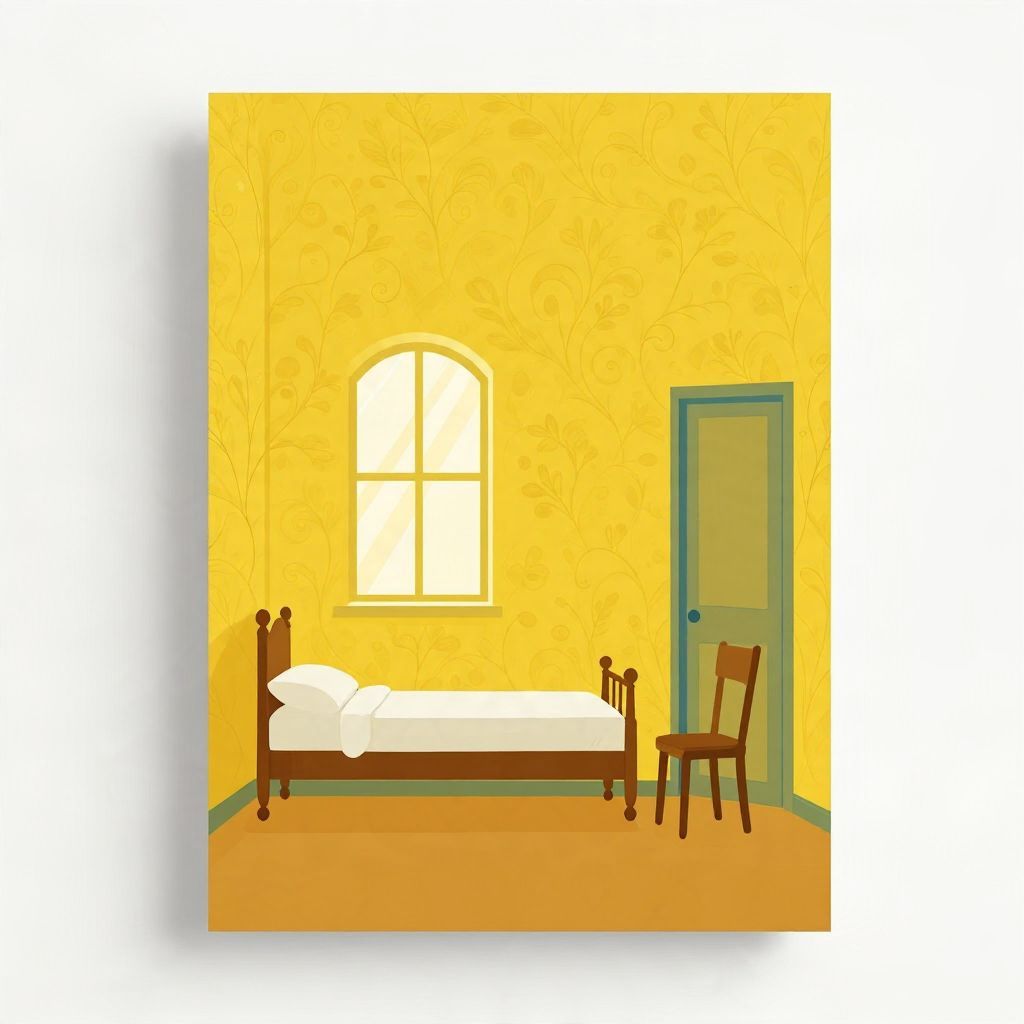
John, a physician, insists that she is not seriously ill and discourages her from writing, socializing, or engaging in stimulating activity. The room she is assigned has ugly yellow wallpaper, barred windows, and a feeling of confinement that grows increasingly oppressive.
As the days pass, the narrator becomes obsessed with the wallpaper’s pattern. She begins to imagine a woman trapped behind it, creeping and struggling to get out, and this image gradually merges with her own sense of imprisonment.
Spoiler note: by the end of the story, the narrator identifies with the woman she believes is trapped in the wallpaper. In a final scene of psychological collapse, she tears at the paper and creeps around the room, while John reacts with horror and fainting.
Why the wallpaper matters
The wallpaper is the story’s central symbol, and it works on several levels at once. It represents the narrator’s confinement, the ugliness of the domestic role forced on her, and the way her mind tries to make sense of a situation she cannot openly resist.
The wallpaper as a symbol of imprisonment
The room itself resembles a nursery or a prison, and the wallpaper becomes an extension of that space. Its chaotic pattern mirrors the narrator’s inability to find order in her life, while the room’s physical features suggest that she is being watched, managed, and contained.
The wallpaper as a symbol of hidden selfhood
Many readers also see the trapped woman in the wallpaper as a projection of the narrator’s own suppressed identity. The story suggests that when a woman’s voice is dismissed, her inner life may surface indirectly through fantasy, fixation, or breakdown.
Main themes in The Yellow Wallpaper
The story is brief, but it concentrates several major themes that have made it a staple of literary study.
1. Gender and power
John’s authority as husband and doctor gives him control over nearly every aspect of the narrator’s life. The story shows how domestic care can become domination when one person’s judgment is treated as absolute.
2. Mental health and isolation
The narrator’s condition is never clinically defined in a modern sense, and that ambiguity is part of the story’s force. What is clear is that isolation, lack of agency, and emotional invalidation intensify her distress.
3. The dangers of “rest cure” treatment
Gilman wrote at a time when some doctors prescribed rest, inactivity, and withdrawal for women with nervous illness. The story dramatizes the harm that can come from treatment that ignores the patient’s voice and imagination.
4. Writing as survival
The narrator secretly writes in her journal even though John forbids it. That act matters: writing becomes one of the few ways she can preserve a self, even as her language becomes increasingly fragmented and unstable.
Characters and their roles
The cast is small, but each character serves a clear literary function.
The narrator
The unnamed narrator is the emotional center of the story. Because readers only know her through her private journal, her voice is intimate, unreliable, and deeply revealing.
John
John is both husband and physician, and that double role is crucial. He believes he is helping, but his certainty and condescension make him an agent of control rather than care.
Jennie
Jennie, John’s sister, appears as a practical household figure who seems to accept the domestic order of the house. She is less developed than the narrator and John, but her presence reinforces the social world the narrator feels trapped inside.
Literary techniques Gilman uses
The Yellow Wallpaper is effective not only because of its subject matter, but because of how carefully it is written. Gilman uses form to make the reader feel the narrator’s increasing unease.
First-person journal form
The story unfolds through diary-like entries, which creates immediacy and emotional intimacy. At the same time, the form limits what readers can know, making the narrator’s perceptions both vivid and uncertain.
Unreliable narration
The narrator is not “unreliable” in a careless sense; rather, her mental state affects how she interprets events. Readers must constantly weigh what is literal, what is imagined, and what is symbolically true.
Repetition and fragmentation
As the story progresses, the language becomes more repetitive and broken. This stylistic shift reflects the narrator’s narrowing world and her growing obsession with the wallpaper.
Irony
One of the story’s strongest effects is dramatic irony. John believes he is rational and benevolent, but the reader can see that his treatment is worsening the narrator’s condition.
Historical and literary context
Charlotte Perkins Gilman published The Yellow Wallpaper in 1892. The story is closely associated with late 19th-century debates about women’s health, domesticity, and the authority of male experts.
Gilman later explained that she wrote the story in response to her own experience with a physician’s advice, though readers should be careful not to reduce the fiction to autobiography. The story is shaped by personal experience, but it is also a crafted literary argument.
Today, the work is often read as an early and influential feminist text. It remains widely taught because it combines psychological intensity with social critique in a compact, unforgettable form.
How to read the ending
The ending can be read in more than one way, and that ambiguity is part of the story’s power. On one level, it depicts a mental breakdown. On another, it can be read as a final act of resistance, however tragic, against the forces that have erased the narrator’s autonomy.
That dual reading is important. Gilman does not present a simple moral lesson; instead, she shows how oppression, illness, and perception can become inseparable.
Why The Yellow Wallpaper still matters
The story continues to resonate because it speaks to issues that remain recognizable: being dismissed by authority, being confined by expectations, and struggling to be heard when one’s inner life is treated as secondary.
It is also a powerful example of how a short story can do a great deal with a small setting, a limited cast, and a single recurring image. For students, it is a rich text for symbolism and feminist criticism; for general readers, it is a haunting portrait of a mind under pressure.
Quick takeaways
- Genre: short story, psychological fiction, feminist literature
- Core premise: a woman’s confinement and mental deterioration during enforced rest
- Main symbol: the yellow wallpaper, representing imprisonment and suppressed identity
- Key themes: gender power, mental health, isolation, and the silencing of women
- Why it matters: it remains one of the most influential American short stories about psychological and social oppression
If you enjoyed this literary overview, you may also like reading about what A Little Life is about or exploring what November 9 is about for another look at character-driven fiction and emotional intensity.