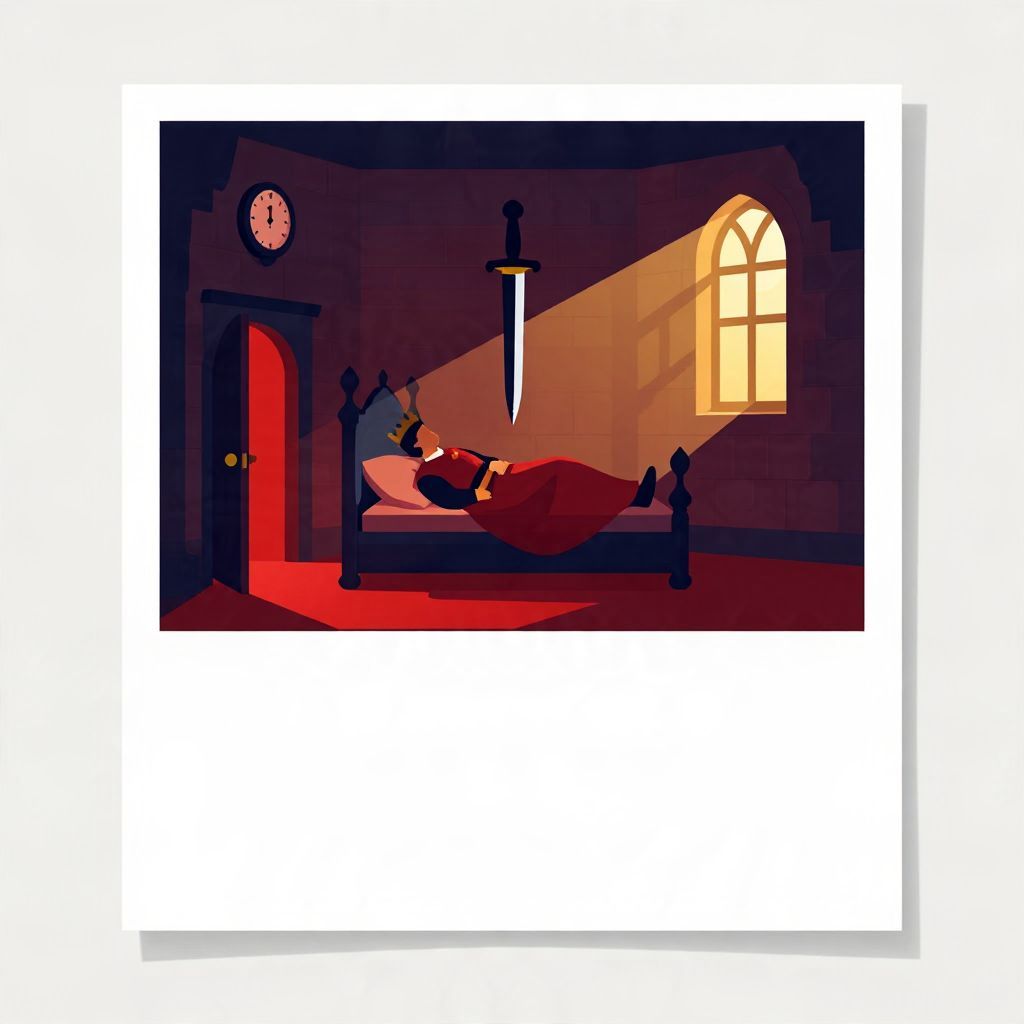
If you’re asking when Macbeth kills Duncan, the short answer is that it happens offstage in Act 2, Scene 2 of Shakespeare’s Macbeth. The murder itself is not shown to the audience; instead, Shakespeare builds suspense through what Macbeth and Lady Macbeth say immediately before and after the act.
That choice matters because the scene is less about the physical killing than about Macbeth’s psychological collapse. The play turns the murder of Duncan into a turning point that changes Macbeth from a hesitant nobleman into a tyrant driven by fear and guilt.
When does Macbeth kill Duncan in the play?
Macbeth kills King Duncan during Act 2, Scene 2, after Duncan has gone to sleep in Macbeth’s castle. Shakespeare does not stage the murder directly. Instead, the audience learns about it through Macbeth’s and Lady Macbeth’s reactions, which makes the moment feel tense, immediate, and morally shocking.
What happens right before the murder?
Before Duncan is killed, Macbeth is tormented by doubt. He has already decided to go through with the plan, but he is anxious about the moral consequences and the danger of being discovered.
Macbeth’s hesitation
In the scenes leading up to the murder, Macbeth imagines violent consequences and fears what the act will do to his soul. His uncertainty is important because it shows he is not naturally ruthless; he chooses ambition over conscience.
Lady Macbeth’s role
Lady Macbeth pushes him to continue. She is practical, forceful, and determined to keep the plan moving, even as Macbeth wavers. Her confidence contrasts sharply with his fear, and that contrast helps drive the tragedy forward.
Why doesn’t Shakespeare show Duncan’s murder onstage?
Shakespeare often uses offstage violence to heighten suspense and focus attention on the emotional aftermath rather than the physical act. In Macbeth, this technique makes the murder feel even more disturbing because the audience must imagine it.
By keeping the killing offstage, Shakespeare also preserves the play’s atmosphere of secrecy and dread. The audience is drawn into Macbeth’s guilty mind instead of being distracted by a realistic stage depiction of the crime.
What is the significance of Duncan’s murder?
Duncan’s death is the central moral break in the play. It is the point at which Macbeth crosses from thought into action, and once he kills Duncan, he can no longer return to innocence or stability.
The turning point of the tragedy
Before the murder, Macbeth is tempted by the idea of power. After the murder, he is trapped by it. The act sets off a chain of paranoia, further violence, and political chaos that shapes the rest of the play.
Guilt and consequences
The murder immediately produces guilt in Macbeth and fear in Lady Macbeth, even though she initially seems stronger. Their responses reveal one of Shakespeare’s major themes: crimes committed for power do not bring peace, only deeper disorder.
How the scene works dramatically
Act 2, Scene 2 is one of the most intense scenes in Shakespeare because it compresses fear, guilt, and suspense into a short exchange. The language is fragmented and unstable, reflecting the characters’ mental state.
Sleep as a symbol
Duncan is murdered while sleeping, and sleep becomes one of the play’s most important symbols. It represents innocence, peace, and natural order. Once Macbeth destroys that order, he and Lady Macbeth lose their own sense of rest.
Blood as a symbol
Blood in this scene is both literal and symbolic. It represents the physical crime, but it also stands for guilt that cannot be washed away. Shakespeare uses blood imagery throughout the play to show how violence stains the conscience.
What happens immediately after Macbeth kills Duncan?
Right after the murder, Macbeth is overwhelmed by fear and horror. He cannot bring himself to say “Amen,” and he fixates on the sounds and images that seem to confirm his guilt. Lady Macbeth takes control in the moment, trying to keep the situation from unraveling.
The knocking at the gate
The knocking that follows is one of the play’s most famous effects. It interrupts the scene with a harsh reminder of reality, as if the outside world is already pressing in on the crime. The sound also increases the sense that Macbeth has crossed into a new, dangerous state.
Macbeth’s guilt becomes visible
Macbeth’s immediate reaction shows that the murder has not made him powerful in any secure sense. Instead, it has made him spiritually and psychologically unstable, which is why the play quickly moves from one act of violence to the next.
Why readers and students ask this question
People often ask when Macbeth kills Duncan because the play’s structure can be confusing at first. Since the murder is offstage, readers need to locate the exact scene and understand how Shakespeare presents the event through dialogue rather than action.
It is also a common study question because the scene is essential to understanding the rest of the tragedy. If you know where Duncan dies and why Shakespeare handles it this way, the play’s themes become much clearer.
Key details to remember
- Act: Duncan is killed in Act 2.
- Scene: The murder is revealed in Scene 2.
- Placement: It happens offstage, not in front of the audience.
- Setting: Duncan is asleep in Macbeth’s castle.
- Importance: The murder is the play’s major turning point and the start of Macbeth’s downfall.
How to understand the moment in context
If you are reading or studying Macbeth, it helps to see Duncan’s murder as more than a plot event. It is the moment where ambition, persuasion, fear, and moral choice all collide.
Shakespeare makes the scene powerful by leaving the violence unseen and focusing instead on the language of guilt. That approach turns the murder into a psychological event as much as a political one.
Takeaway
Macbeth kills Duncan in Act 2, Scene 2, offstage, after Duncan has gone to sleep. The scene matters because it marks Macbeth’s irreversible descent and launches the tragedy’s central themes of guilt, ambition, and the collapse of order.
If you’re exploring more Shakespeare-related reading, you may also enjoy our guide to how Lady Macbeth dies and, for a different kind of theme-based analysis, what the theme of November 9 is.