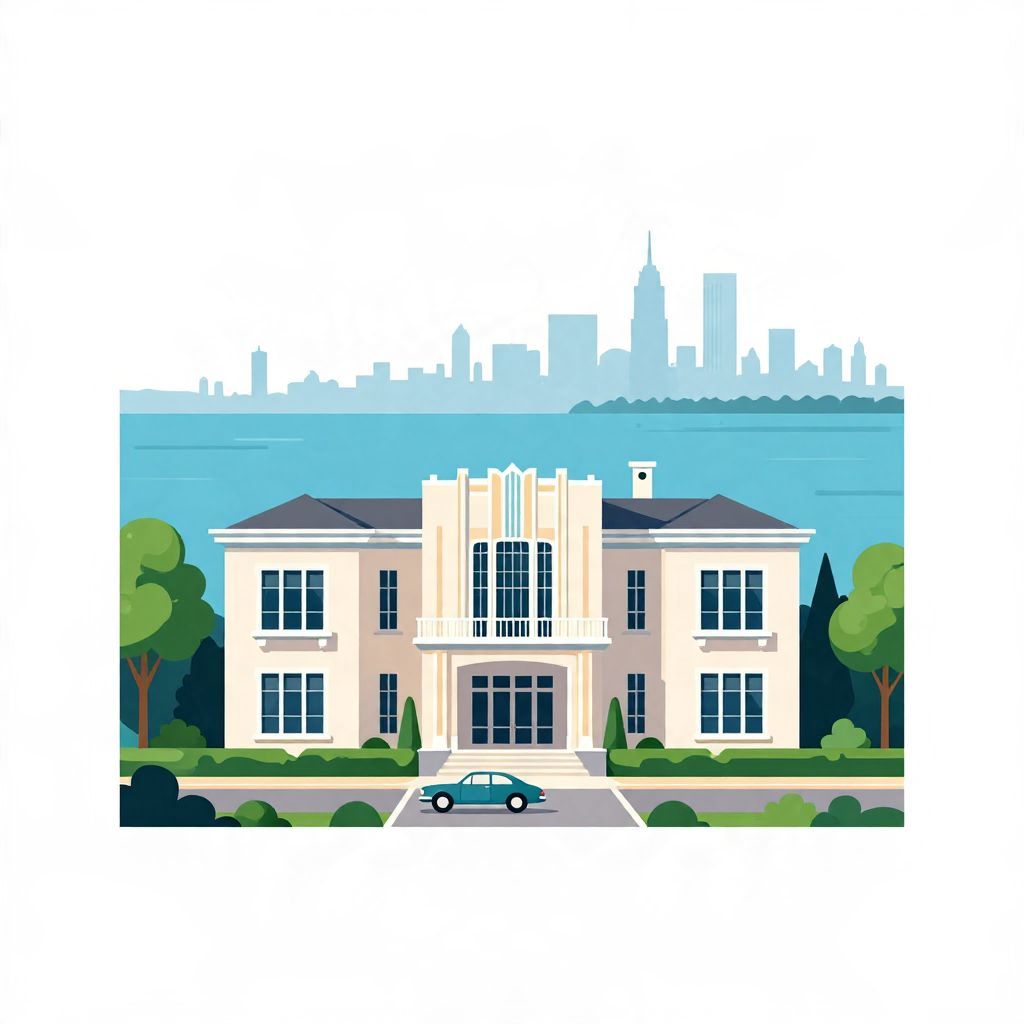
Readers often ask where The Great Gatsby actually takes place because the novel’s setting does so much of the story’s work. F. Scott Fitzgerald does not just place the action in a city and a suburb; he builds a social map of wealth, desire, and disappointment around them.
The novel is set mainly on Long Island, New York, in the 1920s, with key scenes in New York City itself. Fitzgerald uses these locations to contrast old money, new money, and the exhausted spaces in between, making the setting central to the book’s meaning.
Where does The Great Gatsby take place?
The Great Gatsby takes place on Long Island, especially in the fictional towns of West Egg and East Egg, with important scenes in New York City and the industrial “Valley of Ashes” between them. Fitzgerald based these places on real areas on Long Island’s North Shore, using them to show the divide between wealth, status, and moral emptiness in 1920s America.
The main settings in the novel
West Egg
West Egg is where Nick Carraway rents a house and where Jay Gatsby lives in his mansion. It represents “new money,” or wealth that has been recently acquired and is often viewed as less refined by the established elite.
Gatsby’s home in West Egg is extravagant, visible, and slightly theatrical, which fits his self-invented identity. The setting helps explain why Gatsby can be rich and still not fully accepted by the social world he wants to enter.
East Egg
East Egg is home to Tom and Daisy Buchanan. It represents “old money,” inherited wealth, and social prestige that seems secure, effortless, and closed to outsiders.
Fitzgerald places the Buchanans across the water from Gatsby to make the social divide feel physical as well as symbolic. The short distance between the Eggs hides a deep cultural distance.
The Valley of Ashes
Between Long Island and New York City lies the Valley of Ashes, a bleak industrial wasteland. It is one of the novel’s most important symbolic settings, showing the human cost of the wealth displayed nearby.
This area stands for poverty, decay, and the waste produced by a glittering consumer culture. It is where the novel’s moral and social corruption becomes most visible.
New York City
New York City appears as a place of movement, pleasure, secrecy, and excess. The characters travel there for business, affairs, drinking, and escape from the social rules of Long Island.
In the novel, the city is not simply glamorous. It also exposes the instability of the characters’ lives and the way their freedom often leads to recklessness rather than fulfillment.
Why the setting matters so much
It reflects class divisions
The novel’s geography is really a social structure. West Egg, East Egg, the Valley of Ashes, and New York City each represent a different position in the world of money and power.
By moving characters between these places, Fitzgerald shows how class shapes behavior, relationships, and self-image. The setting makes the novel’s social criticism clearer than it would be in an abstract description.
It supports the novel’s symbolism
Fitzgerald uses place as symbol throughout the book. The green light across the water, the ash-gray wasteland, and the glittering parties all gain meaning because of where they are located.
The landscape is not just background. It helps turn the novel into a study of longing, illusion, and the distance between dreams and reality.
It creates emotional distance
Water separates Gatsby from Daisy, and the road between the Eggs and the city becomes a route through desire and danger. The geography repeatedly suggests that what the characters want is visible but hard to reach.
This physical distance mirrors emotional distance. People are near each other in space, but often far apart in values, honesty, and understanding.
What real places inspired the novel?
Fitzgerald drew inspiration from the North Shore of Long Island, where he lived for a time during the 1920s. Scholars often connect West Egg and East Egg to real communities such as Great Neck and Sands Point, though the novel itself uses fictional names and does not map exactly onto one real location.
That matters because Fitzgerald was not writing a travel guide. He was shaping real social geography into a symbolic setting that could capture the tensions of the Jazz Age.
How the 1920s shape the setting
The Jazz Age atmosphere
The novel’s setting belongs to the 1920s, a period associated with prosperity, nightlife, changing social norms, and rapid economic growth. These conditions help explain the parties, cars, fashions, and restless energy that fill the book.
At the same time, the era’s glamour is shadowed by carelessness and inequality. Fitzgerald’s setting captures both the excitement and the instability of the decade.
Postwar disillusionment
Although the novel is often remembered for its luxury, its setting also reflects a deeper postwar emptiness. The world of The Great Gatsby feels energized but spiritually unsettled.
This tension is part of why the novel endures. The places in it are beautiful, but they are also haunted by disappointment, broken promises, and the limits of wealth.
Key setting details readers often miss
- West Egg and East Egg are fictional, but they are modeled on real Long Island communities.
- The water between Gatsby and Daisy matters; it symbolizes separation, longing, and illusion.
- The Valley of Ashes is not just scenery; it represents industrial waste and social neglect.
- New York City is a place of escape, but also of moral looseness and instability.
- The setting changes how characters are seen: the same person can seem glamorous in one place and exposed in another.
Why readers still ask this question
People search for “Where does The Great Gatsby take place” because the novel’s setting is unusually important to its meaning. The locations are easy to name, but their literary function is richer than simple geography.
Knowing where the story takes place helps readers understand why the novel feels so layered. Long Island, the city, and the wasteland between them work together to show the promise and emptiness of the American Dream.
Quick answer for students
If you need a simple response for classwork, you can say: The Great Gatsby takes place mainly on Long Island, New York, in the fictional towns of West Egg and East Egg, with important scenes in New York City and the Valley of Ashes. Those settings are essential to the novel’s themes of class, wealth, and illusion.
For related reading, you may also want to explore where Gatsby lives and what the Valley of Ashes means in Fitzgerald’s novel.