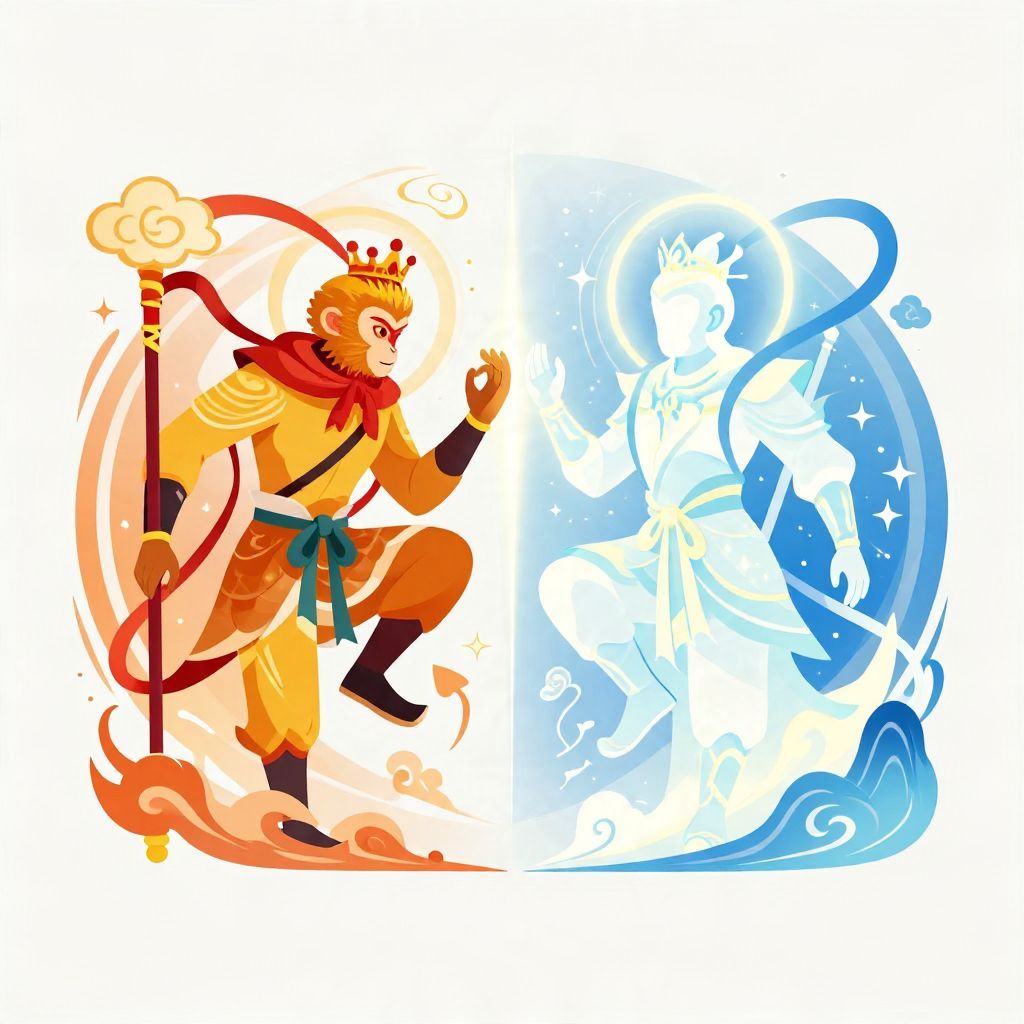
Readers often ask who could possibly defeat Sun Wukong, the Monkey King of Journey to the West. It is a fair question: he is one of the most powerful and difficult-to-contain figures in Chinese literature, famous for speed, shapeshifting, magical weapons, and near-immortality.
The short answer is that Sun Wukong is not usually beaten by brute force alone. In the classic novel, he is overcome through a mix of divine authority, strategic restraint, and spiritual discipline rather than simple combat strength.
Who can beat Sun Wukong in Journey to the West?
In the novel, Sun Wukong is most decisively checked by beings with higher cosmic authority, especially the Buddha. He can also be restrained by gods, immortals, and monks who use seals, spells, talismans, or moral discipline. His defeats usually come from hierarchy and wisdom, not from a stronger fighter.
Why Sun Wukong is so hard to defeat
Sun Wukong is built as an almost impossible opponent. He learns quickly, survives repeated punishments, and uses transformation, illusion, and trickery to escape danger. Even when he loses a fight, he often returns because his strength is tied to supernatural gifts and a rebellious will.
His major abilities
- Shapeshifting into many forms
- Cloud travel and extraordinary speed
- Combat skill with the Ruyi Jingu Bang, his staff
- Resistance to injury and magical punishment
- Cleverness that helps him escape traps
Because of these traits, ordinary warriors cannot simply overpower him. The novel repeatedly shows that Sun Wukong requires a different kind of response: containment, outsmarting, or spiritual correction.
Who can actually beat Sun Wukong?
The strongest answer is the Buddha, whose power is not just physical but cosmic and moral. In the famous mountain-sealing episode, Sun Wukong is trapped under the Buddha’s palm and then confined beneath a mountain. This is less a duel than a demonstration that ultimate spiritual authority outranks raw force.
The Buddha
The Buddha is the clearest figure who can defeat Sun Wukong. He does not merely outfight the Monkey King; he places him in a larger moral and metaphysical order, showing that rebellion has limits when confronted with enlightenment and universal law.
Other heavenly powers
Several gods and immortals can restrain Sun Wukong temporarily, especially when they work together. However, the novel often implies that many heavenly beings are less effective than they appear, and some are unable to stop him without help.
Important examples include:
- Jade Emperor’s court, which can summon forces against him but struggles to control him directly
- Guanyin, who repeatedly guides and restrains him through compassion and strategy
- Laojun and other Daoist figures, whose tools and elixirs are part of the broader celestial order
Monks and ritual power
Sun Wukong is also checked by religious discipline. Tang Sanzang, though physically weak, controls him through the tightening headband spell, which causes pain when Wukong disobeys. This is one of the novel’s most important ideas: spiritual training can restrain power that force cannot.
How Sun Wukong is defeated in the story
Sun Wukong’s defeats usually happen in one of three ways: he is overpowered by a higher being, trapped by a magical device, or disciplined into cooperation. The novel is less interested in “who punches hardest” than in how chaos is brought under control.
1. Overpowered by higher authority
The Buddha’s victory is the clearest example. Sun Wukong can challenge armies, but not the cosmic structure that the Buddha represents. This makes his defeat symbolic as well as literal.
2. Trapped by magic
Some enemies cannot beat him in open battle, so they use nets, spells, mountains, or enchanted objects. These scenes highlight one of the novel’s recurring patterns: clever containment is often more effective than direct combat.
3. Corrected through discipline
As the pilgrimage continues, Sun Wukong becomes less of a rebel and more of a protector. His greatest “defeat” is not destruction but transformation. He is gradually trained to serve a sacred mission larger than his own pride.
What Sun Wukong’s defeats mean
Sun Wukong is not written as a simple villain or hero. His defeats carry thematic weight, showing the tension between freedom and order, ego and humility, power and wisdom. The novel uses him to ask whether strength alone is enough to live rightly.
Rebellion versus discipline
At the start of the novel, Sun Wukong embodies unruly energy. He resists heaven, rejects limits, and demands recognition. His defeats show that ungoverned power eventually meets a boundary.
Strength versus enlightenment
The story suggests that true superiority is not brute force. The Buddha, Guanyin, and the pilgrimage itself point toward compassion, restraint, and spiritual insight as higher forms of power.
Comedy and humility
Many scenes involving Sun Wukong are playful or comic. Even when he is humbled, the novel keeps him vivid and entertaining. His defeats do not erase his brilliance; they make his character more layered.
Can Sun Wukong be killed?
In practical terms, Sun Wukong is extremely difficult to kill. He survives many attempts on his life and possesses layers of supernatural protection. The novel emphasizes that he can be subdued, sealed, or disciplined more easily than he can be permanently destroyed.
That is why the question “who can beat Sun Wukong?” is more accurate than “who can kill him?” The story is about containment and transformation, not simple elimination.
Sun Wukong in literary context
Sun Wukong is one of the great trickster figures in world literature. Like other tricksters, he is brilliant, disruptive, and impossible to fully control. But unlike a purely comic trickster, he is also a spiritual being whose journey reflects Buddhist and Daoist ideas.
Why he remains so popular
- He is powerful but flawed, which makes him memorable
- He combines action, humor, and philosophical depth
- He represents resistance to authority, a theme many readers recognize
- He changes over time, which gives the novel emotional range
This complexity is part of why readers keep asking who can beat him. The question opens onto the larger meaning of the novel itself.
Reading Journey to the West with this question in mind
If you are reading the novel for the first time, it helps to watch how each confrontation with Sun Wukong changes the balance of power. Early episodes emphasize his wildness and dominance, while later ones stress cooperation, restraint, and moral growth.
What to notice as you read
- When force fails, what strategy succeeds?
- Which characters represent authority, compassion, or wisdom?
- How often does Sun Wukong win a battle but lose control of the larger situation?
- How does the novel balance entertainment with spiritual teaching?
These patterns help explain why Sun Wukong is so difficult to beat and why his defeats are never just about physical strength.
Final takeaway
So, who can beat Sun Wukong? In the world of Journey to the West, the strongest answer is the Buddha, followed by other higher spiritual or celestial powers who can restrain him through wisdom, ritual, and cosmic authority. Sun Wukong is less defeated by a stronger fist than by a higher order of meaning.
If you enjoy literary questions that connect character power to larger symbolic systems, you may also like reading about what the seven Horcruxes are and all the Horcruxes in Harry Potter.