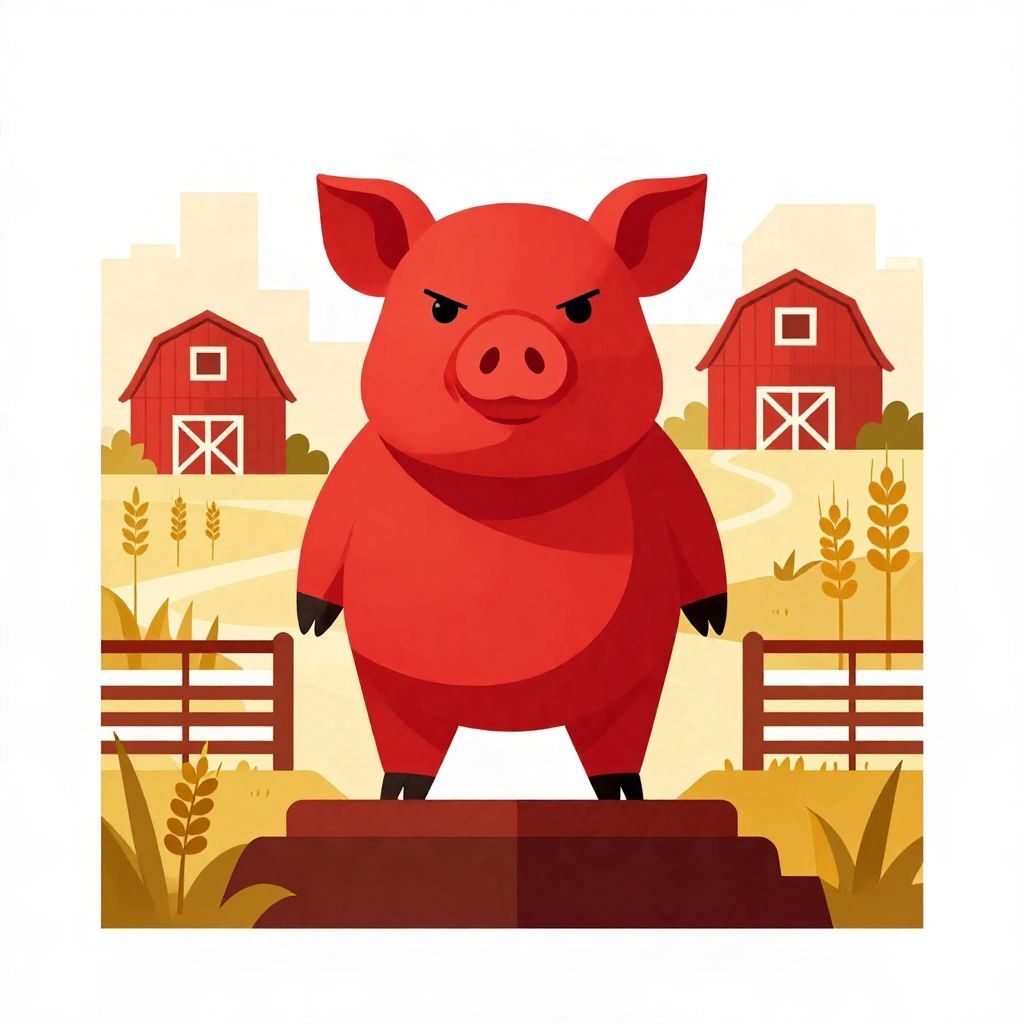
If you’re asking who Napoleon represents in Animal Farm, the short answer is that he stands for Joseph Stalin and, more broadly, the corrupting force of totalitarian power. George Orwell uses Napoleon’s rise to show how a revolutionary leader can become the very kind of tyrant he once promised to overthrow.
That symbolism is central to the novel’s political satire. Napoleon is not just a villainous pig; he is Orwell’s way of dramatizing how propaganda, fear, and violence can turn an idealistic movement into oppression.
Who does Napoleon represent in Animal Farm?
Napoleon represents Joseph Stalin, the Soviet leader whose rule became associated with dictatorship, propaganda, purges, and the concentration of power. Orwell also uses Napoleon to symbolize the broader dangers of authoritarianism: leaders who exploit a revolution for personal control rather than the common good.
Why Napoleon is the key Stalin figure
Orwell wrote Animal Farm as an allegory of the Russian Revolution and its aftermath. In that framework, Napoleon maps onto Stalin because both figures seize power after a revolutionary upheaval and then reshape the system to benefit themselves.
Shared traits between Napoleon and Stalin
- Power consolidation: Napoleon steadily removes rivals and centralizes authority.
- Use of propaganda: He relies on Squealer to rewrite events and control public opinion.
- Fear and punishment: He uses the dogs to intimidate and eliminate dissent.
- Revision of ideals: The original principles of Animalism are gradually altered to justify his rule.
These parallels make Napoleon less a realistic individual character than a political symbol. Orwell is showing how a revolutionary leader can become indistinguishable from the regime he claims to replace.
How Napoleon functions in the novel
He begins as a revolutionary leader and becomes a dictator
At first, Napoleon appears to be one of the pigs helping organize the farm after the rebellion. But unlike Snowball, who speaks publicly and develops plans, Napoleon works quietly and strategically to gain control behind the scenes.
Once he has secured power, he no longer behaves like a fellow reformer. He becomes an autocrat who rules through manipulation, violence, and self-interest.
He depends on force, not persuasion
Napoleon’s authority is not based on trust or shared ideals. It is maintained through the dogs, who function like a secret police force, and through the threat of punishment for anyone who questions him.
This is one reason he represents Stalin so clearly: Orwell emphasizes that totalitarian power often survives by making resistance feel impossible.
He controls the story of reality
Napoleon’s rule also depends on language. Squealer repeatedly explains away contradictions, changes the meaning of events, and convinces the animals to accept worsening conditions as progress.
In this sense, Napoleon represents not only a dictator but also a system in which truth itself becomes unstable. If the leader controls the narrative, he can control the people.
Napoleon versus Snowball: what the contrast means
To understand Napoleon, it helps to compare him with Snowball. Snowball is often associated with Leon Trotsky, Stalin’s rival, while Napoleon represents Stalin. Their conflict reflects the historical struggle for control after the Russian Revolution.
What Orwell is showing through the rivalry
- Competing visions: Snowball is more openly idealistic and reform-minded.
- Practical tyranny: Napoleon is more calculating and willing to use violence.
- Political scapegoating: Once Snowball is expelled, he becomes a convenient enemy for every problem.
By making Napoleon and Snowball opposites, Orwell highlights how revolutions can be derailed by internal power struggles. The enemy is not only outside the movement; it can emerge from within it.
What Napoleon represents beyond Stalin
Although Stalin is the clearest historical match, Napoleon’s meaning is broader than one person. He represents the way authoritarian leaders operate in many contexts, not just Soviet history.
Broader symbolic meanings
- Corruption of revolutionary ideals: A movement for equality becomes a tool for hierarchy.
- Abuse of political language: Noble slogans are turned into excuses for inequality.
- Manipulation of the vulnerable: The working animals are exhausted, undereducated, and easy to control.
- Self-serving leadership: The ruler claims to serve the collective while enriching himself.
That broader symbolism is part of why Animal Farm remains so widely read. Napoleon is tied to a specific historical moment, but the pattern of behavior he represents is timeless.
Napoleon as a literary symbol
Why Orwell chose a pig
Making Napoleon a pig is important because pigs in the novel are associated with intelligence, leadership, and eventually corruption. The choice creates an ironic contrast: the animals who claim to guide the others become the most exploitative.
The name “Napoleon” also carries historical weight. It evokes a famous military and political ruler, which suits a character who combines ambition, strategy, and domination.
How allegory works here
Animal Farm is an allegory, meaning its characters and events correspond to real political figures and historical developments. Napoleon is therefore both a character in the story and a symbolic representation of Stalinist power.
That dual role is what makes him effective. Readers can follow him as a farm leader while also recognizing the larger political critique behind his actions.
Key themes connected to Napoleon
Power corrupts
Napoleon’s arc shows how power can change a leader’s behavior and values. He begins with revolutionary language and ends with complete moral decay.
Equality can be destroyed from within
The farm’s original dream is equality among animals, but Napoleon gradually creates a new class system. The pigs separate themselves from the others and claim privileges that contradict the revolution’s principles.
Ignorance makes oppression easier
Many animals cannot fully understand the changing rules. Orwell suggests that political ignorance and lack of critical thinking make people easier to manipulate.
History can be rewritten
Napoleon’s regime repeatedly alters memory and records. This reflects Orwell’s warning that those in power can reshape the past to control the present.
Common questions about Napoleon’s role
Is Napoleon the main villain?
Yes, in most readings he is the novel’s central antagonist. He is the clearest embodiment of the farm’s betrayal and the collapse of the revolution’s ideals.
Is Napoleon only about Stalin?
No. Stalin is the primary historical reference, but Napoleon also represents dictatorship in general. Orwell’s warning applies to leaders and systems that use fear, propaganda, and violence to dominate others.
Why is Napoleon more dangerous than Snowball?
Snowball is more openly argumentative, but Napoleon is more effective at seizing and keeping power. He is dangerous because he is patient, strategic, and willing to use brutality without hesitation.
Takeaway
So, who does Napoleon represent in Animal Farm? He represents Joseph Stalin most directly, while also standing for the broader dangers of authoritarian rule. Orwell uses him to show how a revolution can be betrayed when power matters more than principle.
If you want to explore the novel’s political meaning further, you may also find these helpful: what is dystopian fiction and what is an antagonist in a story.