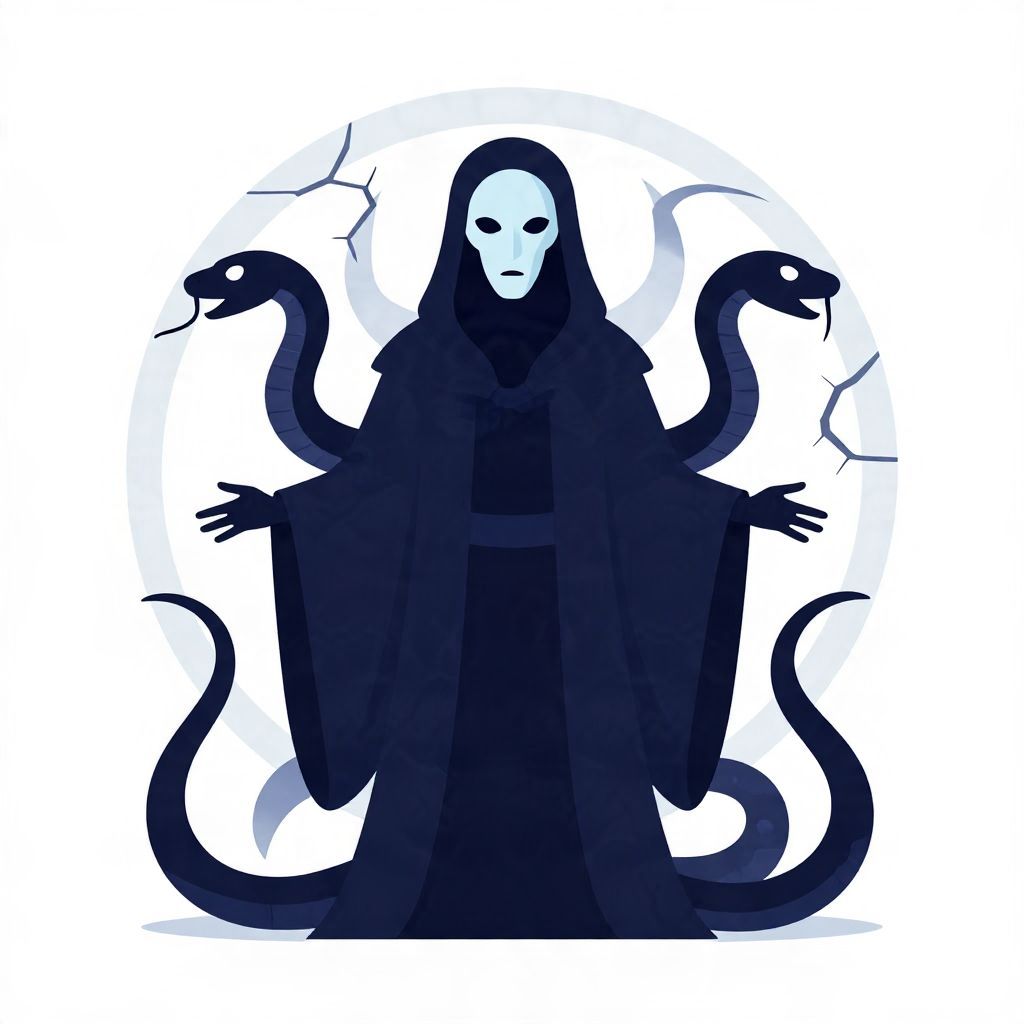
If you have ever wondered why Voldemort looks so unnatural in the Harry Potter series, the answer is tied to magic, body horror, and the cost of his choices. His appearance is not just a visual effect; it reflects how deeply he has damaged his own humanity through dark magic.
J.K. Rowling uses his changing face to signal moral corruption as well as physical transformation. Voldemort’s look becomes a symbol of what happens when power, immortality, and the rejection of ordinary human limits are pushed too far.
Why does Voldemort look like that?
Voldemort looks that way because repeated use of dark magic, especially the splitting of his soul through Horcruxes, has left him less human in both body and presence. His pale, snake-like features emphasize his unnatural state, while his damaged soul and rebirth after his original body’s destruction help explain why he no longer resembles an ordinary wizard.
What the books show about his appearance
Across the series, Voldemort is described as increasingly inhuman: pale skin, slit-like nostrils, red eyes, and a serpentine quality. These details are not random decoration. They create a visual language of menace and make him seem less like a man and more like a creature shaped by fear and dark magic.
His look is tied to his identity as Tom Riddle
Before becoming Voldemort, Tom Riddle is described as handsome, controlled, and charismatic. That contrast matters. Rowling uses it to show that his monstrous appearance is not something he was born with, but something connected to what he becomes.
He is associated with snakes for a reason
Voldemort’s affinity with snakes is one of the clearest symbols in the series. His snake-like appearance reinforces his Parseltongue ability and his link to Slytherin imagery, ambition, and coldness. The visual similarity helps readers feel that his identity has shifted away from human warmth and toward predatory instinct.
The role of Horcruxes in Voldemort’s transformation
One of the most important explanations for Voldemort’s appearance is his use of Horcruxes. By dividing his soul into multiple pieces, he tries to defeat death, but the series strongly suggests that this act damages him spiritually and physically. The more he mutilates his soul, the further he moves from wholeness.
Why soul-splitting matters
In the logic of the series, the soul is connected to personhood. Splitting it is an act of extreme violation, and Rowling presents it as unnatural. Voldemort’s appearance becomes a visible sign of that inner fragmentation, as if his body can no longer fully contain what is left of him.
Not every change is explained in a single sentence
The books do not offer a simple medical-style explanation for every feature of his face. Instead, they blend magical cause and symbolic meaning. His appearance is best understood as the result of dark magic, repeated soul damage, and the story’s broader theme that evil deforms the self.
Why he looks more like a snake than a human
Voldemort’s serpent-like features are one of the most memorable parts of his design. They help make him visually distinct and reinforce his role as a villain who has rejected empathy, family, and ordinary human attachment. The snake image also echoes temptation, deceit, and danger, all central to his character.
Symbolism of the serpent
In literature, snakes often represent hidden threat, cunning, and moral corruption. Rowling draws on that tradition while also making the symbol specific to her world. Voldemort is not merely “snake-like” in a vague sense; his appearance connects to his magical abilities and the values he embraces.
His face mirrors his choices
The series repeatedly links outward form with inward reality. Voldemort’s face is frightening because his life has become organized around domination, fear, and self-preservation at any cost. His appearance is a narrative way of showing that his soul has been warped long before the final battles.
How his rebirth changes him
Voldemort’s return to bodily form is another key moment in understanding why he looks the way he does. When he regains a body, it is not a restoration to normality. Instead, the ritual that brings him back produces a form that is human only in part, suggesting that his return to life is also a return to corruption.
The body he gets is not the body he lost
His new body is described as pale, thin, and unsettling, with features that seem stripped of ordinary humanity. That matters because the series treats his rebirth as a dark parody of resurrection. He comes back, but not as a healed or complete person.
Why Rowling made him look this way
From a literary standpoint, Voldemort’s appearance does several jobs at once. It makes him instantly recognizable, heightens suspense, and gives readers a physical image for abstract evil. It also avoids making him a generic villain; his body itself becomes part of the story’s moral structure.
Body horror and fantasy villainy
Rowling uses a mild form of body horror to make dark magic feel costly. Voldemort’s appearance is disturbing because it suggests that power has a price. In fantasy, villains often gain strength by becoming less human, and Voldemort is one of the clearest examples of that tradition.
Appearance as theme, not just description
His face is not there simply to look scary. It supports the series’ larger ideas about identity, mortality, and the danger of trying to defeat death through cruelty. In that sense, Voldemort’s appearance is part of the argument of the books, not just their visual style.
Common reader questions about Voldemort’s face
Was he born looking like that?
No. The series presents him as originally attractive and human-looking. His later appearance is connected to his choices, especially his pursuit of immortality through dark magic.
Did the Horcruxes physically change him?
The books strongly imply that they did, though not in a neat scientific way. They are part of the reason he becomes less human in both soul and body.
Why is he called “snake-like” so often?
Because the image fits his powers, his personality, and the story’s symbolism. Snakes in the series often suggest secrecy, danger, and cold intelligence, all traits associated with Voldemort.
What this tells us about the character
Voldemort’s appearance is one of the clearest examples of character design serving theme. He is frightening not only because he is powerful, but because he has made himself into something that seems to reject humanity itself. The books make his face a visible record of moral decay.
That is why readers remember him so vividly. His look is not just a special effect of the wizarding world; it is a literary symbol of what happens when a person chooses power over wholeness, and immortality over love.
If you want to explore the details further, you may also enjoy reading about why Voldemort does not have a nose and what all the Horcruxes are.