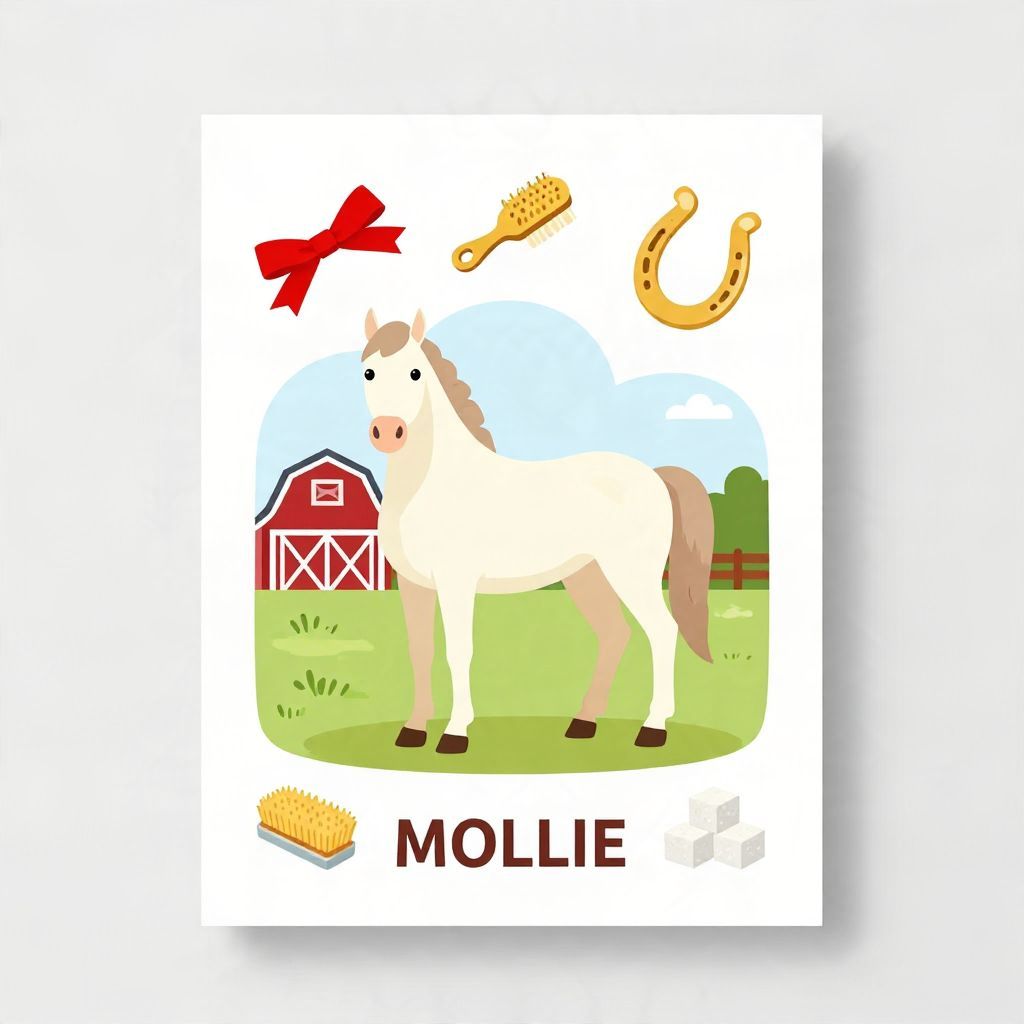
If you are asking who Mollie represents in Animal Farm, the short answer is that she stands for the kind of person who prefers comfort, vanity, and personal convenience over political struggle. In George Orwell’s allegorical novel, Mollie is not a major revolutionary figure; she is a symbolic character whose choices reveal what happens when self-interest meets ideology.
Her role is small, but it is important. Through Mollie, Orwell shows how some individuals resist sacrifice, dislike discipline, and are easily drawn away by luxury and attention.
Who does Mollie represent in Animal Farm?
Mollie represents the self-absorbed, privileged class that resists revolution because it threatens comfort and status. More specifically, she can be read as a symbol of people who value appearance, food, and personal ease above collective ideals. Her behavior suggests those who are unwilling to give up small luxuries for a political cause.
Why Mollie matters in Orwell’s allegory
Orwell uses Animal Farm as a political allegory, meaning the animals and their actions reflect real social and historical forces. Mollie helps illustrate that revolutions do not only face opposition from obvious enemies; they also lose support from people who simply do not want to change their lives.
A character defined by comfort
Mollie is vain, affectionate toward ribbons and sugar, and deeply attached to the pleasures of her old life. These traits make her a poor fit for the farm’s new order, which demands hard work, equality, and sacrifice.
Her symbolic function is clear: she represents those who may accept revolutionary talk in theory but abandon it when it becomes inconvenient. Orwell suggests that such people are not necessarily cruel, but they are unreliable allies in any serious political movement.
Not a villain, but a weakness in the revolution
Mollie is not written as a master manipulator or a tyrant. Instead, she is shallow, vain, and easily distracted. That makes her useful to Orwell, because she embodies a quieter kind of failure: the inability to commit to shared ideals.
In this way, Mollie is less a political enemy than a sign of how fragile collective action can be when personal comfort matters more than principle.
Mollie as a symbol of class privilege
One of the most common interpretations of Mollie is that she represents the privileged classes who benefited from the old social order and were unwilling to accept equality. She likes the trappings of status, especially decorative items and special treatment, which align her with people who miss the advantages of hierarchy.
The lure of luxury
Mollie’s attraction to ribbons and sugar is not random detail. Orwell uses these preferences to show how luxury can become a form of dependence. Even when a system is unjust, some individuals may still prefer it if it gives them comfort or prestige.
This makes Mollie a useful contrast to the more committed animals. She does not dream of justice; she misses the pleasures that came with inequality.
What her departure suggests
When Mollie eventually leaves the farm, her exit reinforces her symbolic role. She does not fight the new regime, and she does not help build it. Instead, she drifts away toward a life that better suits her tastes.
That departure matters because it shows one of Orwell’s recurring ideas: revolutions can lose people not only through violence or betrayal, but through apathy and self-interest.
Mollie compared with the other animals
Mollie stands apart from the animals who are motivated by work, loyalty, or ideology. Her concerns are smaller and more personal, which makes her a foil to characters who are trying to build something collective.
- Boxer represents dedication and labor.
- Benjamin represents skepticism and resignation.
- Snowball represents idealistic political planning.
- Mollie represents vanity, comfort, and resistance to sacrifice.
This contrast helps Orwell show that revolutions are shaped not only by leaders and ideologues, but also by ordinary participants with very different priorities.
What Mollie reveals about Orwell’s themes
Mollie is a small character, but she helps illuminate several major themes in Animal Farm. Her presence deepens the novel’s critique of political idealism by showing how easily personal desire can undermine collective goals.
Self-interest versus collective responsibility
One of Orwell’s central concerns is the tension between private comfort and shared duty. Mollie consistently chooses the private over the collective, which makes her a simple but effective example of that conflict.
She does not need to be openly malicious to weaken the revolutionary project. Her indifference is enough.
The fragility of revolutionary unity
Revolutions often depend on the belief that everyone will pull together for a common future. Mollie’s character reminds readers that unity is difficult to sustain when people want different things from life.
Orwell suggests that a movement can be undermined not only by enemies at the top, but also by those who quietly step away from responsibility.
Appearance and illusion
Mollie’s concern with ribbons and looking attractive also connects to one of Orwell’s broader concerns: the power of surface appearances. In a novel full of slogans, propaganda, and manipulated language, her vanity is a small but telling version of the same problem.
She is drawn to what looks pleasant, not what is morally or politically sound.
Is Mollie based on a real historical figure?
Unlike some characters in Animal Farm who are commonly linked to specific historical figures or groups, Mollie is usually understood more broadly. She is best read as a social type rather than a one-to-one historical stand-in.
That said, readers often connect her to people who left or resisted revolutionary movements because they preferred the old comforts of class privilege. The exact historical parallel is less important than the behavior Orwell wants to criticize.
How to read Mollie in class or for an essay
If you are writing about Mollie, it helps to focus on what she values, how she behaves, and what Orwell achieves through her. She is not a complex psychological portrait in the modern sense; she is a carefully designed symbolic figure.
Useful essay angles
- Mollie as a symbol of vanity and material comfort.
- Mollie as a critique of people who abandon political ideals for personal ease.
- Mollie as a contrast to the more disciplined animals on the farm.
- Mollie as evidence that revolutions can fail through apathy as well as oppression.
In a literary analysis, it is usually strongest to tie her character to Orwell’s larger themes rather than treating her as an isolated example.
Key details about Mollie’s role
Here are the most important points to remember about Mollie in Animal Farm:
- She is a symbolic character in Orwell’s allegory.
- She represents vanity, comfort, and resistance to sacrifice.
- She reflects the people who prefer privilege to equality.
- She is not a central political strategist, but her choices still matter.
- Her departure from the farm shows how fragile revolutionary loyalty can be.
Final takeaway
Mollie represents the self-interested, comfort-loving side of human nature that often resists real social change. In Animal Farm, Orwell uses her to show that revolutions are not only threatened by power-hungry leaders, but also by people who cannot give up vanity, convenience, and privilege.
If you want to explore more Animal Farm character analysis, you may also find these related guides useful: Who does Mollie represent in Animal Farm? and Who does Napoleon represent in Animal Farm?